Buying IPv4 for data centers: planning, routing, and compliance
 Mireia Solà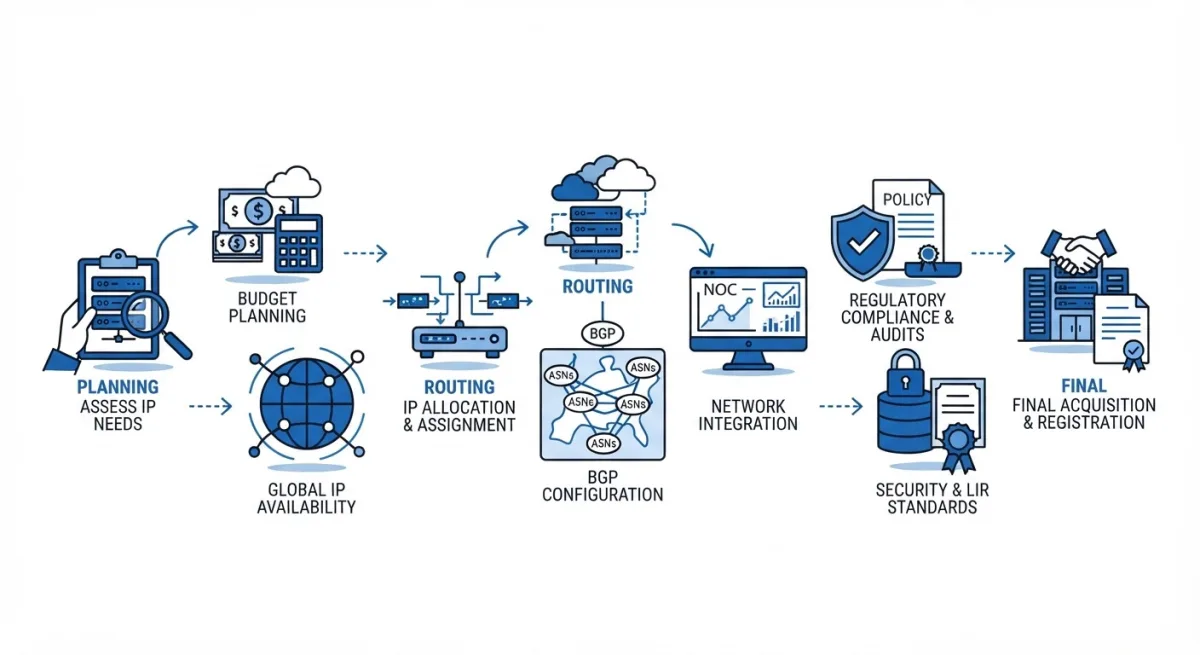
A data center that purchases IPv4 space is making a long-term infrastructure decision. The block must fit current workloads, future growth, routing policy, registry requirements, and customer allocation models. Poor planning can create transfer delays, routing problems, or unnecessary fragmentation after deployment.
Datacenter IPv4 purchase planning is the process of defining how much public address space a data center needs, how the acquisition and transfer will work, and how the block will be routed, registered, and allocated. It connects capacity planning with BGP, RIR compliance, RPKI, address allocation, and future growth.
Table of Contents
- How should a data center estimate IPv4 capacity before acquisition?
- What should be checked before the IPv4 acquisition starts?
- Which routing requirements matter for a data center?
- Why should BGP planning happen before the transfer is complete?
- How does RIR compliance affect the purchase?
- How should RPKI fit into data center routing operations?
- How should address allocation be organized inside the data center?
- How should future growth influence the purchase decision?
- What additional questions should data center teams ask?
- How should a data center approach an IPv4 purchase?
How should a data center estimate IPv4 capacity before acquisition?
Capacity should be based on the service model rather than server count alone. Bare-metal hosting, VPS platforms, colocation customers, load balancers, VPN gateways, and management networks can consume addresses differently.
The planning process should consider:
- current public IPv4 utilization;
- customer allocation policies;
- reserved space for network infrastructure;
- expected server and rack growth;
- regional or facility expansion;
- capacity that can be reduced through IPv6, NAT, or private addressing.
A data center should also decide whether it needs one contiguous prefix or several smaller blocks. Contiguous space can simplify routing and internal allocation, while fragmented acquisitions may add operational complexity.
What should be checked before the IPv4 acquisition starts?
The acquisition process should begin with verification of the resource and the seller. The buyer needs to confirm that the block is controlled by the expected holder and can move through the relevant Regional Internet Registry process.
Before commercial terms are finalized, the team should review:
- seller authority and ownership;
- transfer eligibility and RIR status;
- routing history and reputation;
- existing registry and route records;
- technical readiness for deployment.
Buying IPv4 addresses should be treated as both a transaction and a network onboarding project, because payment alone does not make the prefix production-ready.
Which routing requirements matter for a data center?
Routing requirements depend on how the data center announces customer and infrastructure prefixes. The network team should know which origin ASN will advertise the new block and whether upstream providers will accept the announcement.
The routing design should cover BGP policy, prefix filters, failover behavior, and use across facilities. If the data center operates several sites, the team should decide whether the prefix will be announced from one location, split between sites, or integrated into a multi-homed design.
Why should BGP planning happen before the transfer is complete?
BGP planning should be prepared before registry handover so the acquired block can enter service without unnecessary delay. A valid prefix may still face problems if upstream filters are outdated or the intended origin ASN is not ready.
The data center should align the transfer timeline with routing teams and upstream providers so announcements, monitoring, and rollback procedures are prepared before production use.
How does RIR compliance affect the purchase?
RIR compliance determines whether the transfer can be completed and how the resource will be registered afterward. Requirements differ by registry, and the buyer may need an active account, organizational documents, recipient approval, or other evidence.
The receiving entity should be ready before final terms are signed. Registry information should match the legal organization receiving the resource, while technical and abuse contacts should be prepared for post-transfer updates.
How should RPKI fit into data center routing operations?
RPKI should be part of normal routing operations rather than a one-time transfer task. After acquisition, the correct ROA should authorize the intended origin ASN and remain aligned with future changes in routing design.
IRR records, WHOIS data, abuse contacts, and related route information should also be maintained as part of operational ownership. If origin ASNs or customer pools change, these records should be reviewed together with BGP configuration.
How should address allocation be organized inside the data center?
Address allocation should follow service boundaries and operational ownership. A data center may need separate pools for infrastructure, hosting customers, dedicated servers, virtualization clusters, management systems, and future expansion.
The allocation plan should limit fragmentation and leave room around active service groups. It should also define which addresses are customer-facing, which remain under direct network control, and how returned addresses are cleaned before reassignment.
How should future growth influence the purchase decision?
Growth planning should balance current demand with the cost of unused capacity. Buying too little can force another acquisition sooner than expected, while buying too much can leave capital tied to idle addresses.
The forecast should consider rack expansion, customer growth, new facilities, dedicated IP products, and expected IPv6 adoption. The goal is to choose a block size that supports a realistic growth window without creating excessive inventory.
What additional questions should data center teams ask?
How should a data center approach an IPv4 purchase?
A data center should connect IPv4 acquisition with capacity planning, BGP design, RIR compliance, RPKI, transfer preparation, and address allocation. If a company needs to assess a block, prepare the registry path, and integrate new IPv4 space into its network, it can contact InterLIR Global to structure the purchase around current infrastructure and expected growth.