BYOIP for AWS: key planning questions before you start
 Johanna Reiter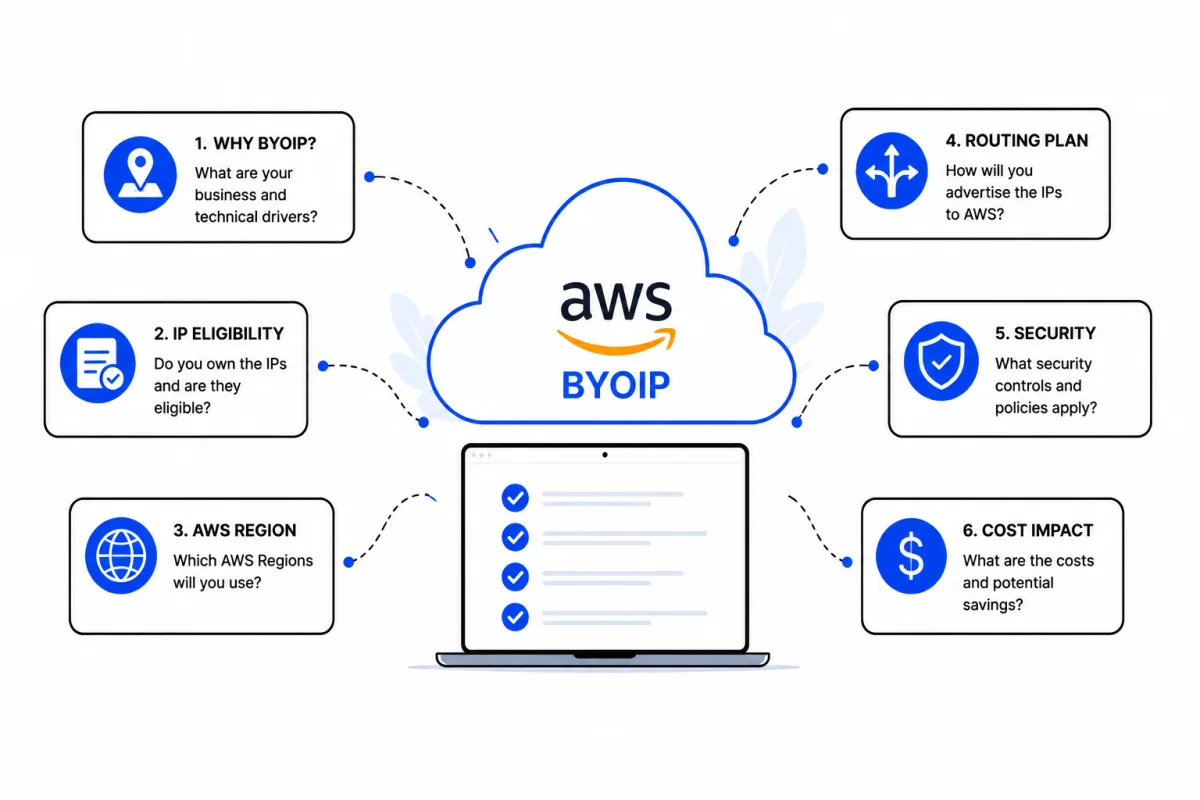
Bringing your own address range into AWS can protect IP continuity, reduce renumbering, and support cloud migration. It also adds registry, routing, certificate, RPKI, and operational steps. Teams should answer key planning questions before they provision any prefix.
BYOIP for AWS is a cloud IP model that lets an organization bring publicly routable IPv4 or IPv6 address space into Amazon EC2 and use it as an AWS address pool. It supports cloud IP planning by keeping address control, preserving allowlists, and aligning cloud deployment with ownership, ROA creation, and routing requirements.
Table of Contents
- What address range can be used for BYOIP for AWS?
- How should cloud IP planning define the target architecture?
- Why does ROA creation matter before provisioning?
- How does IP provisioning work in AWS?
- What should teams know about BGP routing and operations?
- When should leasing be considered for BYOIP planning?
- What should teams clarify before starting AWS BYOIP?
- How should a company move forward?
What address range can be used for BYOIP for AWS?
The address range must be public, registered to the organization, and eligible for validation. AWS supports bringing part or all of a publicly routable range into an AWS account, but the team must prove control before the range becomes usable.
Planning should start with these checks:
- registry holder, sponsoring organization, and contact accuracy;
- minimum prefix size and whether the block is contiguous;
- RDAP or DNS-based validation method;
- current use in on-premises networks, firewalls, VPNs, and DNS;
- reputation, geolocation, and abuse history.
If the company does not already own a suitable block, it can buy IPv4 addresses before starting the cloud onboarding plan. If ownership is not required, a lease can support a separate BYOIP model when the provider and registry setup allow it.
How should cloud IP planning define the target architecture?
Cloud IP planning should define where the address pool will be used, which AWS Region needs it, and which services depend on fixed public addressing. BYOIP is not only a procurement task. It affects DNS, allowlists, load balancers, NAT design, monitoring, and incident response.
The team should document:
- which workloads need BYOIP addresses;
- which AWS account and Region will hold the pool;
- which services need Elastic IPs from the pool;
- which partner systems must accept the same source IPs;
- how rollback will work if provisioning or cutover is delayed.
This planning reduces the chance that a cloud migration creates unexpected address changes.
Why does ROA creation matter before provisioning?
ROA creation is a required routing trust step for publicly advertised BYOIP ranges. A Route Origin Authorization, or RPKI ROA, tells the routing ecosystem which ASN may originate a prefix. For Amazon EC2 BYOIP, the ROA should authorize the required Amazon ASNs and match the prefix that will be provisioned.
Before creating a ROA, teams should confirm:
- exact CIDR notation and maximum prefix length;
- RIR account access and RPKI management rights;
- expiration date and renewal process;
- whether the same block will be split across Regions;
- who can update the ROA during incident response.
Incorrect ROA data can delay validation or create routing problems after the range is advertised.
How does IP provisioning work in AWS?
IP provisioning is the AWS-side onboarding step that validates the range and creates an address pool. AWS checks that the organization controls the range and is authorized to advertise it. Provisioning is not instant; the range becomes usable only after its status changes from pending to provisioned.
A practical sequence is:
- prepare registry records and validation method;
- create the required ROA;
- submit the BYOIP CIDR for provisioning;
- wait for validation and provisioned status;
- allocate Elastic IPs from the BYOIP pool;
- attach addresses to EC2, NAT gateways, or load balancing resources where supported.
The team should avoid scheduling a production cutover before the pool is provisioned and tested.
What should teams know about BGP routing and operations?
BGP routing is handled by AWS after the range is brought into the platform and advertised. The organization still needs to plan how traffic moves from old infrastructure to AWS resources. Routing readiness also depends on DNS, TTLs, firewall rules, upstream filters, and external allowlists.
Operational checks should include:
- reachability tests from target regions and networks;
- DNS and PTR update timing;
- monitoring for packet loss, latency, and geolocation changes;
- security controls for services using the new Elastic IPs;
- a deprovisioning plan if the range must leave AWS later.
BYOIP should be treated as a lifecycle process, not a one-time CLI command.
When should leasing be considered for BYOIP planning?
Some companies want BYOIP benefits without permanent address ownership. A leased block can support cloud IP portability when the lease terms, RPKI/ROA control, LOA, WHOIS, and provider requirements align. This option should be checked before AWS provisioning begins because the organization must be able to prove control and authorize advertisement.
A company can review BYOIP for cloud planning when it needs leased or owned IPv4 ranges prepared for cloud-provider validation, route objects, ROA/RPKI, LOA documentation, and WHOIS coordination.
What should teams clarify before starting AWS BYOIP?
How should a company move forward?
A company should treat BYOIP for AWS as a combined registry, routing, and cloud operations project. To plan address ownership or leasing, prepare ROA creation, coordinate IP provisioning, and align BGP routing with cloud migration goals, contact InterLIR Global and choose an IPv4 path that supports your AWS deployment without losing address control.