Contiguous vs Non-Contiguous IPv4 Blocks: What Buyers Should Consider Before Purchase

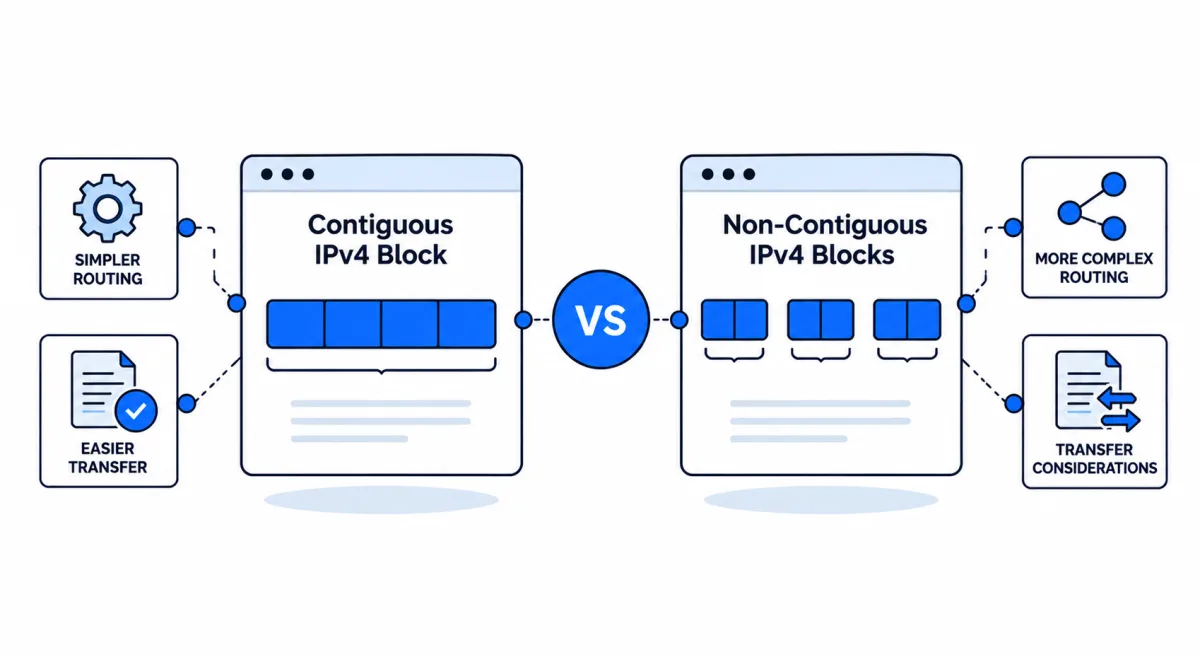
Buying IPv4 space is not only a question of total address count. The structure of the allocation affects routing, management, geolocation, future transfers and the effort required to operate the resource. Buyers should decide whether they need one continuous address range or can work with several separate prefixes.
Contiguous vs noncontiguous IPv4 describes whether purchased address space forms one continuous numerical range or consists of multiple separate blocks. Contiguous space can simplify routing and administration, while non-contiguous space can provide more flexibility for distributed infrastructure, phased deployment and regional allocation.
Table of Contents
- What is the difference between contiguous and non-contiguous IPv4 blocks?
- What are the main contiguous IPv4 purchase benefits?
- How does contiguity affect routing?
- When are non-contiguous blocks useful?
- How does contiguity affect geolocation and reputation?
- What are the purchase contiguity requirements?
- How does non-contiguous space affect management?
- How should buyers make a contiguity decision?
- Frequently Asked Questions
- Match prefix structure to the network
What is the difference between contiguous and non-contiguous IPv4 blocks?
The same total capacity can be acquired in different forms. For example, one /20 contains 4,096 addresses. The same total can also be assembled from four /22 blocks or sixteen /24 blocks.
| Structure | Total addresses | Prefixes | Main benefit | Main trade-off |
|---|---|---|---|---|
| One /20 | 4,096 | 1 | Simpler aggregation | Less granular allocation |
| Four /22s | 4,096 | 4 | More flexible placement | More routing objects |
| Sixteen /24s | 4,096 | 16 | High deployment flexibility | Greater fragmentation |
This contiguous ipv4 purchase management difference matters even when the purchase price per address is similar.
What are the main contiguous IPv4 purchase benefits?
The main contiguous ipv4 purchase benefits are simpler routing, fewer registry objects and easier internal administration.
One larger continuous block can reduce:
- the number of BGP prefixes;
- route-object and ROA management;
- reverse DNS delegations;
- IPAM entries;
- internal allocation records;
- reputation checks across multiple ranges.
If a /20 can be announced as one aggregate, the routing policy is simpler than managing sixteen separate /24 announcements.
How does contiguity affect routing?
Contiguous ipv4 purchase routing can support route aggregation when the prefixes are aligned correctly and the network design permits it. Aggregation reduces the number of individual prefixes that must be announced and maintained.
Noncontiguous ipv4 purchase routing usually requires each independent prefix to be handled separately. Four unrelated /22 blocks may need four route announcements, four ROAs and separate routing policies.
This does not make non-contiguous space unusable. It simply increases the number of network objects that must be controlled.
When are non-contiguous blocks useful?
The main noncontiguous ipv4 purchase tradeoffs are greater management overhead in exchange for deployment flexibility.
Separate prefixes can work well when:
- infrastructure is spread across several data centers;
- different business units require independent address pools;
- blocks need different geolocation;
- migration happens in stages;
- part of the portfolio may later be transferred independently.
A buyer running networks in several regions may prefer four /22s over one /20 because each prefix can be assigned to a separate environment.
How does contiguity affect geolocation and reputation?
A contiguous block is easier to manage as one resource, but buyers should not assume that all addresses automatically share the same reputation or geolocation history.
Before purchase, inspect:
- WHOIS and RIR registration;
- previous routing history;
- blocklist records;
- geolocation databases;
- previous use of the space;
- existing route objects and ROAs.
With several unrelated blocks, these checks must be repeated for every prefix. This can increase due-diligence work before the transaction.
What are the purchase contiguity requirements?
There is no universal rule that a buyer must purchase contiguous address space. Purchase contiguity requirements depend on network design, routing policy, technical architecture and the applicable RIR transfer process.
In the RIPE NCC service region, complete or partial IPv4 blocks can be transferred when policy requirements are met. IPv4 resources received by a holder are generally subject to a 24-month transfer restriction before another transfer.
Buyers should therefore check whether the required prefixes are eligible for transfer before planning consolidation.
How does non-contiguous space affect management?
Noncontiguous ipv4 purchase management becomes more complex as the number of independent blocks increases.
For each prefix, teams may need to maintain:
- RIR registration;
- LOA documentation;
- route objects;
- RPKI/ROA entries;
- reverse DNS;
- abuse contacts;
- monitoring and reputation records.
One /20 may require one primary set of records, while sixteen unrelated /24s may require sixteen separate operational workflows.
How should buyers make a contiguity decision?
A practical buyer contiguity decision should consider total cost and operational effort together.
Compare:
- number of prefixes;
- routing announcements;
- RPKI and registry workload;
- regional deployment needs;
- future transfer flexibility;
- geolocation requirements;
- reputation of each block;
- transfer restrictions.
Companies can buy IPv4 addresses as one larger resource or several independent prefixes depending on how the space will be deployed.
Frequently Asked Questions
Match prefix structure to the network
For contiguous or non-contiguous capacity, send the required address count and routing constraints to InterLIR Global. The shortlist can then be built around prefix structure, transfer eligibility and the management overhead the network can support.