How flexible IPv4 leasing helps reduce infrastructure risk
 Katarzyna Ostrowska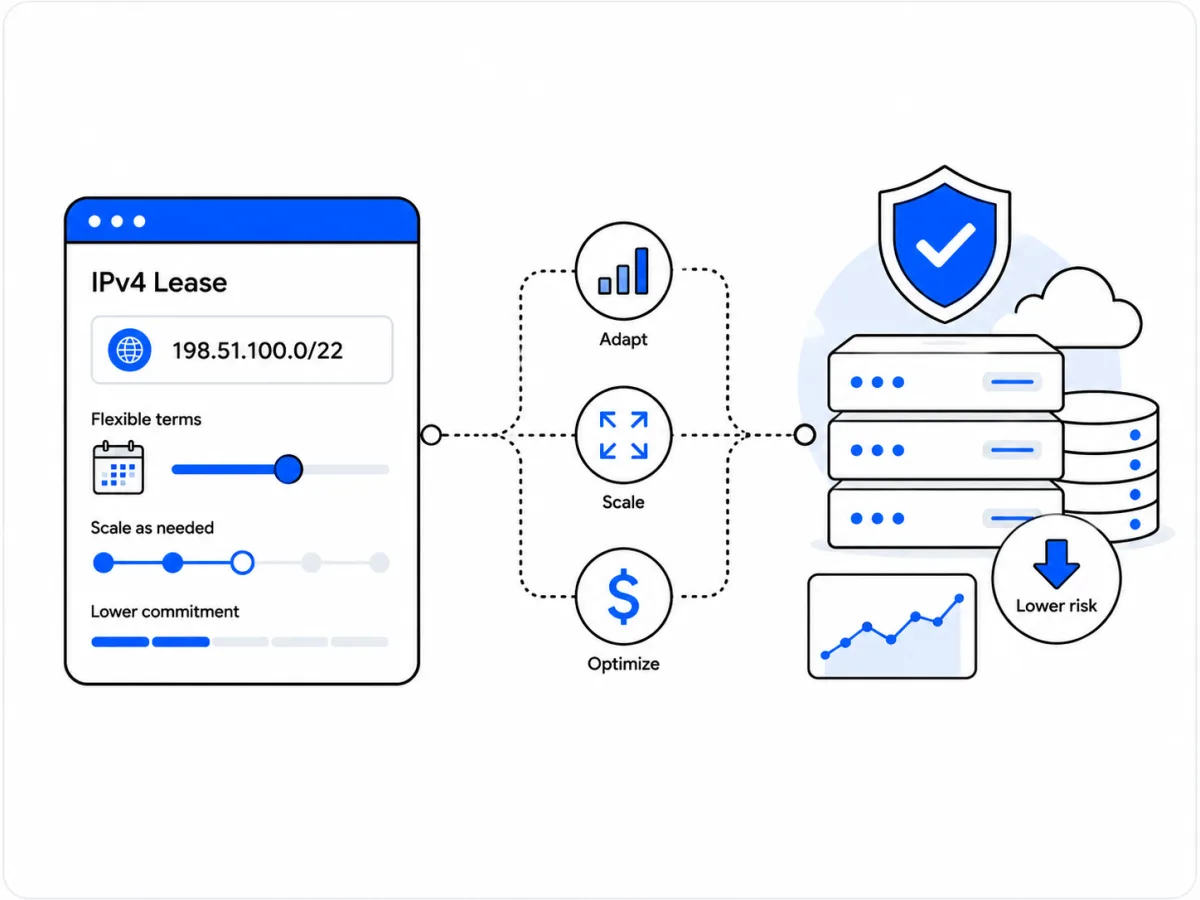
Infrastructure plans change when demand grows faster than budgets, regions need testing, or migration windows move. Buying addresses too early can lock a company into capacity it may not need. Leasing gives the network team a controlled way to add IPv4 space while keeping architecture decisions reversible.
Flexible IPv4 leasing is a temporary access model for public IPv4 address space that lets a company use routable prefixes for a defined term. It helps reduce infrastructure risk by supporting staged deployments, temporary capacity, migration buffers, regional tests, and service continuity without forcing immediate long-term ownership.
Table of Contents
- How does flexible IPv4 leasing reduce infrastructure risk?
- When do short-term IP rentals make sense?
- How does IPv4 leasing improve network agility?
- What risks should be checked before using leased IPv4?
- When should a company move from leasing to ownership?
- What should teams clarify before choosing a flexible lease?
- How should a company move forward?
How does flexible IPv4 leasing reduce infrastructure risk?
Flexible IPv4 leasing can reduce infrastructure risk because the company can match address capacity to a project stage. The team can test a service, region, or customer cluster before it commits to a permanent block, long contract, or larger routing design.
This matters when risk comes from:
- uncertain traffic forecasts;
- delayed hardware delivery or data center changes;
- temporary customer onboarding peaks;
- cloud exit projects that need transition capacity;
- regional launches that may not become permanent.
Leasing does not remove planning. It gives the team more time to validate demand, observe routing behavior, and decide whether the workload needs renewal, replacement, purchase, or redesign.
When do short-term IP rentals make sense?
Short-term IP rentals make sense when address demand is real but the final network state is not stable. A team may need public IPv4 for a few months while it moves services, tests new gateways, or keeps old and new systems online at the same time.
Short-term ranges can support:
- migration overlap between old and new infrastructure;
- temporary NAT pools and VPN gateways;
- pilot environments for SaaS, hosting, or security services;
- regional latency and reachability tests;
- customer projects with a fixed end date.
For these cases, a company can lease IPv4 addresses and keep the temporary range outside the permanent address plan until the use case is proven.
How does IPv4 leasing improve network agility?
Network agility means the network can change without causing uncontrolled downtime, overbuying, or route instability. Leased IPv4 space can make this easier because it gives teams a separate pool for experiments, transition traffic, and controlled failover tests.
A useful agility plan should define:
- Which workload will use the leased range.
- Which ASN and upstreams will announce the prefix.
- Which DNS, PTR, firewall, and monitoring records must change.
- Which customers or partners must update allowlists.
- Which exit steps apply when the lease ends.
This structure keeps flexible capacity from becoming unmanaged capacity. It also helps operations teams avoid hidden dependencies.
What risks should be checked before using leased IPv4?
A flexible lease still brings operational responsibility. The range may have previous routing history, reputation records, or geolocation signals. The tenant should review the prefix before it supports production traffic.
Important checks include:
- authorization to announce the prefix;
- BGP origin history and route visibility;
- WHOIS, IRR, RPKI, and abuse contact accuracy;
- blacklist, mail, proxy, and security reputation;
- contract rules for renewal, termination, and return.
These checks reduce the chance that a temporary range creates blocked traffic, delayed routing approval, failed mail flows, or emergency migration.
When should a company move from leasing to ownership?
Leasing is useful while demand is being tested or while the infrastructure state is changing. Ownership becomes more suitable when the same address space becomes part of the product, customer contracts, long-term routing policy, or compliance documentation.
A company may evaluate buy IPv4 addresses when it needs direct registry control, stable geolocation, long-term route objects, and fewer lease-end dependencies. The decision should compare purchase cost with the operational risk of repeated renewals.
What should teams clarify before choosing a flexible lease?
How should a company move forward?
A company should use flexible leasing when IPv4 capacity is needed, but the long-term infrastructure decision is still open. To plan flexible IPv4 leasing around migration timelines, risk controls, routing readiness, and future purchase options, contact InterLIR Global and choose an IPv4 resource model that keeps network changes controlled.