How IPv4 assets support multi-year infrastructure planning
 Johanna Reiter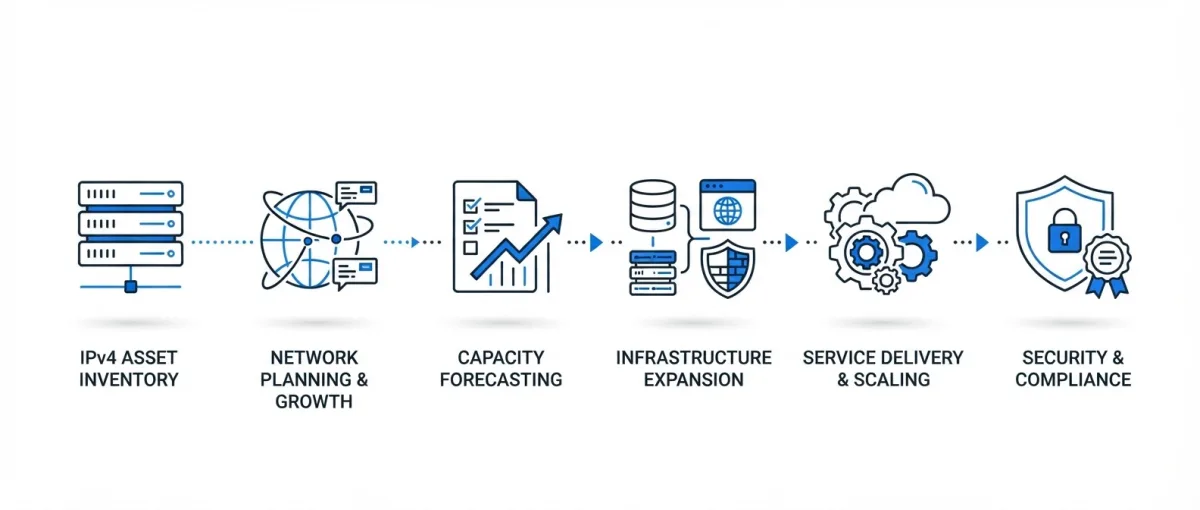
Long-term infrastructure plans depend on resources that can support growth without forcing repeated redesigns. Public IPv4 remains relevant for customer-facing services, dedicated addressing, fixed allowlists, hosting platforms, and systems that cannot move fully to IPv6.
IPv4 multi year planning is the process of treating address space as an asset infrastructure resource across several planning cycles. It connects current capacity, address growth, demand forecast, reserve strategy, allocation, and lifecycle management so the company can decide when IPv4 should be used, expanded, preserved, or reassigned.
Table of Contents
- Why should IPv4 be included in long-term infrastructure planning?
- How should address growth be forecast?
- How much IPv4 reserve should a company maintain?
- How should allocation support multi-year planning?
- How does the IPv4 lifecycle affect long-term capacity?
- How should demand influence acquisition or leasing decisions?
- What strategic value can an IPv4 asset provide?
- How often should the IPv4 plan be reviewed?
- What additional questions should infrastructure teams ask?
- How should a company manage IPv4 across several planning cycles?
Why should IPv4 be included in long-term infrastructure planning?
IPv4 can become a constraint when customer growth, new services, or additional facilities require more public addresses than existing pools can provide. Including it in long-term planning gives the network team visibility beyond immediate requests.
Instead of reacting when a subnet is nearly exhausted, the company can compare future demand with available inventory and determine when additional capacity may be needed.
How should address growth be forecast?
Address growth should be based on actual allocation patterns and planned infrastructure changes. Historical utilization can show how quickly pools are consumed, while product, customer, and regional plans indicate where future demand may appear.
A useful forecast should consider:
- current utilization by service;
- expected customer and workload growth;
- new facilities, regions, or products;
- dedicated IP requirements;
- addresses that may return to the available pool.
The forecast should cover several periods so planners can see when demand may exceed current capacity.
How much IPv4 reserve should a company maintain?
A reserve protects the network from unexpected demand, but excessive unused capacity reduces efficiency. The appropriate level depends on how quickly additional addresses can be acquired or leased and how critical public IPv4 is to deployment.
The reserve should account for customer growth, migration windows, emergency replacement, temporary duplication of services, and allocation boundaries that cannot always be used at full theoretical capacity.
How should allocation support multi-year planning?
Allocation should preserve flexibility rather than consume address space in isolated fragments. Pools should be organized around service boundaries, operational ownership, and realistic expansion needs.
The allocation model may separate:
- customer-facing services;
- hosting or server pools;
- network and security infrastructure;
- regional deployments;
- capacity reserved for future projects.
Good allocation leaves enough structure for future growth without repeated renumbering or unnecessary fragmentation.
How does the IPv4 lifecycle affect long-term capacity?
The lifecycle of an address continues after initial allocation. Addresses can move between services, return from retired systems, require reputation review, or remain unavailable during migration and cleanup.
Lifecycle management should track active use, reserved capacity, returned addresses, and blocks waiting for reassignment. This gives planners a more accurate view of usable inventory and helps identify ranges that can be reclaimed before new IPv4 is acquired.
How should demand influence acquisition or leasing decisions?
Demand determines whether the company should expand permanent assets or use temporary capacity. Predictable long-term demand may support buying IPv4 addresses, while short-term peaks, migrations, or uncertain projects may be better served through leasing.
The decision should consider how long the capacity will be needed, how difficult future renumbering would be, and whether address continuity has operational value.
What strategic value can an IPv4 asset provide?
An IPv4 asset can support disaster recovery, regional expansion, BYOIP, dedicated customer services, and infrastructure migrations where stable public addresses reduce operational work.
Strategic value should be linked to realistic future use. A block should be evaluated against planned services, expected demand, routing requirements, and the cost of obtaining replacement capacity later.
How often should the IPv4 plan be reviewed?
A multi-year plan should be reviewed when infrastructure assumptions change. Customer growth, acquisitions, cloud migration, facility closures, and IPv6 adoption can all affect future IPv4 requirements.
A regular review should compare forecast demand with actual allocation, available reserve, returned capacity, and planned projects. This allows the company to adjust purchasing, leasing, or reclamation decisions before shortages become urgent.
What additional questions should infrastructure teams ask?
How should a company manage IPv4 across several planning cycles?
A multi-year IPv4 strategy should connect forecast demand, capacity reserve, allocation policy, lifecycle management, and realistic growth plans. If a company needs to evaluate future address requirements and decide how owned or leased resources should support infrastructure over time, it can contact InterLIR Global to structure IPv4 capacity around long-term network plans.