How IPv4 Auctions Work: A Transparent Way to Acquire IP Blocks
How IPv4 Auctions Work: A Transparent Way to Acquire IP Blocks
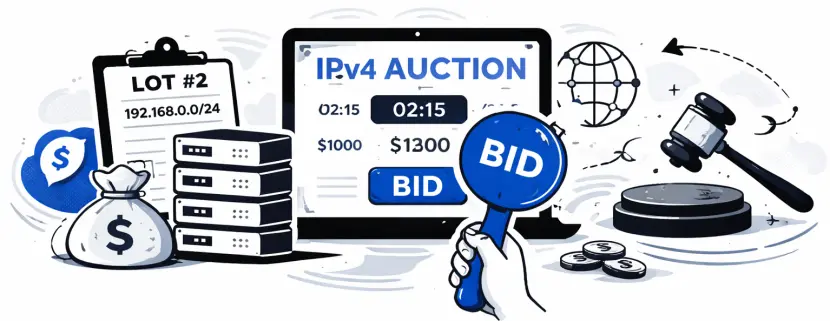
IPv4 auctions offer a transparent, market-driven way to acquire IP blocks in the US and EU. Unlike private negotiations or broker-only deals, IPv4 auctions let multiple bidders compete openly—suppliers get fair market prices, and buyers gain visibility into available blocks and pricing. Understanding how IPv4 auctions work helps hosting providers, ISPs, and infrastructure operators make informed decisions when sourcing address space.
This guide explains the IPv4 auction process, why transparency matters, and how to participate effectively.
Table of Contents
- What Are IPv4 Auctions?
- Why Use IPv4 Auctions Instead of Direct Sale?
- How IPv4 Auctions Work: The Process
- Transparency in IPv4 Auctions
- RIR Regions: RIPE, ARIN, and LACNIC
- Tips for Bidders and Sellers
- How InterLIR Global Auctions Work
- Summary and Next Steps
- Frequently Asked Questions
What Are IPv4 Auctions?
An IPv4 auction is a structured marketplace where IPv4 address blocks are offered to multiple buyers who bid competitively. The highest bidder (or the bidder meeting the reserve) wins the block and completes the transfer. IPv4 auctions bring together verified suppliers and buyers in a transparent environment.
Key characteristics:
- Multiple bidders — Several parties can bid on the same block.
- Open or time-limited — Auctions run for a set period; highest bid wins (or reserve is met).
- Verified blocks — Marketplaces typically pre-screen blocks for blacklist status, routing history, and transfer eligibility.
- Clear rules — Bidding rules, reserve prices (if any), and payment terms are defined upfront.
Why Use IPv4 Auctions Instead of Direct Sale?
| Aspect | Direct Sale | IPv4 Auction |
|---|---|---|
| Price discovery | Negotiation; less visibility | Open bidding; market sets price |
| Speed | Depends on broker/back-and-forth | Fixed auction window; clear deadline |
| Supplier benefit | May undersell if demand is high | Multiple bidders can push price up |
| Buyer benefit | May overpay without competition | Transparent bidding; compare with others |
| Transparency | Often opaque | Visible bids and process |
IPv4 auctions suit suppliers who want to maximize price discovery and buyers who prefer a transparent, competitive process. They are especially useful when block sizes and regions align with multiple interested parties.
How IPv4 Auctions Work: The Process
A typical IPv4 auction flow:
1. Listing (Supplier Side)
The supplier lists a block on the auction platform:
- Block size (e.g., /24, /22, /20)
- RIR region (RIPE, ARIN, LACNIC)
- Reserve price (optional minimum)
- Auction duration
- Block verification (blacklist scan, routing history)
2. Verification
The marketplace verifies the block:
- Legal ownership and transfer eligibility
- Clean status (blacklist checks, abuse history)
- Correct RIR records (inetnum, abuse-c, etc.)
3. Bidding (Buyer Side)
During the auction window:
- Buyers place bids
- Some auctions allow incremental bids; others require minimum increments
- Bidding is visible to participants (transparent) or partially hidden, depending on platform design
4. Closing
When the auction ends:
- Highest bid above reserve wins (or no sale if reserve not met)
- Winning bidder and supplier are notified
- Payment and RIR transfer process begin
5. Transfer and Completion
- Escrow or platform-managed payment secures the transaction
- RIR transfer (RIPE, ARIN, etc.) is coordinated
- Buyer receives ownership; funds release to supplier
Transparency in IPv4 Auctions
Transparency is a core benefit of IPv4 auctions:
- Visible listings — Buyers see available blocks, sizes, regions, and verification status.
- Clear pricing — Bidding activity (or at least current high bid) is visible, reducing information asymmetry.
- Documented process — Rules, timelines, and payment terms are published.
- Verified parties — Both suppliers and buyers are vetted (KYC, organization verification).
- Escrow protection — Funds are held securely until transfer completes.
This transparency helps buyers compare options and suppliers achieve fair market value.
RIR Regions: RIPE, ARIN, and LACNIC
IPv4 auctions often include blocks from multiple RIRs:
| RIR | Region | Typical Transfer Time |
|---|---|---|
| RIPE NCC | Europe, Middle East, parts of Asia | 1–2 weeks |
| ARIN | North America (US, Canada) | 1–2 months |
| LACNIC | Latin America, Caribbean | 1–2 months |
When bidding in an IPv4 auction, check the block’s RIR—transfer timelines and documentation requirements vary. EU-focused operators often prefer RIPE blocks; US operators may target ARIN.
Tips for Bidders and Sellers
For Bidders
- Know your budget — Set a max bid and stick to it.
- Check block details — Verify size, region, blacklist status, and routing history.
- Understand RIR transfer — Be prepared for RIPE, ARIN, or LACNIC documentation.
- Act in time — Don’t wait until the last minute; auctions can extend or close early.
For Sellers
- Set a realistic reserve — Too high may prevent a sale; too low may undersell.
- Provide accurate block info — Verification builds buyer trust.
- Ensure transfer readiness — Have RIR records and documentation in order.
How InterLIR Global Auctions Work
InterLIR Global offers IPv4 auctions as one of three ways to acquire address space—alongside leasing and direct purchase.
For suppliers: Place your blocks on auctions to reach multiple buyers and let the market determine price.
For buyers: Participate in auctions to bid on verified blocks from /24 to /16 across RIPE, ARIN, and LACNIC regions.
InterLIR Global provides:
- Verified blocks — Pre-transfer checks, blacklist scans, routing history
- Transparent process — Clear rules and secure payment via Stripe
- Broker support — Registered in RIPE NCC, ARIN, LACNIC, and APNIC
- Escrow — Secure transactions for complex deals
Open the marketplace to view current IPv4 auction listings and contact us for a free consultation.
Summary and Next Steps
- IPv4 auctions offer a transparent, competitive way to acquire IP blocks in the US and EU.
- The process: listing → verification → bidding → closing → transfer.
- Transparency benefits both suppliers (fair pricing) and buyers (visibility, comparison).
- RIPE, ARIN, and LACNIC blocks have different transfer timelines—factor this into your bidding.
InterLIR Global supports IPv4 auctions alongside leasing and purchase. Get started to bid on verified blocks or list your own.
Frequently Asked Questions
How do IPv4 auctions work?
IPv4 auctions are structured marketplaces where suppliers list address blocks and multiple buyers bid competitively. The highest bidder (above any reserve) wins. The process typically includes block verification, a defined bidding period, and RIR transfer upon payment. Transparency—visible listings, bids, and rules—helps both suppliers and buyers.
Are IPv4 auctions transparent?
Yes. Reputable IPv4 auction platforms offer transparent listings (block size, region, verification status), visible or partly visible bidding, clear rules and timelines, and verified parties. This reduces information asymmetry and supports fair pricing compared to opaque broker-only deals.
What RIR regions are available in IPv4 auctions?
Common RIR regions include RIPE (EU, Middle East, parts of Asia), ARIN (US, Canada), and LACNIC (Latin America). Transfer times vary: RIPE often 1–2 weeks; ARIN and LACNIC often 1–2 months. Check the block’s RIR before bidding.
How long does an IPv4 auction transfer take?
The auction itself runs for a set period (e.g., days or weeks). After the auction closes, RIR transfer time depends on the region: RIPE typically 1–2 weeks; ARIN and LACNIC typically 1–2 months. Escrow or platform-managed payment secures the transaction until transfer completes.
Should I use an IPv4 auction or direct purchase?
Use IPv4 auctions when you want transparent price discovery and competitive bidding. Use direct purchase when you have specific requirements (exact block, custom terms) or prefer a negotiated deal. Leasing is an alternative for short-term or flexible needs.
See Also
- What is InterLIR Global? — Overview of the marketplace
- How to Buy IPv4 — Direct purchase and transfer process
- How to Rent IPv4 — Leasing as an alternative to auction
- IPv4 Lease vs Purchase — Decision guide
- Buy IPv4 — Purchase IPv4 with full ownership
- Rent IPv4 — Lease IPv4 addresses