How IPv4 block size affects sale opportunities
 Cian Doherty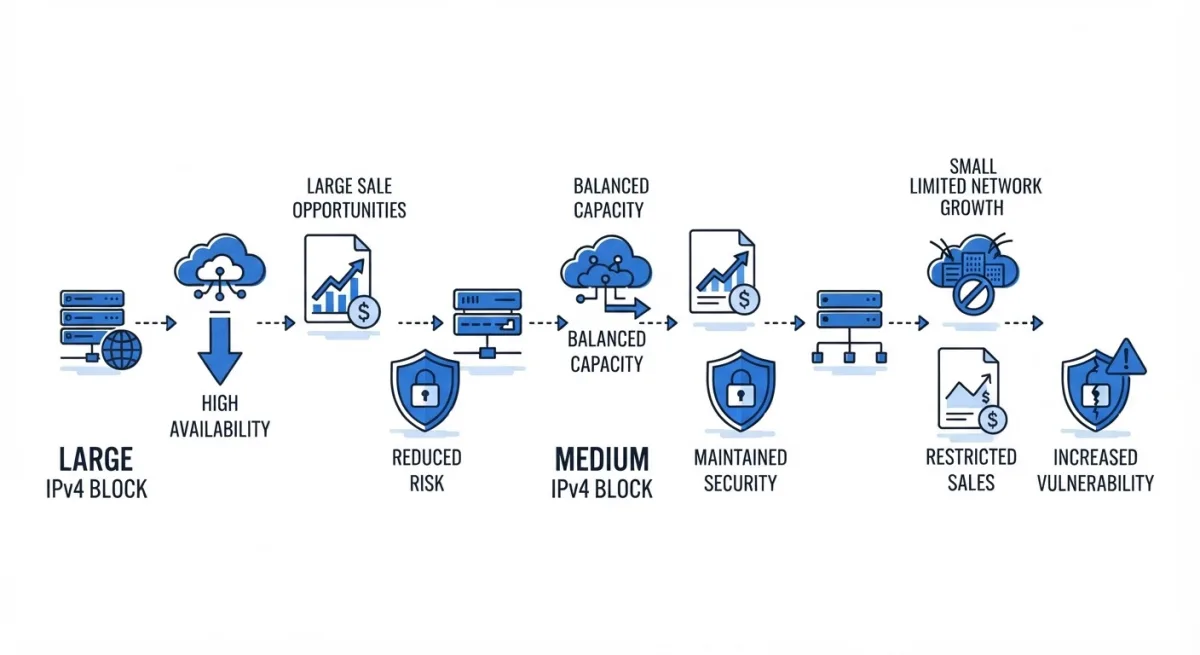
IPv4 block size directly affects which buyers can use a prefix, how easily the resource can be transferred, and how liquid it may be on the market. A larger block can attract infrastructure operators with broad address demand, while smaller prefixes may appeal to more buyers but create additional fragmentation and transaction complexity.
IPv4 block size sale analysis is the process of evaluating how prefix length influences buyer demand, transfer options, liquidity, and expected transaction structure. A /24, /23, or /22 can serve different network requirements, so sellers should understand how block size affects the available buyer pool before deciding whether to sell an allocation whole or in smaller parts.
Table of Contents
- Why does prefix length influence buyer demand?
- How does a /24 differ from larger blocks in the market?
- Does a smaller block always have better liquidity?
- How can larger prefixes affect sale opportunities?
- When does fragmentation make sense?
- How does block size affect pricing and total value?
- Why should transfer rules be checked before splitting a prefix?
- How should sellers match block size to likely buyers?
- What additional questions should IPv4 sellers ask?
- How should sellers use block size in sale planning?
Why does prefix length influence buyer demand?
Prefix length determines how many IPv4 addresses are available and how the block can be used operationally. Buyers generally evaluate whether the resource fits their infrastructure plans without forcing them to acquire significantly more capacity than they need.
A /24 contains 256 addresses, a /23 contains 512, and a /22 contains 1,024. As block size increases, the number of potential buyers may decrease because fewer organizations need larger allocations, but those buyers may have stronger long-term demand.
How does a /24 differ from larger blocks in the market?
A /24 is often a practical minimum unit for independent internet routing because longer prefixes are commonly filtered by network operators. This makes /24 blocks relevant to buyers that need a relatively small independently routable resource.
A /23 or /22 provides more capacity under one contiguous prefix. These blocks may suit hosting providers, ISPs, SaaS infrastructure, data centers, or other networks that need larger pools without managing multiple unrelated allocations.
Does a smaller block always have better liquidity?
Not necessarily. Smaller prefixes can match the requirements of a wider range of buyers, which may improve liquidity, but marketability also depends on RIR region, reputation, routing history, transfer eligibility, and price.
A seller should consider:
- number of buyers seeking the prefix size;
- expected transaction value;
- RIR transfer requirements;
- routing and reputation condition;
- cost of splitting the original allocation;
- remaining value after fragmentation.
Liquidity should therefore be evaluated for the specific block rather than inferred from prefix length alone.
How can larger prefixes affect sale opportunities?
Larger blocks can attract buyers that prefer operational simplicity. Acquiring one /22 instead of four separate /24s may reduce registry, routing, documentation, and network-management work.
However, a larger block can also require a longer search for the right buyer. If demand for the full prefix is limited, the seller may need to compare the benefits of waiting for one transaction with the possibility of splitting the resource into smaller transferable units.
When does fragmentation make sense?
Fragmentation can increase the number of potential buyers by converting a large allocation into smaller prefixes. For example, a /22 can technically be divided into two /23s or four /24s, subject to registry policy, transfer eligibility, and operational conditions.
Before splitting a block, the seller should review:
- whether the smaller prefixes can be transferred separately;
- whether fragmentation affects buyer pricing;
- how many transactions will be required;
- whether routing records need additional cleanup;
- what unused fragments will remain after each sale.
Fragmentation can improve flexibility but also creates more due diligence, contracts, transfers, and administrative work.
How does block size affect pricing and total value?
Price per address and total transaction value are separate considerations. A smaller prefix may attract more buyers, while a larger contiguous block may have strategic value for organizations seeking substantial capacity under one allocation.
The seller should compare expected proceeds after transaction costs rather than assuming that dividing a block automatically improves returns. Several smaller sales may involve more broker, legal, escrow, and operational effort than a single larger transfer.
Why should transfer rules be checked before splitting a prefix?
A technically possible split is not automatically a valid transfer strategy. RIR policies can impose minimum transfer sizes and other eligibility requirements, so sellers need to confirm that each planned child prefix can move independently.
Before selling an IPv4 block, the owner should map the proposed prefix structure to the applicable transfer policy. This prevents a fragmentation plan from creating blocks that cannot be transferred as intended.
How should sellers match block size to likely buyers?
The seller should identify buyer segments before deciding how to structure the asset. A smaller business may need only a /24, while a regional hosting company or ISP may prefer a /22 or larger allocation.
Matching the resource to realistic buyer demand can reduce time on market and unnecessary restructuring. The objective is to find a prefix size that balances liquidity, transaction efficiency, and the value of keeping the block contiguous.
What additional questions should IPv4 sellers ask?
How should sellers use block size in sale planning?
IPv4 block size should be treated as a commercial and operational factor rather than only a technical property. Prefix length influences demand, liquidity, transfer structure, buyer fit, and fragmentation options. If an organization wants to assess whether a /24, /23, /22, or larger block should be sold whole or divided, it can contact InterLIR Global to structure the sale around realistic buyer demand and transfer requirements.