How IPv4 leasing supports temporary projects and product launches
 Katarzyna Ostrowska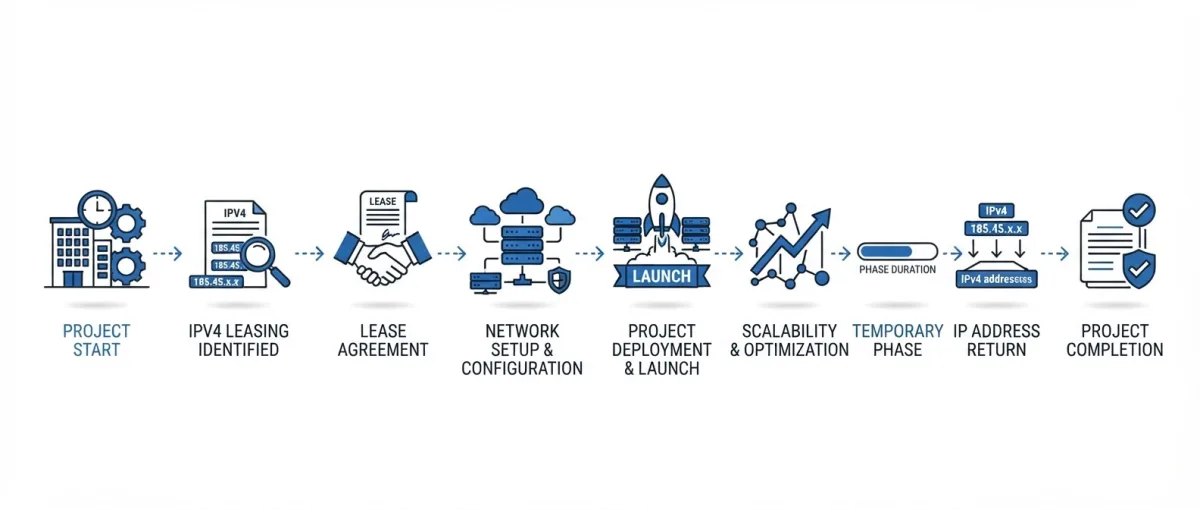
Temporary projects often require public IPv4 space before a company is ready to purchase an address block. This is common during migrations, pilots, seasonal demand, and new service launches where the duration and future scale are not yet fully defined.
IPv4 leasing for temporary projects is a model in which a company receives a public IPv4 block for an agreed period and a specific task. It provides the required capacity, supports product launches and temporary workloads, and avoids permanent address acquisition while keeping control over timing, routing, and resource return.
Table of Contents
- When Does IPv4 Leasing Fit a Temporary Project?
- How Does IPv4 Leasing Help With Product Launches?
- How Should IPv4 Capacity Be Calculated?
- How Does Project Duration Affect Lease Terms?
- What Technical Checks Are Needed Before Traffic Goes Live?
- How Should Temporary IPv4 Infrastructure Be Organized?
- How Should a Project Prepare to Return an IPv4 Block?
- When Can Buying IPv4 Be More Practical Than Leasing?
- What Additional Questions Should Teams Consider?
- How Should a Company Organize IPv4 for a Temporary Project?
When Does IPv4 Leasing Fit a Temporary Project?
Leasing fits when the need for addresses is limited by the project timeline or depends on its outcome. This allows the company to match the resource to the actual duration of the task instead of buying a block that may become unnecessary afterward.
Typical use cases include:
- migration between data centers or cloud environments;
- a pilot for a new service;
- temporary NAT pools and VPN gateways;
- seasonal infrastructure expansion;
- isolated customer environments with a fixed duration.
This short-term model is useful when address demand is real but the final network state is still changing. The team can operate the required services during the project and make a separate long-term decision once the workload becomes predictable.
How Does IPv4 Leasing Help With Product Launches?
During product launches, the final architecture often continues to change. The team may not yet know the exact number of customers, regions, or public services that will be required. A temporary block allows the new environment to use a separate range for APIs, gateways, load balancers, and external integrations.
Leasing IPv4 addresses makes it possible to test demand, network design, and actual address consumption before making a long-term decision. If the product becomes permanent, the company can separately evaluate buying IPv4 addresses based on real usage rather than an early forecast.
How Should IPv4 Capacity Be Calculated?
Capacity should be based on network architecture rather than user count alone. One product may use several public gateways, while another may require separate IPs for customers, regions, or service groups.
The team should consider:
- the number of systems that truly need public IPv4;
- the use of NAT and IPv6;
- separation of production, testing, and customer segments;
- a reasonable growth reserve;
- BGP announcement limits imposed by upstream providers.
The block size should cover expected workloads for the lease period without creating unnecessary excess capacity that remains unused during most of the project.
How Does Project Duration Affect Lease Terms?
Duration affects the commercial and operational structure of the lease. For temporary infrastructure, the team should define the main lease period together with renewal, notice, and termination conditions so that contractual timing matches the project schedule.
Important terms include:
- minimum lease duration;
- renewal window;
- notice period;
- early termination conditions;
- additional time reserved for technical exit.
This planning helps prevent a situation where the agreement ends before the team can renew the lease, complete the project, or move to another address model.
What Technical Checks Are Needed Before Traffic Goes Live?
A short-term project still requires full technical due diligence. Before traffic is enabled, the team should confirm announcement rights, routing history, registry consistency, and the reputation of the range.
The review should include:
- WHOIS and registry data;
- IRR route objects and RPKI ROA;
- BGP history and previous origin ASN;
- blacklist, spam, and proxy reputation;
- geolocation;
- current abuse contacts.
These checks are especially important for SaaS, VPN, API, and mail infrastructure, where external systems may evaluate traffic based on address reputation and routing context.
How Should Temporary IPv4 Infrastructure Be Organized?
A temporary range should be kept separate from permanent address pools whenever possible. This makes dependencies easier to track and simplifies the later removal of the block from production systems.
For each range, the team should document:
- the internal owner;
- the purpose of the block;
- permitted workloads;
- origin ASN;
- DNS and PTR records;
- firewall policies;
- the review date for continued use.
This documentation keeps temporary infrastructure controlled throughout the project lifecycle and reduces the chance that a short-term range becomes an undocumented permanent dependency.
How Should a Project Prepare to Return an IPv4 Block?
Returning the block is a separate technical process. Before the agreement ends, the team should remove every dependency created during the period of use and confirm that no production service still relies on the range.
Before return, the team should:
- move services to replacement addresses;
- update DNS, PTR, and allowlists;
- change firewall rules;
- verify inbound and outbound traffic;
- withdraw the BGP announcement;
- confirm that no active services still depend on the old range.
A controlled return process reduces the risk of downtime, stale routes, or continued use of addresses after the lease has formally ended.
When Can Buying IPv4 Be More Practical Than Leasing?
Buying becomes more practical when the addresses become a permanent part of the product or infrastructure. This is especially relevant for multi-year use, extensive external allowlists, fixed customer IPs, and direct control over registry data.
In these cases, ownership can reduce repeated renumbering and dependence on future lease renewals. The decision should compare acquisition cost with the operational impact of keeping the same address space over a long period.
What Additional Questions Should Teams Consider?
How Should a Company Organize IPv4 for a Temporary Project?
A company should connect each IPv4 resource to a specific task, project duration, network architecture, and exit plan. If the team needs to select a range for a temporary launch, review its technical condition, and define the right usage model, it can contact InterLIR Global to choose IPv4 resources that match the actual project duration and workload requirements.