How IPv4 owners can evaluate demand before monetizing address space
 Katarzyna Ostrowska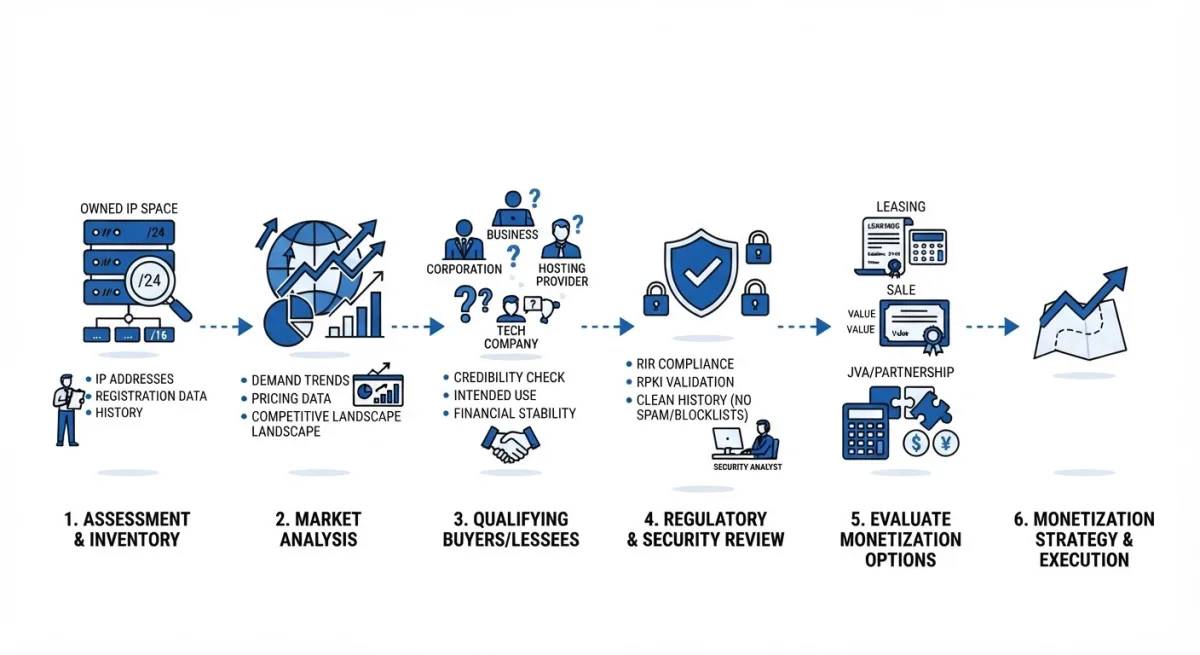
Monetizing unused IPv4 can create recurring income, but demand is not equal across every block, region, or tenant segment. Before offering address space for lease, an owner should understand which prefixes are likely to attract tenants, how quickly they may be placed, and whether expected revenue justifies the operational effort.
IPv4 monetization demand analysis is the process of evaluating market interest in an available block before leasing begins. It reviews prefix size, region, tenant requirements, expected lease duration, market conditions, and forecast demand so the owner can decide how to position the resource and estimate realistic utilization.
Table of Contents
- What should owners measure before offering a block?
- How does prefix size influence leasing demand?
- Why does region matter when evaluating the market?
- How should tenant demand be assessed?
- How should owners evaluate lease duration preferences?
- How should market demand be forecast?
- When should an owner delay monetization?
- What additional questions should IPv4 owners ask?
- How should owners prepare address space for monetization?
What should owners measure before offering a block?
Demand analysis should start with the characteristics of the actual resource. Two IPv4 blocks of the same size may attract different tenants because their registry region, routing history, reputation, geolocation, or ability to support specific network models differs.
The initial review should cover:
- prefix size and exact block boundaries;
- RIR region and registry status;
- routing and reputation condition;
- geolocation;
- acceptable tenant use cases;
- availability date and possible lease duration.
This creates a resource profile that can be compared with current tenant requirements instead of assuming that every unused prefix has the same marketability.
How does prefix size influence leasing demand?
Prefix size affects the type and number of potential tenants. A /24 may fit a smaller hosting environment, SaaS platform, VPN location, or enterprise network, while larger blocks can attract providers that need broader address pools.
Larger prefixes can reduce the number of separate leases an owner needs to manage, but they may also have a smaller tenant pool. Smaller blocks can attract more prospects while increasing administration, routing coordination, and vacancy exposure across multiple agreements.
Why does region matter when evaluating the market?
Region can affect demand because tenants may need addresses associated with a particular RIR, routing environment, or expected geolocation. A company expanding infrastructure in Europe may evaluate a prefix differently from one focused on North America or Asia-Pacific.
Owners should therefore avoid using global demand as the only indicator. Market analysis should consider where potential tenants operate, whether the block’s registry position fits their requirements, and whether geolocation expectations can be supported.
How should tenant demand be assessed?
Tenant demand should be evaluated by use case rather than only by the number of inquiries. A high volume of prospects does not automatically create attractive monetization if most requests involve short terms, unsuitable traffic, or operational risk.
Useful tenant segments may include hosting providers, SaaS platforms, ISPs, VPN services, security companies, and infrastructure operators. The owner should compare each segment by expected block size, lease duration, reputation exposure, and the amount of technical support required.
This helps distinguish strong demand from activity that is unlikely to produce sustainable income.
How should owners evaluate lease duration preferences?
Lease duration affects both demand and revenue stability. Some tenants need temporary capacity for migrations or regional tests, while others prefer longer agreements because addresses become embedded in customer systems and allowlists.
The owner should identify whether the market for a specific block favors short, medium, or long commitments. Flexible terms may increase the tenant pool, while longer leases can reduce vacancy and placement work if suitable counterparties are available.
How should market demand be forecast?
A forecast should combine current inquiries with historical placement data and realistic assumptions about future tenants. It should not treat one active request as proof that the same demand will continue throughout the year.
The forecast can track:
- number of qualified tenant inquiries;
- requested prefix sizes;
- preferred regions;
- typical lease periods;
- conversion from inquiry to signed lease;
- expected vacancy between contracts.
These indicators help estimate how much of the available portfolio is likely to produce income and how quickly a returned block may be leased again.
When should an owner delay monetization?
Monetization may be worth delaying when demand is weak, the prefix requires reputation cleanup, or likely tenants do not fit the owner’s acceptable-use policy. Immediate placement at poor terms can create more risk than leaving the resource idle temporarily.
An owner should also consider internal forecasts. If the block may soon be required for network growth, a long lease can conflict with future infrastructure needs even when current market demand is strong.
What additional questions should IPv4 owners ask?
How should owners prepare address space for monetization?
Owners should connect market demand with prefix characteristics, tenant quality, region, lease duration, and realistic forecasting before placing a block. If an organization wants to evaluate demand and structure IPv4 leasing around the expected market for its address portfolio, it can contact InterLIR Global to plan monetization around qualified tenant demand and future resource needs.