How lease terms affect IPv4 monetization for address holders
 Mireia Solà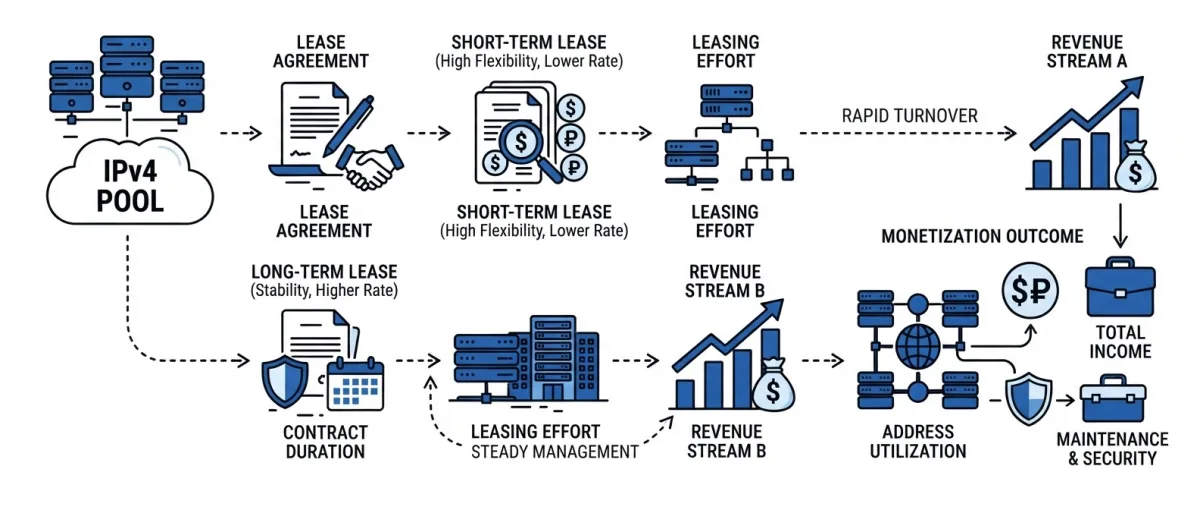
IPv4 monetization depends on more than finding a tenant and setting a monthly rate. Contract structure determines how predictable the income will be, how long the block may remain vacant, and how quickly the owner can regain control if the address space is needed elsewhere.
IPv4 lease terms monetization is the process of structuring duration, renewal, termination, payment, minimum commitment, and utilization rules so an address holder can turn unused IPv4 into recurring revenue. The contract affects revenue stability, vacancy risk, contract yield, downtime between tenants, and the owner’s ability to reuse or reassign the block.
Table of Contents
- How does lease duration affect revenue?
- Why do renewal terms matter for monetization?
- How do termination clauses affect contract yield?
- How should payment terms be structured?
- How does utilization affect monetization?
- How should vacancy risk be included in planning?
- Why does minimum commitment matter?
- How does downtime between tenants reduce yield?
- What additional questions should address holders ask?
- How should address holders structure lease terms?
How does lease duration affect revenue?
Duration directly affects revenue predictability. A longer lease can reduce vacancy risk and administrative work because the block stays with one tenant for a defined period. A shorter agreement gives the owner more flexibility but may require more frequent tenant placement, onboarding, and handover.
The right duration should reflect both market demand and internal plans. A multi-year commitment may improve revenue stability but can become restrictive if the block is needed for future infrastructure growth.
Why do renewal terms matter for monetization?
Renewal rules determine whether income continues smoothly after the initial term. Automatic renewal can reduce unexpected vacancy, while manual renewal gives both parties more control over pricing and future use.
The agreement should define:
- when renewal discussions begin;
- whether the lease renews automatically;
- how much notice is required;
- whether pricing can change;
- how renewal affects the next payment period.
Clear renewal terms help the owner plan cash flow without assuming that every tenant will remain indefinitely.
How do termination clauses affect contract yield?
Termination rules influence the practical value of the contract. A high monthly rate may produce weak contract yield if the tenant can exit with little notice or if the owner must keep the block unavailable during a long offboarding period.
The owner should understand when either party can terminate, what notice applies, and whether early termination fees exist. Abuse, non-payment, unauthorized routing, or prohibited use may also justify immediate action.
How should payment terms be structured?
Payment terms affect cash flow and financial risk. The agreement should state the billing cycle, due date, currency, deposit, late-payment rules, and what happens if the tenant misses a payment.
Advance payment or deposits can reduce exposure, while longer billing cycles may lower administrative work. Leasing IPv4 addresses should therefore be evaluated together with the commercial terms that determine when income is actually received.
How does utilization affect monetization?
Utilization shows how much of the available address space is producing revenue. A large block with only partial tenant use may generate less value than several smaller allocations, but splitting the resource can also increase routing and administration work.
The owner should consider:
- how much of the block is leased;
- whether the remaining space can be placed separately;
- whether fragmentation affects routing;
- whether a larger tenant reduces operational complexity;
- how utilization changes expected yield.
The goal is not maximum occupancy at any cost. Utilization should be balanced with tenant quality and operational risk.
How should vacancy risk be included in planning?
Vacancy risk is the period when a block produces no income between tenants. It can appear after expiration, early termination, failed renewal, or remediation work following abuse or reputation problems.
Planning should include realistic vacancy assumptions rather than treating recurring revenue as continuous. Owners with several blocks can also stagger lease end dates to reduce simultaneous vacancy across the portfolio.
Why does minimum commitment matter?
A minimum commitment protects the owner from very short use periods that create more onboarding and offboarding cost than revenue. It can be defined through a minimum lease duration, payment period, or early termination charge.
The right minimum depends on block size, tenant demand, and operational effort. A strict commitment can improve predictability, but overly rigid terms may reduce tenant demand.
How does downtime between tenants reduce yield?
Downtime includes more than the period without a signed contract. A block may need route cleanup, DNS changes, reputation review, abuse remediation, or registry updates before reassignment.
This downtime should be included in contract yield calculations. A slightly lower-rate lease with faster turnover may produce better long-term results than a higher-rate agreement followed by weeks of remediation.
What additional questions should address holders ask?
How should address holders structure lease terms?
Address holders should connect duration, renewal, termination, payment, utilization, vacancy risk, minimum commitments, and downtime to the expected net yield of the block. If an organization wants to monetize IPv4 while retaining ownership and controlling contract risk, it can contact InterLIR Global to structure lease terms around revenue goals and future use of the address space.