How to build a business case for an IPv4 purchase
 Katarzyna Ostrowska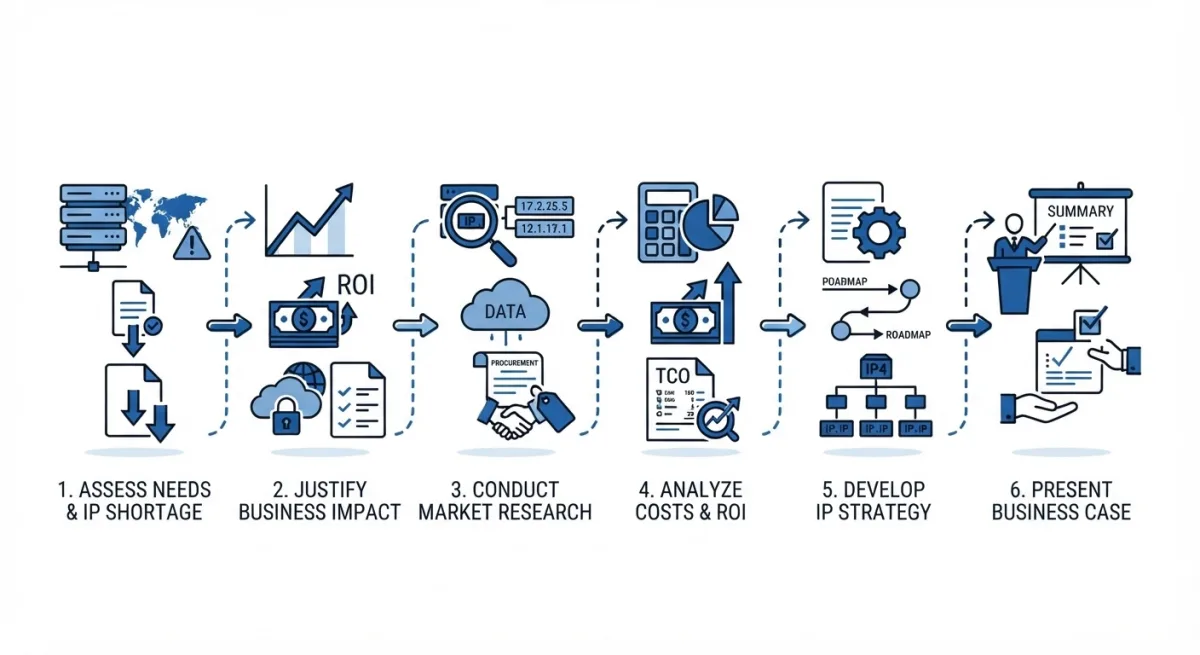
An IPv4 purchase can require significant capital, so technical need alone may not be enough to approve the acquisition. Network, finance, and management teams need a shared view of expected demand, ownership costs, operational risks, and the value of keeping address space under direct control.
An IPv4 purchase business case is a structured justification for acquiring address space based on capacity requirements, demand forecast, ROI analysis, risk, strategic value, and decision criteria. It compares ownership with leasing and other alternatives so the company can determine whether acquisition supports its network and financial objectives.
Table of Contents
- What should justify an IPv4 acquisition?
- How should capacity and demand forecast be calculated?
- What should an ROI analysis include?
- How should risk be included in the business case?
- What strategic value can IPv4 ownership provide?
- How should ownership and leasing be compared?
- Which decision criteria should management use?
- What additional questions should teams ask?
- How should a company prepare an IPv4 purchase decision?
What should justify an IPv4 acquisition?
The justification should begin with a measurable infrastructure requirement. A company may need more public addresses because existing pools are approaching capacity, new customer environments require dedicated IPs, or expansion plans cannot be supported with current resources.
The business case should separate immediate demand from possible future demand. The technical team should explain which workloads require public IPv4 and why NAT, IPv6, address reclamation, or provider-assigned space cannot fully solve the requirement.
How should capacity and demand forecast be calculated?
Capacity planning should connect current utilization with expected growth over a defined period. Historical allocation data can show how quickly existing pools are consumed, while product and infrastructure plans indicate where new demand may appear.
A demand forecast should consider:
- current IPv4 utilization and available reserve;
- expected customer and workload growth;
- new regions, facilities, or products;
- dedicated IP and allowlist requirements;
- addresses that can be reclaimed or replaced with IPv6.
The forecast should include expected, lower, and higher demand scenarios so management can see how sensitive the purchase is to growth assumptions.
What should an ROI analysis include?
ROI analysis should compare acquisition cost with the economic effects of ownership over the expected holding period. The calculation should not treat the purchase price as the only cost or assume that every unused address creates immediate value.
The analysis may include purchase price, RIR and transfer expenses, due diligence, routing preparation, administration, and cost of capital. These costs can be compared with lease payments avoided and operational costs linked to repeated renewals or migrations.
A purchase that appears expensive over one year may have a different financial profile if the same block is expected to support infrastructure for several years.
How should risk be included in the business case?
Risk should be represented as a business factor rather than a separate technical note. Ownership may reduce lease renewal dependency and forced renumbering, while creating responsibility for registry maintenance, reputation, security, and long-term resource management.
Important risks to evaluate include:
- future address shortages;
- changes in IPv4 market pricing;
- unexpected demand reduction;
- routing or reputation problems;
- transfer delays;
- costs of maintaining unused capacity.
The business case should show how these risks affect cost, timing, and service continuity rather than assigning an arbitrary score.
What strategic value can IPv4 ownership provide?
Strategic value appears when direct control of address space supports broader infrastructure goals. Ownership can provide stable source IPs for customer allowlists, long-term routing control, direct management of RPKI and registry records, and more flexibility when workloads move between providers or facilities.
The value may also include disaster recovery, regional expansion, BYOIP architecture, or future product capacity. These benefits should be counted only when there is a realistic use case.
How should ownership and leasing be compared?
An ownership leasing comparison should use the same capacity requirement and time horizon for both options. Leasing often reduces initial capital requirements and fits temporary or uncertain demand. Purchasing creates a larger upfront cost but may provide stronger control when the same addresses are expected to remain in use for years.
The comparison should account for renewal risk, migration effort, registry control, operational administration, and capital versus recurring expense. Buying IPv4 addresses becomes easier to justify when long-term demand is predictable and ownership benefits exceed the flexibility of leasing.
Which decision criteria should management use?
Decision criteria should convert technical and financial analysis into a clear approval framework. The final recommendation should state the required block size, expected utilization period, total acquisition cost, major risks, and alternatives considered.
Management should determine whether the acquisition solves a documented capacity problem, whether expected utilization justifies the capital commitment, and whether ownership offers measurable advantages over leasing. The business case should also define conditions that would change the recommendation.
What additional questions should teams ask?
How should a company prepare an IPv4 purchase decision?
A strong business case should connect acquisition with measurable capacity demand, realistic growth assumptions, ROI analysis, risk, strategic value, and clear decision criteria. If a company needs to evaluate available IPv4 resources and structure a purchase around its technical and financial requirements, it can contact InterLIR Global to prepare an acquisition path aligned with the planned use of the address space.