How to plan IPv4 acquisition for mergers and network expansion
 Bram de Vries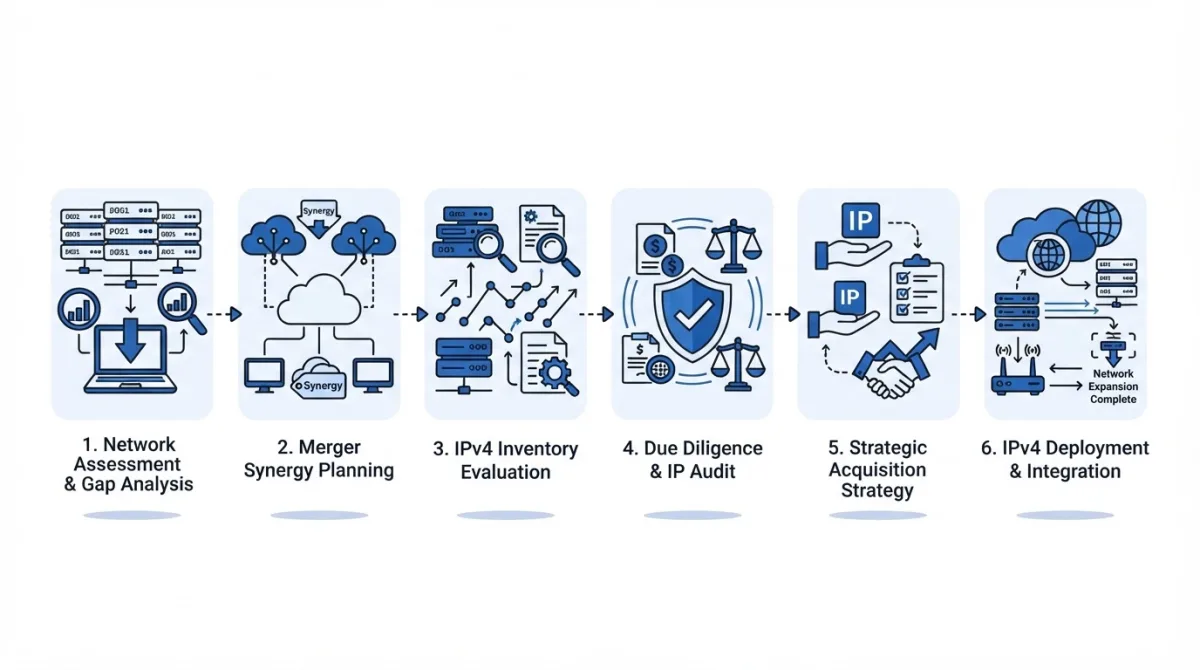
Mergers, acquisitions, and network expansion often change how much public IPv4 a company needs and where that capacity must be available. Address plans that worked for separate organizations can become fragmented after integration, while new facilities, customers, and services may require additional space.
IPv4 acquisition merger planning is the process of assessing address capacity before and during M&A or network expansion, then defining how additional IPv4 will be acquired, transferred, integrated, and allocated. It connects current inventory with forecast demand, RIR transfer requirements, routing changes, and the technical integration of combined networks.
Table of Contents
- Why should IPv4 planning start early in an M&A process?
- How should existing address capacity be assessed?
- How should future demand be forecast during network expansion?
- How should acquisition fit into the integration plan?
- What RIR transfer issues should be checked?
- How should IPv4 be integrated into the combined network?
- How should routing changes be coordinated with acquisition?
- What additional questions should M&A teams ask?
- How should a company prepare IPv4 for M&A and expansion?
Why should IPv4 planning start early in an M&A process?
IPv4 planning should begin before network integration starts because both companies may already have dependencies tied to existing public addresses. Firewalls, customer allowlists, VPNs, DNS, monitoring, and external APIs can all depend on specific ranges.
An early review helps identify which resources can be retained, which blocks are underused, and where additional capacity may be required after consolidation. It also gives the integration team time to verify registry ownership and transfer conditions before those issues affect the broader migration schedule.
How should existing address capacity be assessed?
The first step is to build a combined inventory of the IPv4 resources used by both organizations. Registered holdings alone are not enough because some ranges may be fully utilized while others contain inactive or fragmented allocations.
The assessment should cover:
- active public address usage;
- customer and infrastructure allocations;
- unused or reclaimable ranges;
- temporary leased space;
- addresses tied to external allowlists;
- expected capacity released by consolidation.
This inventory creates a baseline for deciding whether the merged network already has enough address space or whether a new acquisition is required.
How should future demand be forecast during network expansion?
A forecast should connect integration plans with expected operational growth. M&A can create immediate demand through duplicated environments, while network expansion may add new data centers, regional services, customer platforms, or security infrastructure.
The forecast should distinguish between temporary overlap and long-term demand. Addresses used only during migration should not automatically justify a permanent purchase, while stable growth in hosting, SaaS, VPN, or dedicated customer services may support additional owned capacity.
How should acquisition fit into the integration plan?
Acquisition should be linked to the timing of network integration. The new block must be available early enough for routing, DNS, customer migration, and security changes, but purchasing too early can leave capacity idle if the final architecture changes.
Buying IPv4 addresses can be considered when the combined network has a documented long-term shortage and ownership provides operational value. The acquisition plan should define block size, intended use, target registry account, routing ownership, and the point at which production workloads will begin using the new range.
What RIR transfer issues should be checked?
RIR transfer requirements can affect both timing and legal ownership during M&A. A block may be registered to an entity that is being merged, renamed, or dissolved, which can create additional documentation requirements before the resource can move.
The team should verify:
- the registered holder of each block;
- whether corporate changes affect ownership records;
- transfer eligibility;
- recipient account readiness;
- inter-RIR requirements where relevant;
- technical and abuse contacts after transfer.
Registry preparation should be coordinated with legal integration so that resource ownership matches the post-merger corporate structure.
How should IPv4 be integrated into the combined network?
Integration should focus on creating a clear address structure rather than simply combining two existing plans. The network team may need to separate customer pools, infrastructure ranges, management networks, and regional allocations under a new model.
Where possible, the plan should reduce unnecessary fragmentation and remove obsolete assignments. New IPv4 should be introduced into defined pools with clear ownership, routing policy, DNS responsibilities, and reassignment procedures. This creates a more stable foundation for future network expansion.
How should routing changes be coordinated with acquisition?
A newly acquired block must fit the routing architecture of the combined network. The team should define the intended origin ASN, upstream providers, IRR records, RPKI authorization, and failover model before the prefix enters production.
This is especially important after M&A because the companies may operate different ASNs, transit relationships, or routing policies. The integration plan should decide which routing model will remain and how acquired address space will fit into that structure without creating conflicting announcements.
What additional questions should M&A teams ask?
How should a company prepare IPv4 for M&A and expansion?
A company should connect IPv4 acquisition with combined inventory, capacity forecast, RIR transfer planning, routing design, and the final integration model. If an organization needs to assess address requirements for a merger or network expansion and determine whether additional owned space is required, it can contact InterLIR Global to structure an IPv4 acquisition path around the new network architecture.