How to Set a Competitive Lease Price for Unused IPv4 Address Space

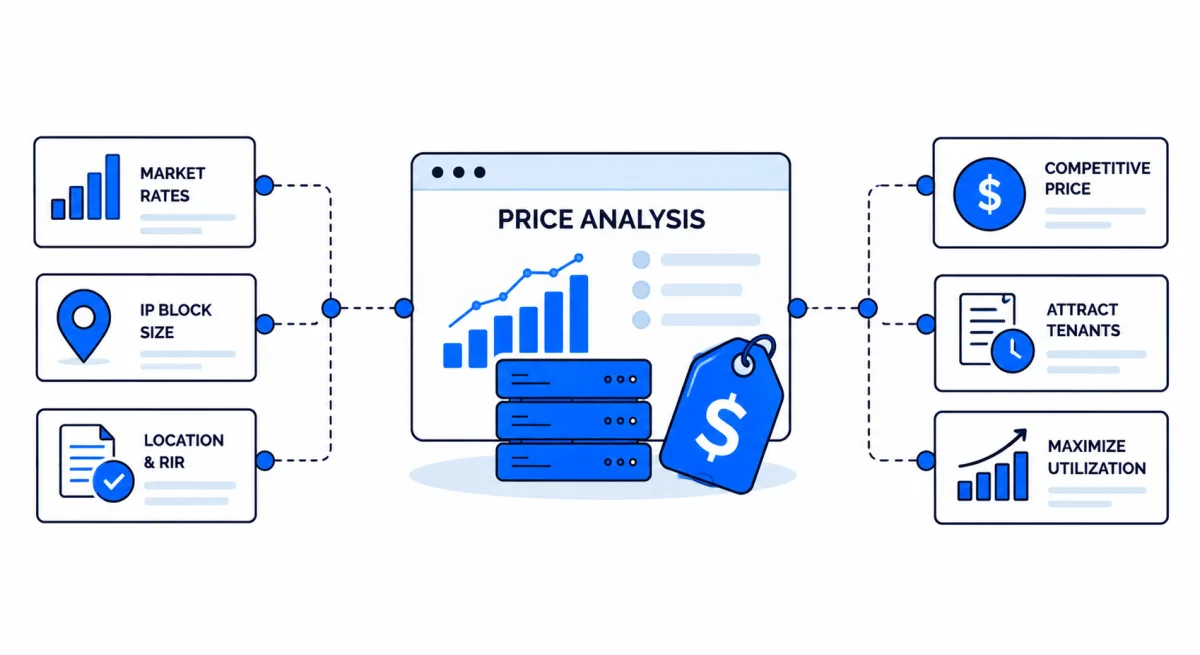
Owners of unused IPv4 space need to balance two objectives: generating income and keeping the block attractive to qualified tenants. Setting the rate too high can extend vacancy periods, while pricing too low can reduce the return generated by a scarce network asset.
Unused IPv4 lease pricing is the process of setting a recurring rental rate for address space based on market benchmarks, prefix size, region, reputation, permitted use and lease terms. A competitive rate should reflect both current demand and the specific characteristics of the block instead of copying one market-wide price per IP.
Table of Contents
- What should a competitive lease rate be based on?
- How does prefix size affect lease price setting?
- Why is lease rate benchmarking important?
- Which lease pricing factors can justify a higher rate?
- How should reputation affect unused IPv4 pricing strategy?
- How can owners compare different lease pricing strategies?
- When should a lease rate adjustment be considered?
- How can owners calculate the cost of vacancy?
- Frequently Asked Questions
- Set a competitive lease rate
What should a competitive lease rate be based on?
A competitive lease rate starts with comparable transactions, but market averages should be treated as reference points rather than automatic prices.
A pricing review should consider:
- prefix size;
- RIR region;
- routing history;
- reputation and blocklist exposure;
- geolocation;
- expected lease term;
- permitted tenant use;
- operational support included;
- current supply and demand.
The same nominal lease market rate may not be appropriate for two technically different blocks.
How does prefix size affect lease price setting?
Lease price setting should account for the size and usability of the prefix. Larger tenants may prefer aggregated address space because it reduces routing and administrative overhead, while smaller blocks can serve a broader range of buyers.
To compare offers, owners can calculate:
Monthly revenue = number of leased addresses × monthly rate per IP.
For a /24:
256 × $0.35 = $89.60 per month.
For a /22:
1,024 × $0.35 = $358.40 per month.
These are arithmetic examples, not fixed market prices. Actual unused IPv4 lease rate levels depend on the individual resource and contract.
Why is lease rate benchmarking important?
Lease rate benchmarking prevents pricing decisions from being based only on one quote or one advertised offer. Owners should compare several similar blocks and normalize the data to the same unit.
A useful benchmark compares:
- monthly price per IPv4 address;
- effective price per block;
- minimum lease term;
- included technical services;
- tenant restrictions;
- payment schedule;
- renewal conditions.
A block quoted at a higher nominal rate may still be competitive if it includes stronger routing support or has a better reputation profile.
Which lease pricing factors can justify a higher rate?
Several lease pricing factors can support a premium when they create measurable value for the tenant.
These may include:
- clean reputation history;
- stable geolocation;
- desirable RIR region;
- ready route objects;
- RPKI/ROA support;
- reverse DNS capability;
- short onboarding time;
- flexible lease terms.
However, no single characteristic guarantees a premium. Tenants evaluate the complete operating package, not only the address block itself.
How should reputation affect unused IPv4 pricing strategy?
An effective unused IPv4 pricing strategy should reflect operational quality. A block with unresolved blocklist issues, inconsistent registry records or problematic routing history can require additional remediation before it becomes attractive to tenants.
Owners should review:
- major blocklists;
- historical routing data;
- previous use;
- WHOIS and registry records;
- geolocation consistency;
- abuse history.
If remediation is required, the owner can either fix the issues before listing or account for them in the asking rate.
How can owners compare different lease pricing strategies?
A lease pricing strategy can prioritize maximum nominal rate, faster occupancy or longer tenant retention. These objectives produce different pricing decisions.
For example:
- premium strategy — higher rate, potentially longer time to secure a tenant;
- market-rate strategy — pricing near comparable inventory;
- occupancy strategy — lower rate to reduce vacancy;
- long-term strategy — rate designed around a longer commitment.
The best approach depends on how urgently the owner wants the block leased and whether predictable recurring revenue is more important than maximizing the monthly rate.
When should a lease rate adjustment be considered?
A lease rate adjustment may be appropriate when market conditions, block quality or contract terms change.
Review the rate when:
- the block remains unleased longer than expected;
- comparable market offers move materially;
- a reputation issue is resolved;
- a new GEO requirement increases demand;
- the owner changes the minimum lease term;
- the service package changes.
Frequent changes can create uncertainty, so rate reviews should follow a defined process rather than reacting to individual inquiries.
How can owners calculate the cost of vacancy?
The highest asking rate is not always the most profitable option.
Suppose a /22 could lease at $350 per month immediately or at $400 after three months of vacancy.
Immediate option over 12 months:
$350 × 12 = $4,200.
Higher-rate option after three vacant months:
$400 × 9 = $3,600.
In this example, the lower competitive lease rate generates $600 more during the year because the block is occupied sooner.
This is why unused IPv4 lease pricing should consider occupancy as well as nominal rate.
Frequently Asked Questions
Set a competitive lease rate
To set a lease rate for unused space, provide the prefix, RIR, history and preferred term to InterLIR Global. The rate can then be assessed alongside likely occupancy, tenant requirements and current market conditions instead of relying on one headline benchmark.