IPv4 block valuation: factors that influence market price
 Henrik Sandberg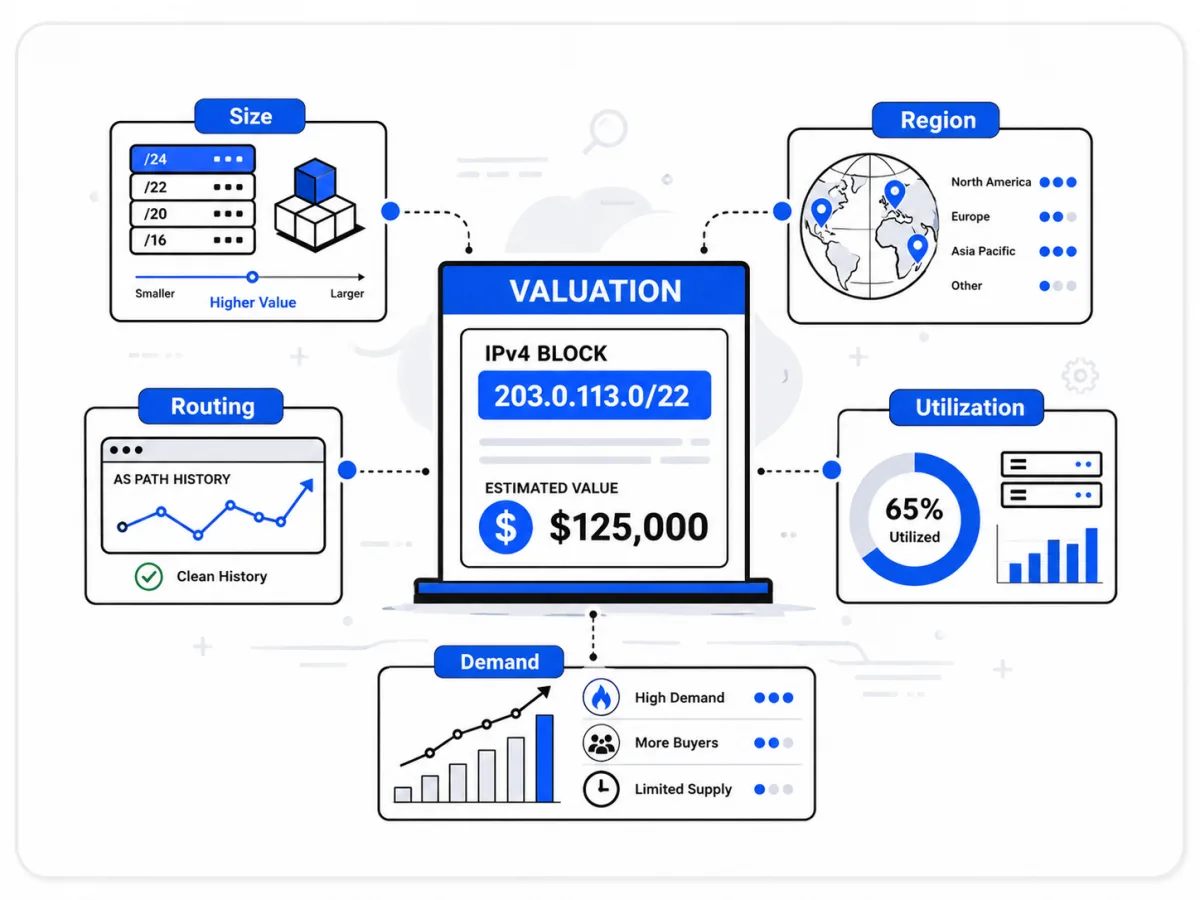
IPv4 addresses are limited assets, but two blocks with the same number of addresses may not have the same value. Buyers, sellers, and brokers assess size, registry region, transferability, routing quality, reputation, documentation, and current demand before they define a realistic price range.
IPv4 block valuation is the process of estimating the market value of an IPv4 prefix by reviewing its size, registry status, routing history, reputation, transfer conditions, and buyer demand. It helps address owners, buyers, and finance teams set expectations before a sale, purchase, lease, or portfolio decision.
Table of Contents
- Why does IPv4 block valuation matter before a transaction?
- How do subnet sizes affect IPv4 market price?
- Why does routing history change the value of a block?
- How does global demand influence valuation?
- What reduces IPv4 block value?
- When should buyers compare valuation with purchase strategy?
- What should teams clarify before valuing an IPv4 block?
- How should an IPv4 owner move forward?
Why does IPv4 block valuation matter before a transaction?
IPv4 block valuation matters because the asking price alone does not show whether a block is easy to transfer, route, monetize, or use in production. A lower-priced prefix can become expensive if it has legal issues, poor reputation, or unresolved registry records.
A valuation review helps both sides understand:
- whether the block can be transferred under the relevant RIR policy;
- whether the seller has clear authority over the resource;
- whether the prefix has usable routing and registry data;
- whether the price reflects current market demand;
- whether the buyer will need cleanup after acquisition.
This makes the transaction less dependent on assumptions and more dependent on verifiable conditions.
How do subnet sizes affect IPv4 market price?
Subnet sizes influence liquidity, buyer profile, routing options, and total transaction value. A /24 may be easier to place because many networks need a small routable block. A /22 or /20 may attract infrastructure buyers that need capacity for hosting, SaaS, VPN, ISP, or cloud environments.
Common valuation logic includes:
- Smaller blocks may have more potential buyers but lower total deal value.
- Medium blocks can fit growing networks that want fewer fragmented routes.
- Larger blocks may require fewer transactions but a smaller buyer pool.
- Very large allocations can need deeper legal, registry, and routing review.
- Price per address can change by size, region, and available supply.
The best valuation does not use size alone. It connects size with demand, transfer path, and operational quality.
Why does routing history change the value of a block?
Routing history affects whether buyers trust the prefix. A block with stable BGP origin history, consistent route objects, clean RPKI status, and accurate WHOIS data is easier to evaluate. A block with many unrelated origins, past route leaks, or missing records may need remediation.
Buyers often check:
- previous origin ASNs and route stability;
- IRR records and RPKI ROAs;
- WHOIS holder data and abuse contacts;
- geolocation accuracy;
- blacklist, spam, proxy, and malware signals.
Clean records can support a stronger valuation because they reduce post-purchase work. Weak records can lower the price or delay the deal.
How does global demand influence valuation?
Global demand changes by RIR region, buyer type, budget cycle, IPv6 adoption, hosting growth, cloud costs, and transfer policy. Demand may be stronger where companies need routable IPv4 for customer services, dedicated IP products, security infrastructure, or partner allowlists.
Market demand also changes with urgency. A buyer that needs addresses for a fixed deployment date may value availability more than a buyer planning a long-term portfolio purchase. Sellers should not rely only on old transactions. They should compare recent market activity, block size, region, and quality.
If the owner is considering a sale, it can review a sell IPv4 addresses process and prepare documentation before entering price discussions.
What reduces IPv4 block value?
A block can lose value when risk is visible or when the buyer expects cleanup. The issue may not be the number of addresses. It may be the cost of making the block usable.
Value can be reduced by:
- unclear ownership or missing seller authority;
- transfer restrictions or incomplete registry records;
- poor IP reputation or active blacklist history;
- inconsistent route objects or missing RPKI planning;
- inaccurate geolocation for target markets;
- open abuse issues or unresolved disputes.
These problems do not always block a deal, but they change negotiation power and timing.
When should buyers compare valuation with purchase strategy?
A buyer should compare valuation with deployment needs before signing. A clean block that matches the network plan may be worth more than a cheaper block that needs weeks of cleanup. If the company needs ownership for long-term infrastructure, it can review buy IPv4 addresses and compare price with transfer time, routing quality, and future control.
The final decision should include technical readiness, not only price per address.
What should teams clarify before valuing an IPv4 block?
How should an IPv4 owner move forward?
An IPv4 owner should treat valuation as a technical and commercial review, not only as a price estimate. To assess IPv4 block valuation, compare subnet sizes, review routing history, measure global demand, and choose whether to sell, lease, or hold the resource, contact InterLIR Global and build a valuation path around the real quality of your IPv4 portfolio.