IPv4 for VPN providers: network design and compliance considerations
 Katarzyna Ostrowska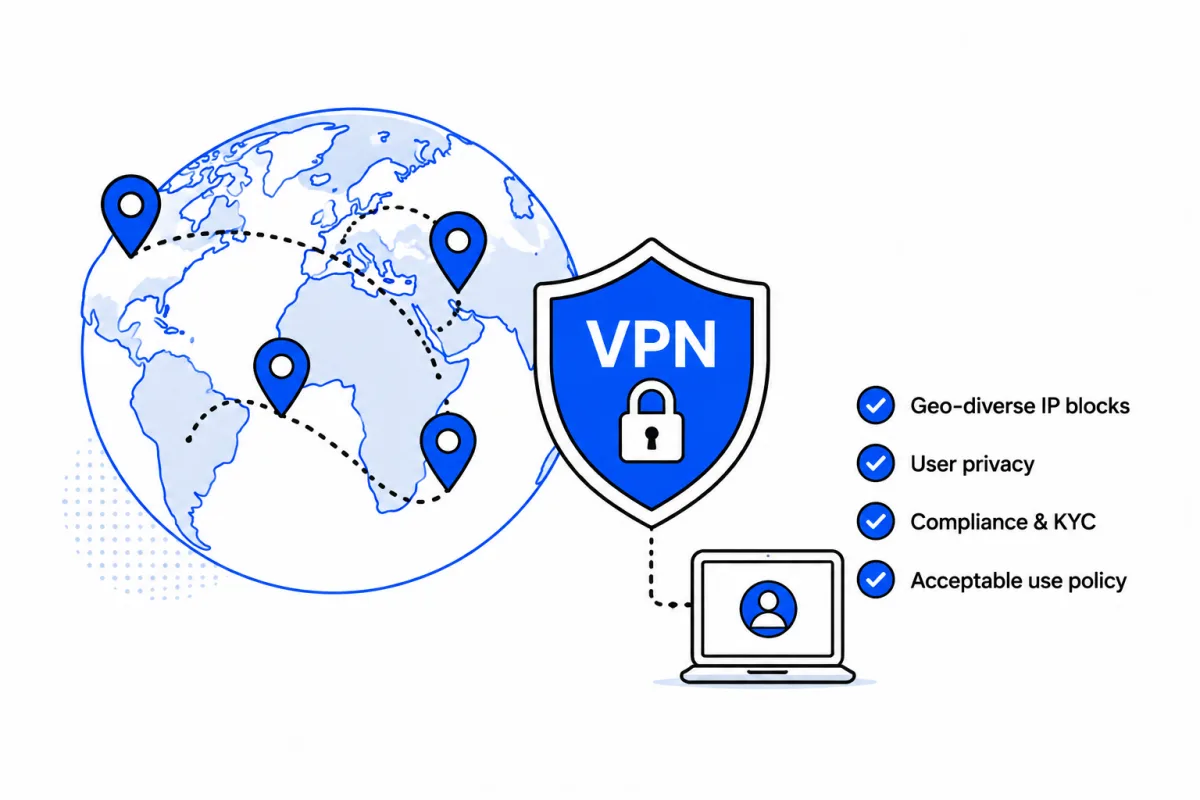
VPN services still depend on public IPv4 because many users, websites, payment systems, streaming platforms, enterprise firewalls, and access policies expect IPv4 connectivity. A provider needs address space that supports stable routing, regional access, abuse response, privacy controls, and customer experience.
IPv4 for VPN providers is public address capacity used to operate VPN gateways, exit-node pools, dedicated IP services, and regional access points. It helps a provider route user sessions, separate shared and fixed-address products, apply abuse controls, document infrastructure ownership, and meet privacy and compliance requirements.
Table of Contents
- Why do VPN providers need IPv4 in network design?
- How should IP routing be planned for VPN exit nodes?
- What compliance considerations apply to VPN IPv4 resources?
- How do privacy standards affect IPv4 operations?
- When does IPv4 ownership become more suitable for VPN services?
- What should VPN teams check before expanding IPv4 pools?
- How should a VPN provider move forward?
Why do VPN providers need IPv4 in network design?
A VPN platform must connect many users to many destinations through controlled gateways. Network design defines how exit nodes, regions, tunnels, DNS, NAT, and monitoring work together. IPv4 remains necessary because many external services still identify sessions by public IPv4 source addresses.
A provider may need separate IPv4 pools for:
- consumer VPN exits in different countries or cities;
- enterprise VPN gateways with fixed allowlisted addresses;
- dedicated IP products for customers that need stable source identity;
- test nodes used for latency, DNS, and route validation;
- abuse-sensitive services that should not share one address pool.
Clear separation helps the team isolate incidents and protect reliable pools from high-risk traffic.
How should IP routing be planned for VPN exit nodes?
IP routing affects latency, reachability, failover, and how traffic appears to external networks. VPN providers should avoid placing every region behind one routing pattern. Each point of presence should have documented upstreams, route filters, BGP policy, and fallback behavior.
Routing planning should cover:
- Which ASN announces each prefix and from which location.
- Which upstream providers accept the route and apply filters.
- How route leaks, hijacks, and abnormal path changes are detected.
- How DNS, Anycast, or regional steering sends users to the right gateway.
- How traffic moves if an exit node, provider, or prefix becomes unavailable.
When a provider tests a new region, it can lease IPv4 addresses for a limited routing window and measure latency, user demand, block rates, and upstream stability before the range becomes part of the long-term network plan.
What compliance considerations apply to VPN IPv4 resources?
Compliance considerations depend on the provider’s market, customer type, and data handling model. A VPN company may need to prove how it manages abuse reports, law enforcement requests, retention limits, customer notices, and infrastructure access.
The team should document:
- who owns each address pool internally;
- which logs are collected, minimized, protected, or deleted;
- which teams can access gateway data;
- how abuse reports are reviewed and escalated;
- how customer contracts describe dedicated IPs and shared exits.
Compliance work should not be limited to legal text. It should match the actual behavior of routers, VPN gateways, DNS systems, billing tools, and support workflows.
How do privacy standards affect IPv4 operations?
Privacy standards influence how a VPN provider assigns addresses, stores events, and separates users. Shared exit addresses can improve user privacy, but they also increase the impact of one user’s abuse on the whole pool. Dedicated IPs can improve access stability, but they create stronger linkage between a customer and an address.
A practical policy should define:
- which services use shared exits and which use dedicated IPs;
- how session metadata is limited;
- how long operational logs exist;
- how abuse investigation avoids unnecessary data exposure;
- how support teams handle account and address questions.
The goal is to keep the service usable without turning infrastructure records into avoidable privacy risk.
When does IPv4 ownership become more suitable for VPN services?
Leasing works for market tests, temporary pools, and new exit locations. Ownership becomes more suitable when a VPN provider builds a long-lived region, sells dedicated IP products under strict contracts, or needs direct control over registry records, route objects, RPKI, and abuse contacts.
A provider can review buy IPv4 addresses when address continuity becomes part of the product promise. This decision should consider transfer time, historical reputation, geolocation accuracy, route acceptance, and the cost of maintaining the same ranges over several years.
What should VPN teams check before expanding IPv4 pools?
How should a VPN provider move forward?
A VPN provider should treat IPv4 planning as part of product architecture, not only as an address request. To build regional pools, separate shared and dedicated IP services, check routing conditions, and define lease or ownership boundaries, contact InterLIR Global and select an IPv4 resource model that fits your VPN network design.