IPv4 Lease Pricing Models 2026: Per-IP, Per-Block and Volume Rates
 Mireia Solà
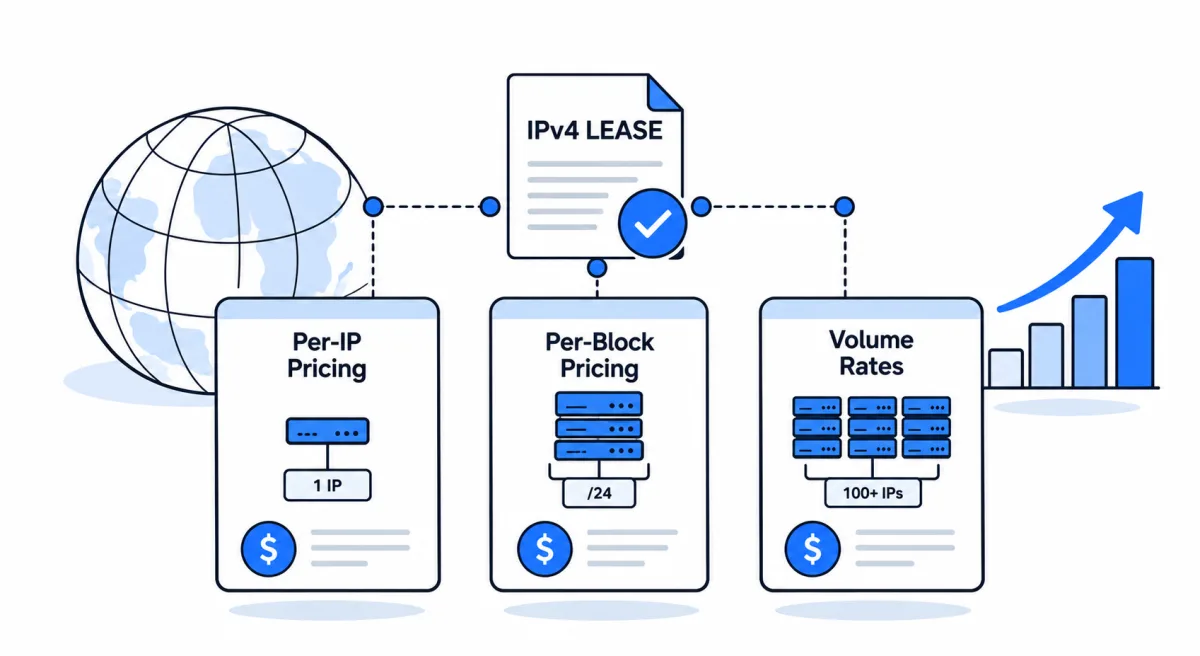
IPv4 leasing in 2026 requires more than comparing an advertised monthly rate. Teams should account for subnet size, utilization, contract term, routing support, address reputation, setup fees and renewal conditions. A low nominal rate can become expensive when a company leases more capacity than it uses.
IPv4 lease pricing models are methods for calculating recurring charges for temporary use of IPv4 space. They define whether a customer pays per address, per CIDR block or by volume tier. The model helps companies forecast costs, compare offers on one basis and match leased capacity to real demand.
Table of Contents
- What IPv4 lease pricing models are used in 2026?
- When is a per-block lease rate more useful?
- How do volume lease rates work?
- What should a lease rate comparison include?
- Which factors can change IPv4 lease pricing?
- Frequently Asked Questions
- Compare lease pricing on one basis
What IPv4 lease pricing models are used in 2026?
Three models are common: per-IP, per-block and volume pricing. Each affects billing and the risk of unused capacity.
| Model | Billing unit | Suitable for | Main risk |
|---|---|---|---|
| Per IP lease rate | Each address | Flexible demand | Extra service fees |
| Per block lease rate | Full CIDR prefix | Fixed subnet needs | Unused capacity |
| Volume lease rates | Committed volume | Large deployments | Minimum volume or term |
Current market data places many IPv4 lease deals around the mid-$0.30 range per address per month, although actual IPv4 lease pricing in 2026 varies by prefix, RIR region, reputation, contract length and included services. Market figures should be treated as benchmarks rather than fixed rates.
How does a per-IP lease rate work?
A per IP lease rate follows a simple formula:
Monthly base cost = billed addresses × monthly rate per IP.
A /24 contains 256 addresses, a /23 contains 512 and a /22 contains 1,024.
Using $0.36 only as an example benchmark:
/24: 256 × $0.36 = $92.16 per month;
/23: 512 × $0.36 = $184.32;
/22: 1,024 × $0.36 = $368.64.
However, lease unit pricing may exclude LOA support, route objects, RPKI/ROA work, reverse DNS, geolocation updates, abuse handling or replacement. Companies that need temporary capacity can lease IPv4 addresses instead of acquiring address space permanently.
When is a per-block lease rate more useful?
A per block lease rate applies one recurring charge to a complete subnet. This block pricing model works well when infrastructure already requires a defined prefix.
Suppose a /22 costs $350 per month. The nominal rate is $350 ÷ 1,024 = about $0.342 per IP. If only 700 addresses are active, the effective rate becomes $350 ÷ 700 = $0.50 per used IP.
The cheaper nominal rate therefore does not always mean lower operating cost. Utilization should be calculated for the full lease term.
How do volume lease rates work?
A volume pricing model changes the unit rate when a customer reaches a defined quantity. Lease rate tiers may depend on address count, aggregate prefix size, number of blocks or contract duration.
A volume quote should state:
- the threshold for each tier;
- minimum committed volume and term;
- billing and prepayment rules;
- conditions for adding or returning blocks;
- renewal and repricing terms.
There is no universal volume discount. Leasing 8,192 addresses at a lower rate is not economical if only half are used. For long-term demand, teams can also compare leasing with buying IPv4 addresses and estimate the break-even period.
What should a lease rate comparison include?
A useful lease rate comparison converts every offer to the same monthly basis and measures nominal and utilized cost.
- Convert annual or quarterly billing to a monthly figure.
- Divide the monthly charge by all leased addresses.
- Divide it again by the number expected to be active.
- Add mandatory setup, routing or management fees.
- Compare minimum term, renewal and exit conditions.
For example, a $4,200 annual /22 lease equals $350 per month. The nominal rate is about $0.342 per IP, but at 700 active addresses the utilized rate is $0.50.
Which factors can change IPv4 lease pricing?
Rates can change with CIDR size, RIR region, reputation, routing history, geolocation, permitted use and contract duration. Current marketplace observations show that average monthly prices can vary by several cents per IP between regions and block types.
Before signing, check:
- registration and authorization status;
- blocklist and abuse history;
- BGP and routing requirements;
- LOA, WHOIS, RPKI/ROA and reverse DNS support;
- setup, management and replacement fees;
- renewal price and termination notice.
These details can outweigh a small difference in the headline rate.
Frequently Asked Questions
Compare lease pricing on one basis
To compare per-IP, per-block and volume pricing on the same basis, send the required prefix, expected term and deployment conditions to InterLIR Global. The comparison can then focus on effective operating cost, included services and utilization rather than the headline rate alone.