IPv4 Lease vs IPv4 Purchase: What's Better for ISPs and Hosting Providers?
IPv4 Lease vs IPv4 Purchase: What’s Better for ISPs and Hosting Providers?
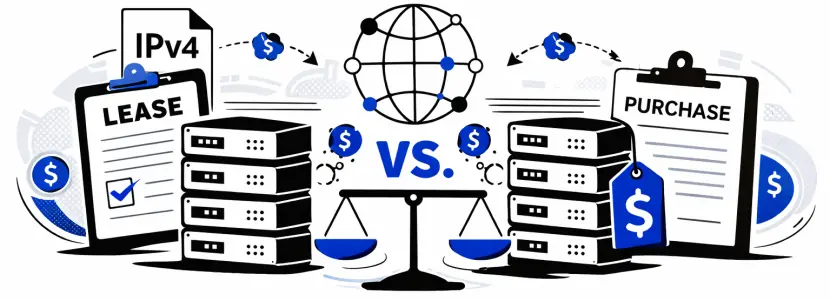
Hosting providers and ISPs in the US and EU face a recurring dilemma: IPv4 lease vs purchase. With the IPv4 free pool exhausted, both options route through the secondary market—but the financial model, risk profile, and operational impact differ significantly. Choosing between IPv4 leasing and IPv4 purchase affects capital allocation, cash flow, and long-term strategy.
This guide breaks down the IPv4 lease versus purchase decision for infrastructure operators, with a clear comparison, when-to-use logic, and a decision framework tailored to commercial traffic goals.
Table of Contents
- IPv4 Lease vs Purchase: Quick Comparison
- When IPv4 Leasing Makes Sense
- When IPv4 Purchase Makes Sense
- CapEx vs OpEx: The Financial View
- US and EU Market Considerations
- Decision Framework for Hosting Providers
- Hybrid Approach: Lease Now, Buy Later
- Summary and Next Steps
- Frequently Asked Questions
IPv4 Lease vs Purchase: Quick Comparison
| Factor | IPv4 Lease | IPv4 Purchase |
|---|---|---|
| Upfront cost | Low (monthly fee, often no deposit) | High ($35–60+ per IP, total block price) |
| Ongoing cost | Recurring (OpEx) | Minimal after transfer |
| Deployment speed | Hours to 24–48 hours | Weeks (RIPE) to months (ARIN) |
| Ownership | No ownership; use rights for term | Full RIR-registered ownership |
| Flexibility | Scale up/down, month-to-month | Fixed block; sell or transfer to exit |
| Capital preservation | Preserves cash flow | Commits capital upfront |
| Use case fit | Pilots, variable demand, growth testing | Long-term infrastructure, known need |
For hosting providers and ISPs, the IPv4 lease vs purchase choice often comes down to: How certain is your demand, and how much capital can you allocate today?
When IPv4 Leasing Makes Sense
IPv4 leasing works best when:
- Demand is uncertain — You’re entering a new market, testing a product, or expect seasonal spikes. Leasing lets you scale without committing.
- Capital is constrained — A /24 purchase can cost $8,000–15,000+; leasing at €0.30–0.50 per IP per month keeps OpEx manageable.
- Speed matters — You need addresses in hours, not weeks. An IPv4 marketplace delivers LOA and routing details within 24 hours.
- You want to avoid RIR paperwork — Lease arrangements are handled by the lessor; you focus on BGP and operations.
- IPv6 migration is on the horizon — Leasing reduces sunk cost if you plan to transition to IPv6 in the next 3–5 years.
Around 40% of IPv4 transactions now involve leasing rather than permanent acquisition—and that share is rising among hosting providers in both US and EU markets.
When IPv4 Purchase Makes Sense
IPv4 purchase fits when:
- Demand is stable and long-term — You know you’ll need the block for 5+ years. At current prices, buying can break even vs leasing after roughly 3–4 years.
- You need asset on the books — Owning IPv4 creates a balance-sheet asset. Some operators prefer this for accounting or M&A.
- Reputation and control matter — Full ownership means you control RIR records, abuse contacts, and reputation. No lessor can reclaim the block.
- You have capital to deploy — If cash flow allows, upfront purchase locks in today’s price and eliminates recurring lease fees.
- RIR compliance and transfers are manageable — You’re prepared for RIPE or ARIN transfer documentation and timelines.
For ISPs with mature networks and predictable growth, IPv4 purchase often aligns better with long-term planning.
CapEx vs OpEx: The Financial View
| Model | IPv4 Lease | IPv4 Purchase |
|---|---|---|
| Accounting | Operational expenditure (OpEx) | Capital expenditure (CapEx) |
| Cash flow | Spread over time; predictable monthly | Large outflow at transfer |
| Break-even | N/A (ongoing expense) | ~3–5 years vs typical lease rates |
| Tax treatment | Deductible as operating expense | Depreciable as asset (jurisdiction-dependent) |
Hosting providers focused on organic commercial traffic often prefer OpEx (leasing) to preserve runway and scale marketing or infra spend. ISPs with strong cash positions may prefer CapEx (purchase) for long-term cost efficiency and balance-sheet structure.
US and EU Market Considerations
EU (RIPE Region)
- RIPE supports leasing for PA (Provider Allocated) space. Sub-allocation and lease arrangements are documented in the RIPE database.
- Hosting providers in the EU can lease or purchase through marketplaces or direct LIR agreements.
- Typical activation: 24–48 hours for lease; 1–2 weeks for RIPE-to-RIPE transfer.
US (ARIN Region)
- ARIN does not process lease-based requests for new allocations. Leased space cannot justify waiting-list or transfer requests.
- Most US operators lease through marketplaces or brokers; the commercial terms and RIR updates are handled by the platform.
- Transfer timelines: 1–2 months for ARIN transfers; lease activation 24–48 hours via marketplace.
Decision Framework for Hosting Providers
Use this flow to choose between IPv4 lease vs purchase:
What’s your time horizon?
< 2 years → Lean toward lease. 5+ years → Consider purchase.What’s your budget?
Limited capital → Lease. Strong reserves → Purchase may improve long-term ROI.How fast do you need it?
Urgent (days) → Lease via marketplace. Can wait weeks/months → Purchase possible.Is demand variable?
Yes → Lease for flexibility. No → Purchase for cost efficiency.Do you need asset ownership?
Yes (M&A, accounting) → Purchase. No → Lease is simpler.
Hybrid Approach: Lease Now, Buy Later
Many hosting providers and ISPs use a hybrid strategy:
- Lease initially to validate demand, enter a market, or bridge a short-term gap.
- Monitor usage and pricing; when usage stabilizes and ROI justifies it, purchase the block or a similar one.
InterLIR Global supports both paths: rent IPv4 addresses from €99 per /24 per month, or buy IPv4 for full ownership. You can start with a lease and later complete an RIR transfer if your strategy shifts.
Summary and Next Steps
- IPv4 lease vs purchase is a strategic choice, not a one-size-fits-all answer.
- Leasing fits variable demand, capital constraints, speed, and flexibility. Purchase fits long-term stable need, capital availability, and asset ownership.
- US and EU markets differ: RIPE supports leasing; ARIN does not process lease-based allocations. Marketplaces serve both regions.
- Use the decision framework above to align your choice with business goals.
For hosting providers targeting organic commercial traffic in the US and EU, InterLIR Global offers IPv4 leasing and purchase with automated LOAs, RIR record management, and abuse handling. Get started to lease or buy IPv4 in under 24 hours (lease) or complete a transfer (purchase).
Frequently Asked Questions
Is it better to lease or buy IPv4?
It depends on your time horizon, budget, and demand certainty. Lease IPv4 when demand is uncertain, capital is limited, or you need addresses quickly. Buy IPv4 when you have stable long-term need, capital to deploy, and want full ownership. A hybrid approach—lease first, buy later—works for many hosting providers.
How much does IPv4 leasing cost vs purchasing?
IPv4 leasing typically runs €0.30–0.50 per IP per month (e.g., €99+ per /24/month). IPv4 purchase costs $35–60+ per IP upfront. Leasing preserves capital; purchase can break even after roughly 3–5 years if you need the block long-term.
Can ISPs lease IPv4 addresses?
Yes. ISPs in both the US and EU can lease IPv4 through marketplaces or direct agreements. In the EU (RIPE), leasing is supported for PA space. In the US (ARIN), lease-based requests don’t qualify for new allocations, but ISPs commonly lease via marketplaces for operational use.
What is the difference between IPv4 lease and purchase?
An IPv4 lease gives you use rights for a term; you pay recurring fees and return the block when the lease ends. An IPv4 purchase transfers full ownership via RIR transfer; you own the block, control RIR records, and can sell or transfer it. Lease = OpEx, flexibility; Purchase = CapEx, ownership.
Should hosting providers lease or buy IPv4?
Hosting providers with variable demand, new markets, or capital constraints typically benefit from leasing. Those with stable, long-term need and available capital often prefer purchasing. Use a hybrid approach: lease to start, buy when usage and ROI justify it.
See Also
- How to Lease IPv4 Address Blocks in 2026 — Step-by-step guide for hosting providers
- What Is an Assignment Request and How Does IPv4 Activation Work? — RIR processes explained
- How to Rent IPv4 Addresses — Detailed InterLIR Global rental flow
- How to Buy IPv4 — RIR transfer and ownership process
- Rent IPv4 — Flexible IPv4 leasing from InterLIR Global
- Buy IPv4 — Purchase IPv4 with full ownership