IPv4 leasing for SaaS platforms: practical use cases
 Johanna Reiter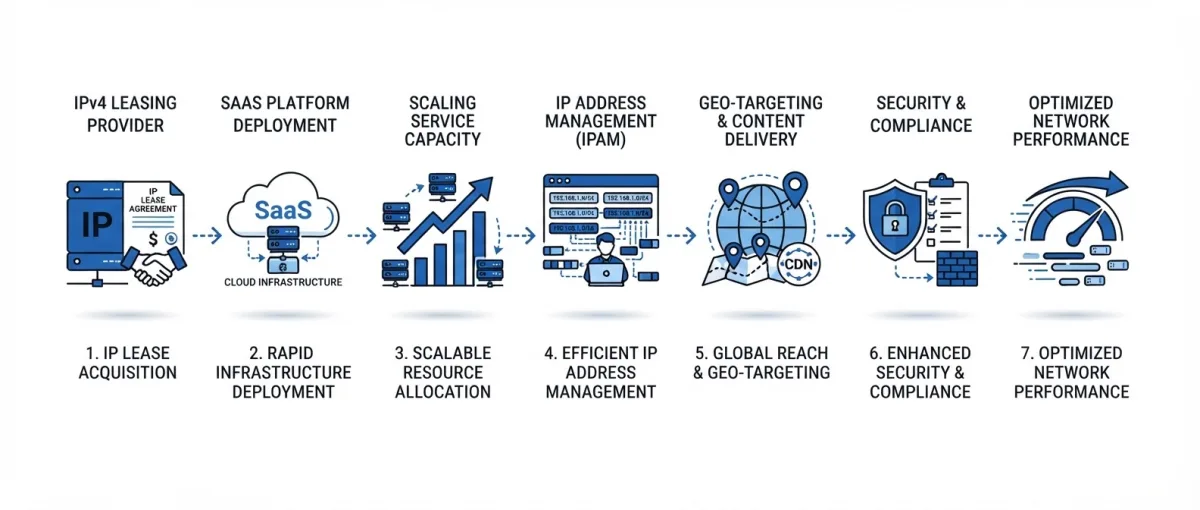
SaaS platforms often run customer-facing applications, APIs, background processes, email services, and external integrations at the same time. Public IPv4 therefore supports more than connectivity. It also helps separate network functions, control address reputation, and maintain stable access for enterprise customers that rely on fixed IPs and allowlists.
IPv4 leasing for SaaS platforms is a temporary public address model that helps organize hosting, control outbound traffic, support email, enterprise integrations, and allowlists, and scale multitenant infrastructure as workloads grow and the platform expands into new regions.
Table of Contents
- Which SaaS Use Cases Benefit From Leased IPv4?
- How Does IPv4 Leasing Help Control Outbound Traffic?
- Why Should Email Be Separated From Other Workloads?
- How Does IPv4 Support Integrations and Allowlists?
- How Does IPv4 Leasing Support Multitenancy?
- How Does IPv4 Leasing Support SaaS Scaling?
- What Changes When a SaaS Platform Expands Into New Regions?
- What Additional Questions Should SaaS Teams Consider?
- How Should a SaaS Platform Choose an IPv4 Usage Model?
Which SaaS Use Cases Benefit From Leased IPv4?
The main lease use cases appear where a service needs a stable public traffic source or a separate network identity. This may include an API, administrative gateway, mail system, customer-facing endpoint, or integration infrastructure. Separate ranges are useful when platform components have different risk profiles, because experimental services should not affect addresses used for enterprise APIs or transactional email.
Common use cases include:
- production APIs and customer-facing services;
- NAT and gateway pools;
- email infrastructure;
- partner and enterprise integrations.
How Does IPv4 Leasing Help Control Outbound Traffic?
Stable outbound traffic is important for SaaS platforms that connect to external APIs, payment systems, CRM platforms, ERP systems, or customer infrastructure. Many enterprise environments allow access only from approved source IPs, so an unexpected address change can interrupt an integration even when the application remains operational.
A leased range lets the platform assign specific addresses to specific services instead of mixing system traffic with user-generated traffic. This simplifies firewall policy, troubleshooting, and external access control. Leasing IPv4 addresses is useful when a SaaS team needs stable public source IPs without immediately purchasing a permanent block.
Why Should Email Be Separated From Other Workloads?
IP reputation is particularly important for email. If the same range is used for APIs, proxy functions, automated jobs, and other services with unpredictable traffic, one problematic workload can affect deliverability and trigger additional filtering.
Transactional messages and system notifications are therefore often placed in a separate IPv4 pool. This makes PTR, reverse DNS, SPF management, and blacklist monitoring easier. The range should also be checked before use because historical reputation may continue to influence spam filtering after the tenant changes.
How Does IPv4 Support Integrations and Allowlists?
Enterprise integrations often rely on IP-based access control. A customer adds the SaaS platform’s address to an allowlist and expects that source IP to remain stable unless a change is communicated in advance. As the number of integrations grows, the operational cost of an unplanned range change increases.
The SaaS team should know which addresses belong to production, which ones support backup paths, and how customers will be notified about changes. A single changed source IP can interrupt access to a CRM, ERP platform, payment system, or internal customer API.
How Does IPv4 Leasing Support Multitenancy?
In a multitenancy model, several customers use the same SaaS infrastructure, but their network requirements may differ. Some can share a common NAT pool, while others need a fixed source IP for access policies, audits, or restricted internal systems.
Leased ranges allow the platform to create separate pools for larger customers or selected tenant groups without redesigning the entire network. Not every tenant needs a dedicated IPv4 address. Separate addressing is useful only when it provides a clear technical, contractual, or operational benefit.
How Does IPv4 Leasing Support SaaS Scaling?
Scaling increases integrations, background jobs, customer environments, API requests, and public endpoints, while existing NAT and gateway pools gradually approach their limits.
Before expanding an IPv4 pool, the team should review:
- how many services require a fixed public IP;
- where NAT or gateway pools are approaching capacity;
- which customers require separate addressing;
- what reserve is needed for migrations;
- which workloads can move to IPv6 or private addressing.
This approach allows address capacity to grow with actual platform demand instead of an approximate forecast.
What Changes When a SaaS Platform Expands Into New Regions?
New regions introduce routing, latency, and geolocation requirements. A range that works correctly in one market may be classified differently by another geolocation database or reach users through a different upstream path.
Before a regional launch, the team should review the origin ASN, routing visibility, latency, geolocation, and critical external services. If the market is still being tested, leased address space can support the initial deployment before the region becomes a permanent part of the infrastructure.
What Additional Questions Should SaaS Teams Consider?
How Should a SaaS Platform Choose an IPv4 Usage Model?
A SaaS team should assign IPv4 resources by function rather than use one shared pool for every service. Outbound traffic, email, integrations, tenant isolation, and regional growth have different stability, routing, and reputation requirements. If a company needs to select address ranges for this architecture, it can contact InterLIR Global to build an IPv4 model around the platform’s actual workloads and network requirements.