IPv4 rental contracts: key terms every customer should understand
 Cian Doherty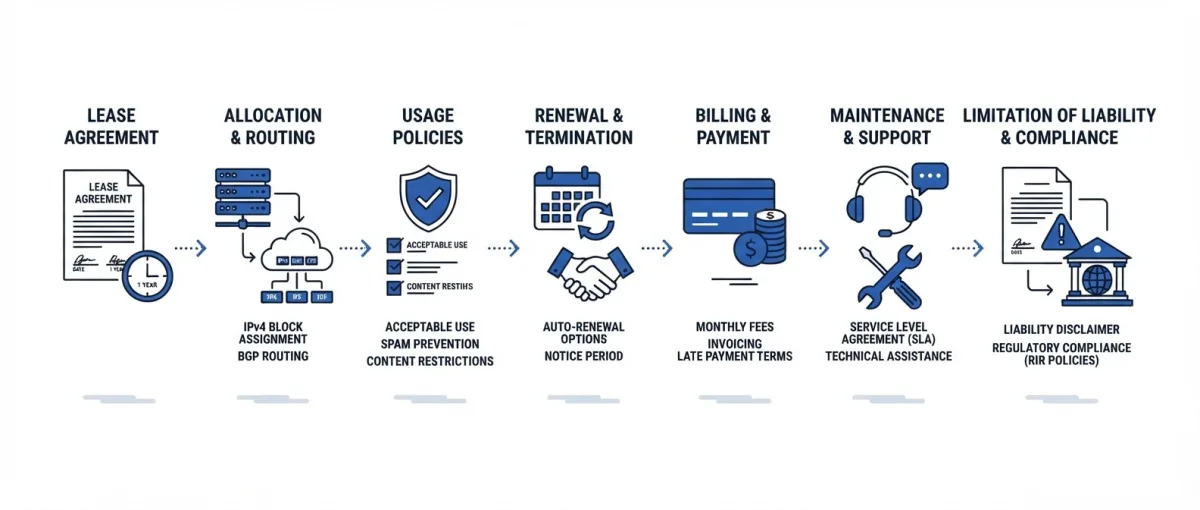
An IPv4 rental contract defines more than the price of address space. It sets the usage period, permitted scenarios, routing rules, payment conditions, and consequences of violations. Technical teams should therefore review the agreement together with the network design and operational risks.
IPv4 rental contract terms are the commercial, technical, and operational rules that define the customer’s right to use an address block, the duration of the lease agreement, renewal and payment procedures, termination conditions, usage restrictions, routing obligations, liability boundaries, and the process for returning or reassigning the resource.
Table of Contents
- What Should Be Defined Before an IPv4 Block Is Activated?
- How Should Customers Read Duration and Renewal Terms?
- Which Termination Terms Need Special Attention?
- Which Payment Terms Can Affect Access to IPv4?
- What Should Abuse Clauses Regulate?
- Which Routing Obligations Should Be Checked in Advance?
- How Should Liability Be Divided Between the Parties?
- How Should the Contract Address Reassignment and Usage Restrictions?
- What Additional Questions Should Customers Ask Before Signing?
- How Should a Customer Evaluate an IPv4 Rental Contract?
What Should Be Defined Before an IPv4 Block Is Activated?
Commercial terms should match the technical setup before the block goes into use. The customer needs to understand exactly which resource is provided, when the right to use it begins, and which operational conditions apply from the first day.
The agreement should normally specify:
- the exact prefix and block size;
- the start date of the lease agreement;
- the permitted use case;
- the origin ASN and announcement method;
- DNS and PTR responsibilities;
- the abuse contact process;
- the return procedure.
Clear terms at this stage reduce the risk of disputes after the range is already connected to production systems, customers, or external integrations.
How Should Customers Read Duration and Renewal Terms?
Duration should explain more than the end date. The customer should understand whether the lease is fixed-term, monthly, or automatically renewed, and how much notice is required before the next contractual period begins.
Important points include:
- the minimum billable period;
- the billing start date;
- the renewal window;
- the notice period;
- whether the rate can change.
If the project depends on stable IP addresses, the contract should leave enough time to decide whether to renew or migrate to another range without creating an urgent network change.
Which Termination Terms Need Special Attention?
Termination clauses should define specific grounds and consequences. A general phrase such as “violation of rules” is not enough if the agreement does not explain what counts as a violation or when immediate action is permitted.
Customers should check:
- whether either party can terminate without breach;
- the required notice period;
- when immediate suspension is allowed;
- what happens to prepaid amounts;
- when the right to use the prefix ends.
This section should regulate the contractual end of the agreement, while the technical removal of routes, DNS records, and other dependencies should be handled through a separate operational process.
Which Payment Terms Can Affect Access to IPv4?
The payment section should clearly show when non-payment starts to affect the customer’s right to use the resource. This matters because a billing issue can become a network issue if the contract allows suspension or termination after a defined delay.
The customer should review:
- billing frequency;
- currency and applicable taxes;
- payment deadline;
- grace period;
- consequences of late payment;
- deposits and additional fees.
The technical team should know these conditions in advance so that production services do not depend on a payment rule that has not been included in operational planning.
What Should Abuse Clauses Regulate?
Abuse clauses should define both prohibited activities and the response process. For the customer, response deadlines, evidence requirements, and escalation rules are as important as the list of restricted behavior.
The contract may restrict:
- spam and phishing;
- malware and botnet traffic;
- unauthorized scanning;
- attempts to bypass technical restrictions;
- activity that creates persistent blacklist signals.
The agreement should also explain who reviews complaints, how quickly the customer must respond, and under what conditions the range can be suspended or the lease terminated.
Which Routing Obligations Should Be Checked in Advance?
Routing obligations define how and through which network the customer may use the prefix. A rented block should not be assumed to be announceable through any ASN without approval from the resource holder.
The agreement should clarify:
- the permitted origin ASN;
- who provides the LOA;
- who creates the IRR route object;
- who manages the RPKI ROA;
- whether an ASN change is allowed;
- who is responsible for an incorrect BGP announcement.
Leasing IPv4 addresses should begin only after the contractual rights and the actual routing model are aligned, because unclear authorization can delay deployment or create route filtering.
How Should Liability Be Divided Between the Parties?
The liability section should separate risks controlled by the resource holder from risks created by the customer’s activity. It should also explain whether financial exposure is limited and which operational events remain outside the provider’s responsibility.
The agreement should define:
- who is responsible for registry records;
- who resolves routing conflicts;
- who works with reputation databases;
- who is responsible for end-user behavior;
- which losses are excluded;
- whether liability is capped.
This allows both parties to understand in advance who must act when a routing, reputation, compliance, or customer-use incident occurs.
How Should the Contract Address Reassignment and Usage Restrictions?
Reassignment and usage restrictions are especially important for hosting, SaaS, VPN, and managed services. They determine whether the customer may allocate addresses to end users, divide the range into internal pools, or use it outside the original scenario.
The customer should check:
- whether IPs may be assigned to end users;
- whether sublicensing is allowed;
- whether the range may be divided into internal pools;
- whether cloud and BYOIP use cases are permitted;
- which services are prohibited.
After the agreement ends, the block may be prepared for reassignment once previous routes, DNS dependencies, and customer references have been removed from the former tenant’s environment.
What Additional Questions Should Customers Ask Before Signing?
How Should a Customer Evaluate an IPv4 Rental Contract?
A customer should review the contract as a combination of commercial and network obligations: duration, renewal, payment, termination, abuse procedures, routing obligations, usage restrictions, liability, and reassignment. If a company needs to select an address resource and define a lease model for a specific infrastructure setup, it can contact InterLIR Global to structure IPv4 usage around the technical and operational requirements of the project.