Lease out or keep idle IPv4 space: questions for asset owners
 Cian Doherty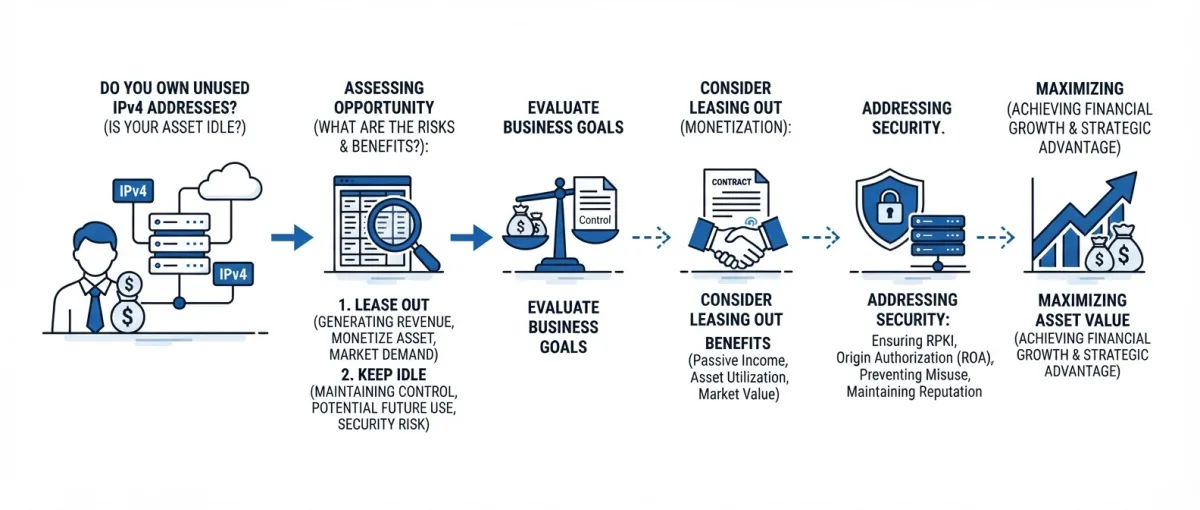
Idle IPv4 space creates a strategic choice for address owners. Keeping a block unused preserves flexibility for future network needs, while leasing can generate recurring income. The right decision depends on internal demand, market conditions, operational readiness, tenant risk, and the long-term role of the asset.
IPv4 leasing vs holding is a decision framework for choosing whether to lease an idle address block or retain it unused. The analysis compares strategy, asset value, tradeoffs, risk assessment, readiness, and retention criteria so the owner can decide whether monetization supports or conflicts with future infrastructure plans.
Table of Contents
- When does it make sense to keep IPv4 idle?
- When does leasing become the stronger option?
- What tradeoffs should asset owners compare?
- How should risk assessment influence the decision?
- What does readiness for leasing look like?
- Which retention criteria should justify holding the block?
- How should strategy change when market demand shifts?
- What additional questions should asset owners ask?
- How should an IPv4 owner choose between leasing and holding?
When does it make sense to keep IPv4 idle?
Holding can be appropriate when the block may be needed for internal growth, disaster recovery, future customer allocation, or a planned infrastructure project. In these cases, immediate lease income may be less valuable than keeping the resource available.
The owner should also consider how difficult replacement capacity would be to obtain later. If reacquiring a similar prefix would be expensive, slow, or operationally disruptive, retention may have strategic value even when the block is not currently in use.
When does leasing become the stronger option?
Leasing becomes more attractive when internal demand is low and the block can generate income without limiting future plans. The decision is stronger when the asset has clean routing history, acceptable reputation, accurate registry records, and a clear tenant market.
A lease can also make sense when the owner wants to retain long-term control instead of selling. Leasing IPv4 addresses can turn unused capacity into recurring revenue while preserving ownership, provided the contract leaves enough flexibility for future reuse.
What tradeoffs should asset owners compare?
The main tradeoff is between flexibility and income. Holding keeps the block immediately available but produces no lease revenue. Leasing creates cash flow but introduces contractual commitments, tenant management, and possible remediation work after the term ends.
The comparison should include:
- expected lease income;
- future internal demand;
- minimum contract duration;
- vacancy and re-leasing risk;
- administrative and monitoring costs;
- possible impact on reputation.
The objective is not to maximize short-term yield. The owner should choose the option that creates the best balance between asset utility, income, and future control.
How should risk assessment influence the decision?
Risk assessment should cover both leasing risk and holding risk. Leasing can expose the block to abuse, blacklist events, routing problems, or tenant disputes. Holding avoids tenant-related exposure but may leave a valuable asset unused while market conditions change.
The owner should compare the likelihood and impact of each risk rather than assuming that one strategy is automatically safer. A clean, well-controlled lease may create acceptable risk, while holding may still carry opportunity cost and future market uncertainty.
What does readiness for leasing look like?
Readiness means the block can be offered without creating unresolved technical or administrative issues. The owner should know exactly which prefix is available, who controls the registry records, and whether the range is free from internal dependencies.
A lease-ready asset should have:
- clear ownership and registry status;
- current routing and RPKI information;
- verified reputation and blacklist condition;
- defined acceptable-use rules;
- an abuse response process;
- a documented return procedure.
If these elements are missing, the owner may need to prepare the block before entering the market.
Which retention criteria should justify holding the block?
Retention criteria should be explicit rather than based on a general preference to keep addresses “just in case.” The owner should define the situations in which future internal value exceeds expected lease income.
Valid criteria may include planned network expansion, regulatory or contractual requirements, disaster recovery reserves, customer growth, or a known need for address continuity. If none of these conditions are realistic within the planning horizon, continued idle status may be harder to justify.
How should strategy change when market demand shifts?
Market conditions can change the value of both options. Strong tenant demand may improve lease economics, while weak demand can increase vacancy or reduce achievable rates. At the same time, rising internal demand may make retention more important.
The strategy should therefore be reviewed when lease pricing, tenant demand, infrastructure plans, or replacement costs change materially. A block that should be held today may become suitable for monetization later, and the reverse can also be true.
What additional questions should asset owners ask?
How should an IPv4 owner choose between leasing and holding?
The decision should connect asset strategy with internal demand, lease economics, risk assessment, readiness, and retention criteria. If an organization needs to evaluate whether idle IPv4 should remain reserved or be monetized, it can contact InterLIR Global to structure a decision around the future role and current market value of the address space.