Managed BYOIP vs Self-Managed BYOIP: Cost, Responsibility and Support Comparison

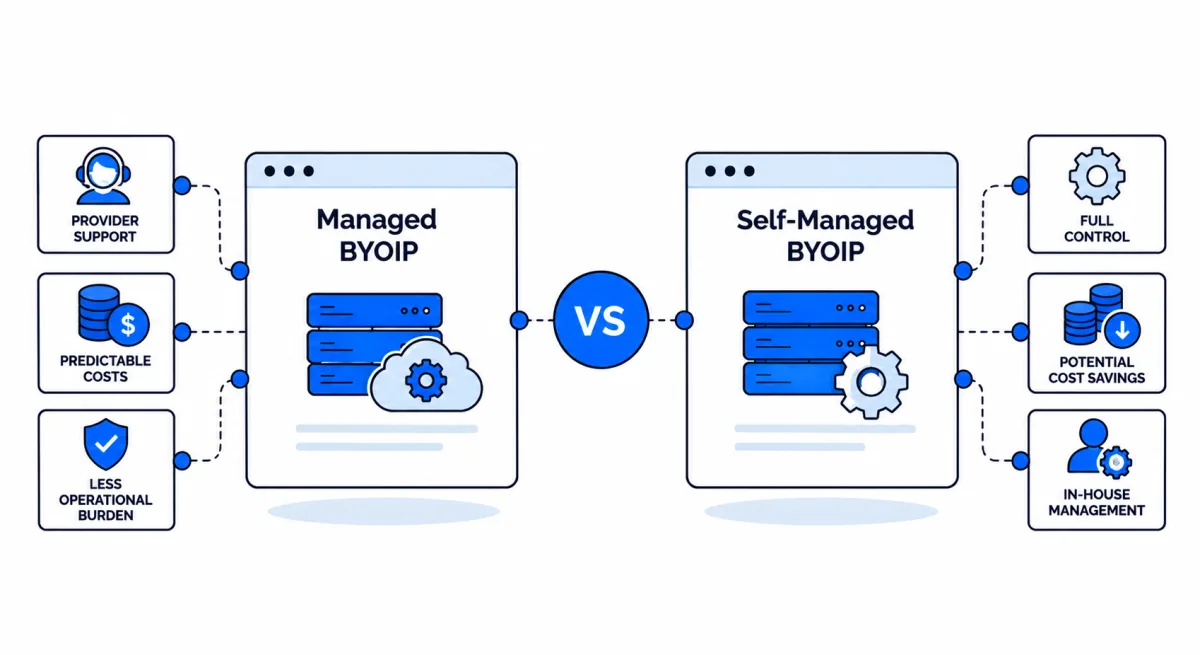
Bringing owned IPv4 space to a cloud platform requires more than creating a prefix resource. Teams may need to prepare RIR records, configure RPKI/ROA, prove control of the range, plan routing changes and monitor the prefix after activation. The main decision is whether internal staff will own these steps or a managed provider will coordinate them.
Managed vs self-managed BYOIP compares two operating models for moving existing address space to cloud infrastructure. Self-management keeps technical work and responsibility inside the company. A managed model transfers part of the preparation, coordination and support workload to a specialist while the address holder retains ownership of the prefix.
Table of Contents
- What is the difference between managed and self-managed BYOIP?
- What work does self-managed BYOIP require?
- What does a managed BYOIP service change?
- How do managed and self-managed BYOIP costs differ?
- How much workload can BYOIP create?
- How does support differ between the two models?
- When is self-management the better fit?
- When does managed BYOIP reduce operational risk?
- Frequently Asked Questions
- Plan the BYOIP operating model
What is the difference between managed and self-managed BYOIP?
The technical objective is the same, but responsibility is distributed differently.
| Area | Managed BYOIP | Self-managed BYOIP |
|---|---|---|
| RIR preparation | Coordinated with support | Internal team handles it |
| RPKI/ROA | Assisted or managed | Internal responsibility |
| Cloud onboarding | Guided | Performed internally |
| Troubleshooting | Provider support | Internal engineering |
| Internal workload | Lower | Higher |
| Direct control | Shared workflow | Maximum internal control |
This BYOIP management workload comparison matters because cloud providers still impose their own technical requirements regardless of who manages the process.
What work does self-managed BYOIP require?
With self-management, the company handles the full onboarding process and ongoing maintenance. The exact steps depend on the cloud platform.
Some cloud BYOIP workflows require proof of control, an X.509 certificate in the relevant RIR record and a ROA authorizing the platform’s ASNs. A /24 is a common minimum IPv4 prefix, and a newly created ROA can take up to 24 hours to become available to the platform.
Typical self-managed BYOIP responsibilities include:
- verifying ownership and RIR records;
- creating and maintaining ROAs;
- preparing authorization data;
- provisioning the prefix in the cloud account;
- planning BGP advertisement changes;
- monitoring routing and reputation;
- updating documentation when the design changes.
These tasks require staff who understand RPKI, BGP, RIR processes and cloud networking.
What does a managed BYOIP service change?
A managed model does not remove cloud requirements. It changes who coordinates and executes the work.
Managed BYOIP responsibilities can include checking whether the prefix qualifies, preparing RIR changes, validating ROAs, coordinating cloud onboarding and supporting routing changes.
A managed approach is useful when:
- internal network engineers are limited;
- BYOIP is a one-time project rather than a routine task;
- several prefixes or cloud platforms are involved;
- downtime or routing errors would create high business impact;
- the team wants external support during cutover.
Companies that need help with onboarding can use a BYOIP service instead of building the complete process internally.
How do managed and self-managed BYOIP costs differ?
A managed BYOIP cost comparison should include more than the provider fee. Self-management uses internal engineering time, while managed service converts part of that workload into an external service cost.
Assume a BYOIP project requires 20 engineering hours. At an internal loaded rate of $90 per hour, labor costs $1,800. If troubleshooting adds another 10 hours, the internal cost rises to $2,700.
The example does not define a standard BYOIP project cost. It shows why self-managed BYOIP costs should include labor as well as cloud fees.
Some cloud platforms do not charge separately to provision or use imported custom IP prefixes, although normal traffic charges can still apply.
How much workload can BYOIP create?
The workload depends on prefix count and cloud architecture. Onboarding multiple non-contiguous ranges can require repeating the process for each range, although some preparation steps may not need to be repeated when one contiguous block is split across several regions.
This means four unrelated prefixes can require more work than one contiguous resource.
A realistic workload estimate should include:
- RIR and RPKI preparation;
- cloud configuration;
- routing validation;
- migration testing;
- cutover monitoring;
- rollback planning;
- documentation.
This is where managed BYOIP service trade-offs become measurable rather than theoretical.
How does support differ between the two models?
A managed BYOIP support comparison focuses on who investigates problems when onboarding does not proceed as expected.
With self-management, internal teams must determine whether the issue is related to the RIR, ROA, cloud configuration or routing. With managed service, a specialist can help isolate the problem and coordinate the relevant steps.
A cloud BYOIP process may include validation, provisioning and commissioning. Unified custom IPv4 prefixes are commonly accepted within defined prefix ranges, while regional child prefixes may be smaller depending on configuration.
Platform-specific rules are one reason multi-cloud BYOIP can require significant specialist time.
When is self-management the better fit?
self-managed BYOIP trade-offs favor organizations that already operate RPKI, BGP and cloud networking internally.
Self-management can be practical when:
- the network team already maintains ROAs;
- BYOIP is used frequently;
- internal change processes are mature;
- direct operational control is important;
- the organization can troubleshoot routing problems without external assistance.
In this case, an additional managed fee may not create enough value.
When does managed BYOIP reduce operational risk?
A managed model can make more sense when staff time, migration risk and coordination effort exceed the service cost.
Overlapping BYOIP route announcements can cause unexpected routing and packet loss. Correct sequencing therefore matters during migration.
The practical managed BYOIP service trade-offs are additional service cost versus lower internal workload, access to specialist support and reduced risk of configuration mistakes.
Frequently Asked Questions
Plan the BYOIP operating model
For a BYOIP project, send the target platform, prefix and current routing status to InterLIR Global. The required RIR, ROA, LOA and onboarding work can then be mapped before deciding whether to manage the process internally or use external support.