Monthly vs Annual IPv4 Leasing: Cost, Commitment and Flexibility for Buyers

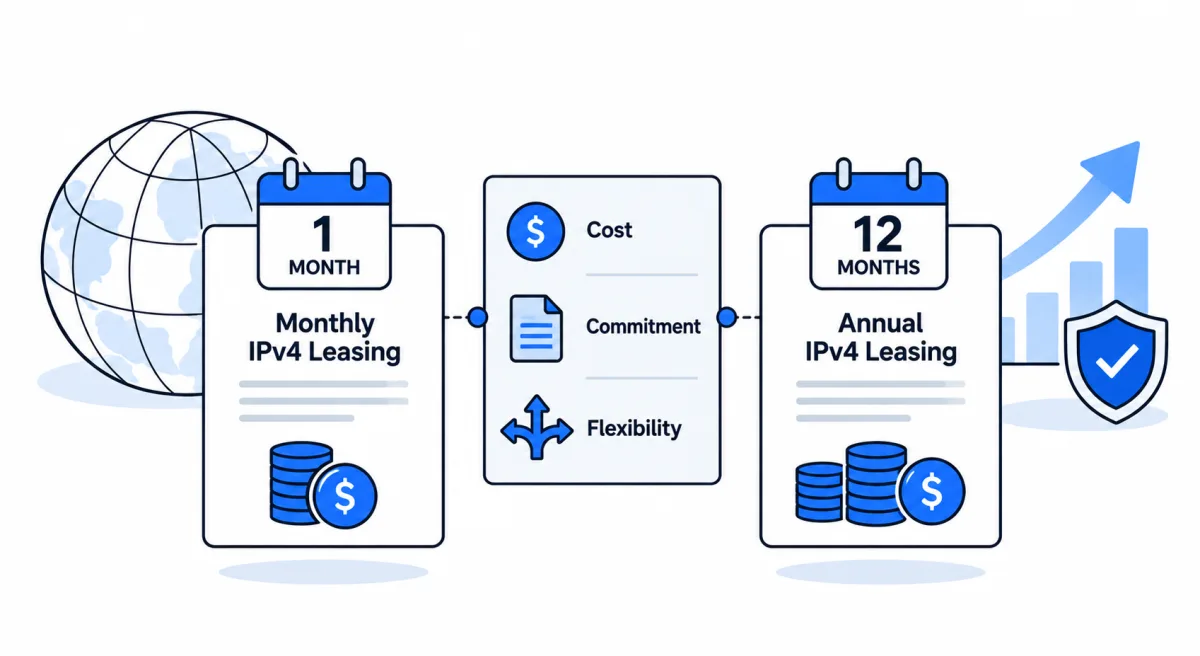
Choosing between monthly and annual IPv4 leasing affects more than the invoice schedule. Buyers should compare total contract cost, minimum commitment, cancellation terms, utilization and the risk that requirements change before the lease ends.
Monthly vs annual IPv4 lease comparison means weighing short-term flexibility against longer-term cost predictability. Monthly terms reduce commitment when demand is uncertain. Annual terms can simplify budgeting and may lower the effective rate when the same address capacity is needed throughout the year.
Table of Contents
- How do monthly and annual IPv4 leases differ?
- What does a monthly vs annual cost comparison show?
- When does monthly lease flexibility matter?
- When can an annual lease reduce cost?
- How should buyers compare lease term costs?
- Which option should a buyer choose?
- Frequently Asked Questions
- Choose a lease term around real usage
How do monthly and annual IPv4 leases differ?
The main difference is the period for which the buyer commits to the address space.
| Factor | Monthly lease | Annual lease |
|---|---|---|
| Commitment | Shorter | Usually 12 months |
| Budgeting | Cost can change more often | More predictable during the term |
| Flexibility | Higher | Lower if demand changes |
| Payment | Often smaller installments | May require prepayment |
| Best fit | Temporary demand | Stable demand |
Public offers show both structures. Some providers offer prepaid monthly leases with no minimum term, while others publish annual-contract pricing or require multi-year commitments for lower rates. Monthly and annual lease terms are therefore provider-specific rather than standardized.
What does a monthly vs annual cost comparison show?
A useful monthly vs annual cost comparison uses the same block size, service scope and expected utilization.
Assume a /24 costs $128 per month:
$128 × 12 = $1,536 per year.
If an annual agreement for the same /24 costs $1,380, its effective monthly cost is $115. The annual option saves $156 over 12 months, or about 10.2%. This is an example, not a market standard. Buyers should calculate savings from actual quotes because there is no universal annual discount.
Also include setup fees, routing support, RPKI/ROA work, reverse DNS, geolocation and management charges.
When does monthly lease flexibility matter?
Monthly lease flexibility is useful when address demand may change. It can fit temporary services, regional tests, migrations and projects with uncertain capacity.
Monthly terms are practical when:
- the deployment is temporary;
- capacity may rise or fall;
- IP reputation or routing must be tested;
- the migration end date is uncertain.
However, monthly lease commitment does not always mean instant cancellation. Some providers use minimum terms or prepaid billing. Some current marketplace terms use a three-month minimum, although monthly commitments may also be available.
Teams that need temporary capacity can lease IPv4 addresses instead of buying a block for a short project.
When can an annual lease reduce cost?
An annual lease commitment fits stable requirements when the same addresses will be used for most of the year. Potential annual lease savings can come from a lower effective rate and fewer renewals.
Before accepting an annual quote, check:
- whether payment is monthly or prepaid;
- whether the rate is fixed for the full term;
- early-return or termination rules;
- whether unused capacity can be reduced;
- renewal and repricing conditions.
Lower cost does not always mean greater annual lease flexibility. A buyer may save on the unit rate but lose the ability to reduce capacity during the term.
How should buyers compare lease term costs?
A practical lease term cost comparison should measure the cost of addresses that will actually be used:
Effective cost per used IP = total lease cost ÷ active addresses ÷ months.
Suppose a /22 with 1,024 addresses costs $4,200 per year. At full utilization, the monthly rate is about $0.342 per IP. If only 700 addresses are active, the effective rate becomes $0.50 per used IP.
A longer contract can therefore cost more in practice when capacity forecasts are inaccurate.
Which option should a buyer choose?
Monthly leasing is more suitable when demand or deployment duration is uncertain. Annual leasing is easier to justify when usage is stable and the buyer expects to keep the same capacity.
Compare:
- total contract value;
- effective rate per used IP;
- minimum commitment;
- notice and termination rules;
- renewal and repricing terms;
- included routing and registry support.
For persistent demand, buyers can also compare leasing with buying IPv4 addresses and calculate whether continued rental still fits the infrastructure plan.
Frequently Asked Questions
Choose a lease term around real usage
Before choosing a monthly or annual term, share the expected usage period and capacity profile with InterLIR Global. This makes it easier to compare commitment, renewal conditions and effective cost against the way the addresses will actually be used.