One Large IPv4 Block vs Multiple Smaller Blocks: Cost and Transfer Trade-Offs for Buyers

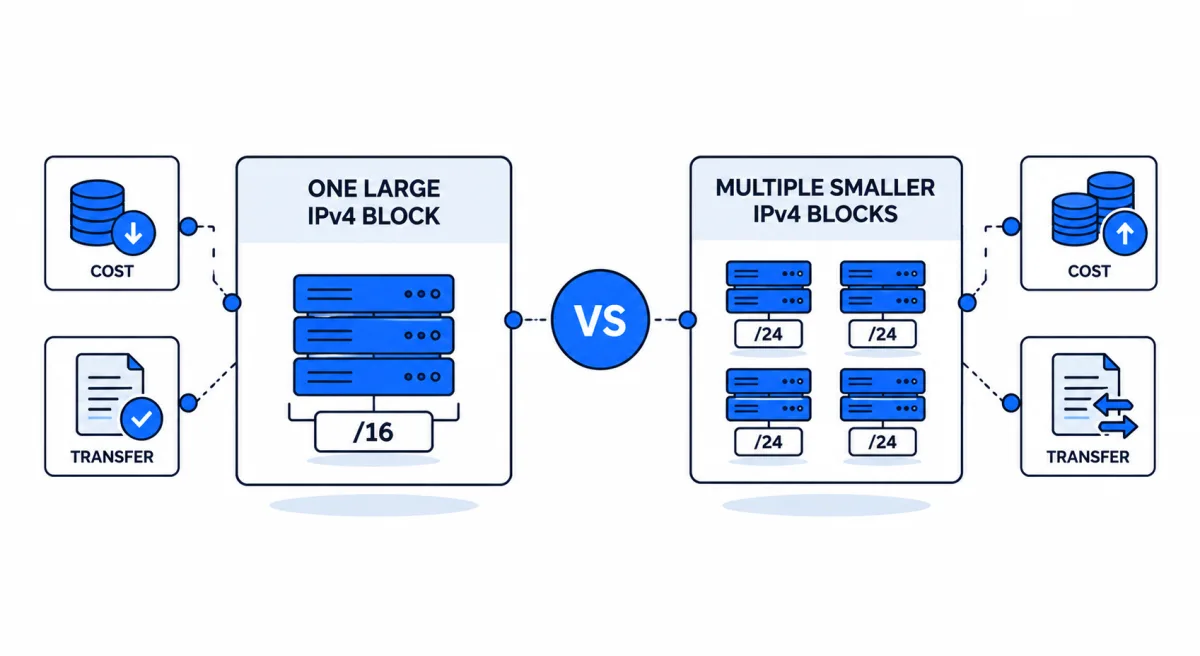
Buying one large IPv4 block and buying several smaller prefixes can deliver the same address count, but the operational result is different. Buyers should compare transfer overhead, routing complexity, fragmentation, deployment flexibility and the cost of managing each resource separately.
Large vs small IPv4 blocks comparison means deciding whether the required address capacity should be acquired as one contiguous prefix or as several independent blocks. A larger block can simplify routing and administration, while smaller blocks can make phased deployment, regional allocation and future resale more flexible.
Table of Contents
- How does one large IPv4 block compare with several smaller blocks?
- When does one large IPv4 block reduce operational complexity?
- When are multiple small IPv4 blocks more practical?
- How do transfer costs differ between large and small blocks?
- How does fragmentation affect routing?
- What are the trade-offs of block consolidation?
- How should buyers compare purchase structures?
- Frequently Asked Questions
- Compare block size before acquisition
How does one large IPv4 block compare with several smaller blocks?
The address count can be identical even when the block structure differs. For example, one /20 contains 4,096 IPv4 addresses. The same total can be assembled from four /22s, sixteen /24s or another combination.
| Structure | Total addresses | Number of prefixes | Main advantage | Main trade-off |
|---|---|---|---|---|
| One /20 | 4,096 | 1 | Simpler routing and management | Less granular allocation |
| Four /22s | 4,096 | 4 | More deployment flexibility | More objects to manage |
| Sixteen /24s | 4,096 | 16 | High allocation granularity | Greater routing and transfer overhead |
This block size cost comparison should therefore include more than the purchase price per address.
When does one large IPv4 block reduce operational complexity?
One large IPv4 block can be easier to manage because the buyer works with fewer registry objects, routing announcements and internal allocation records.
A single larger prefix can reduce:
- the number of transfer records;
- route-object and RPKI/ROA administration;
- reverse DNS delegation work;
- internal IPAM entries;
- documentation and compliance checks.
For example, one /20 requires management of one primary prefix, while sixteen /24s create sixteen separate resources. The number of addresses is the same, but the administrative workload is not.
When are multiple small IPv4 blocks more practical?
Multiple small IPv4 blocks can make sense when capacity must be divided among regions, data centers, customers or business units.
The structure is useful when:
- addresses will be deployed in several independent networks;
- the buyer expects phased migration;
- different prefixes need different geolocation;
- part of the portfolio may later be sold;
- operational separation is more important than aggregation.
This is the main benefit in the buyer’s block-size choice. The buyer gains flexibility, but accepts more fragmented management.
How do transfer costs differ between large and small blocks?
A block transfer comparison should examine how the relevant RIR calculates transfer fees. The result can differ by registry.
Recipient transfer processing fees can vary by aggregate block size. For example, a /24 may carry a $187.50 recipient fee, while aggregate transfers larger than /24 through /22 may carry a $375 fee.
That means sixteen completely separate /24 transfer requests could create more processing overhead than one larger transaction, although the final amount depends on how the transfer is structured and which RIR is involved.
In the RIPE NCC service region, resource transfers are processed without a separate transfer charge, but IPv4 resources are generally subject to a 24-month transfer restriction after receipt.
Therefore, multiple block transfer costs and large block transfer costs cannot be compared with one universal fee. The buyer must check the applicable registry, transaction structure and current policy.
How does fragmentation affect routing?
Block fragmentation tradeoffs become important when many small prefixes must be announced independently. More prefixes can mean more BGP announcements, more route-policy entries and more operational checks.
For example:
- one /20 can potentially be announced as one aggregate;
- four /22s may require four announcements;
- sixteen /24s may require sixteen separate announcements.
Smaller prefixes can also face routing limitations. In the ARIN region, the minimum IPv4 transfer size is /24. In practical global routing, /24 is also commonly treated as the smallest generally accepted IPv4 prefix because many networks filter more-specific routes.
A buyer planning public BGP announcements should therefore examine routability before purchasing highly fragmented space.
What are the trade-offs of block consolidation?
Block consolidation tradeoffs involve balancing operational simplicity against flexibility. Consolidation can simplify IPAM, routing and registry administration, but it can also make later restructuring harder.
One large block may be preferable when:
- the addresses support one network or service;
- the buyer wants fewer BGP announcements;
- management overhead should be minimized;
- long-term utilization is predictable.
Several smaller blocks may be preferable when the network architecture is distributed or the buyer wants the option to separate assets later.
How should buyers compare purchase structures?
A useful comparison should calculate both acquisition and operating costs.
Check:
- purchase price per IPv4 address;
- number of transfer transactions;
- RIR processing fees;
- routing and RPKI administration;
- IPAM and reverse DNS workload;
- reputation of each individual block;
- future transfer restrictions;
- expected utilization by location.
Buyers can buy IPv4 addresses as a single larger prefix or evaluate several available blocks, depending on the required network structure.
Frequently Asked Questions
Compare block size before acquisition
If the choice is between one larger prefix and several smaller blocks, provide the routing model and target RIR to InterLIR Global. Available options can then be compared by transfer conditions, operational complexity and future flexibility.