Partial IPv4 Portfolio Sale: How to Decide Which Address Blocks to Sell First

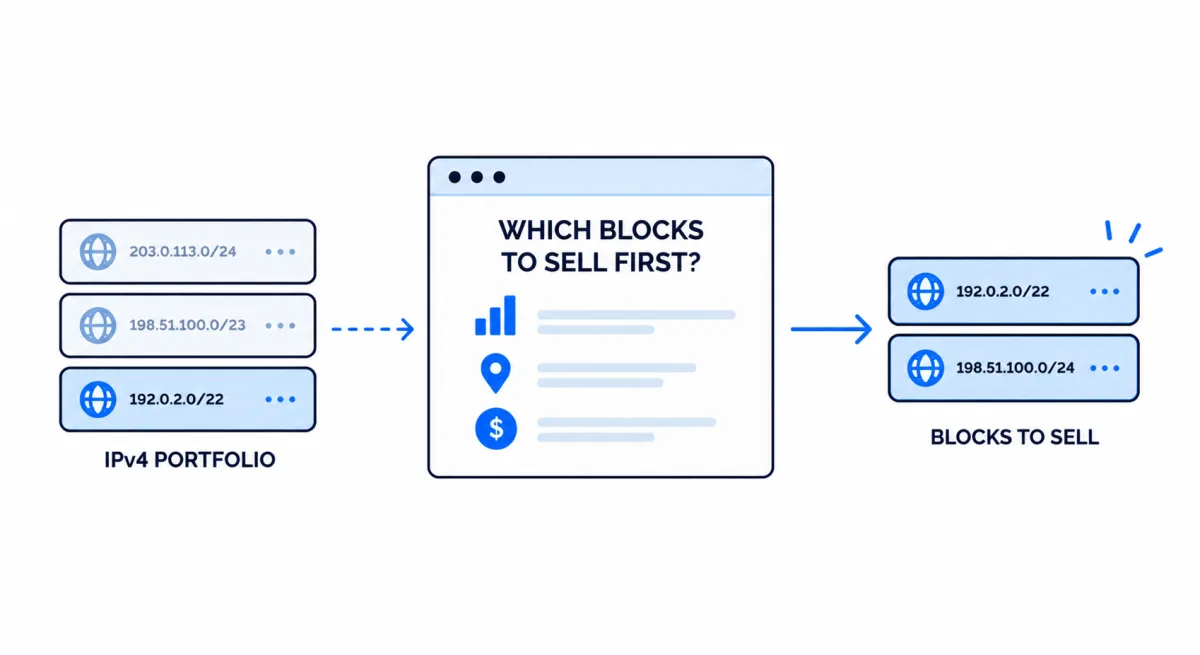
Selling part of an IPv4 portfolio is not only a liquidity decision. The owner must identify which blocks are nonstrategic, transferable and unlikely to be needed later. Selling the wrong prefix can create future renumbering costs, fragment the remaining inventory or remove valuable operational address space.
Partial IPv4 portfolio sale is the process of divesting selected address blocks while retaining the rest for operations or growth. A sound strategy ranks blocks by business importance, transfer eligibility, utilization, reputation, prefix size and liquidity before deciding which resources should leave the portfolio first.
Table of Contents
- Which IPv4 blocks should be reviewed first?
- How should owners define blocks to sell first?
- Why does transfer eligibility matter?
- How does liquidity affect sale priority?
- How should strategic and nonstrategic blocks be separated?
- How does sale sequencing reduce risk?
- What costs should be included in a partial sale?
- How should owners make the final sale decision?
- Frequently Asked Questions
- Prepare a partial portfolio sale
Which IPv4 blocks should be reviewed first?
The first candidates are usually resources that are unused and operationally independent.
| Criterion | Strong sale candidate | Strong retention candidate |
|---|---|---|
| Utilization | Idle | Actively used |
| Strategic role | Noncritical | Core resource |
| Transfer status | Eligible | Restricted |
| Prefix structure | Independent | Needed for aggregation |
| Future demand | Low | Expected growth |
This portfolio sale prioritization helps prevent a short-term cash decision from creating long-term infrastructure cost.
How should owners define blocks to sell first?
Blocks to sell first should be chosen through technical and financial screening rather than by size alone.
Review:
- current and forecast utilization;
- dependency on internal systems;
- route aggregation value;
- geolocation and reputation;
- RIR transfer restrictions;
- expected buyer demand;
- replacement difficulty.
An idle block that is important to routing may be less suitable for sale than an independent prefix with no operational dependencies.
Why does transfer eligibility matter?
A portfolio block selection process must exclude resources that cannot yet be transferred.
In the ARIN region, the minimum IPv4 transfer size is /24, and source organizations must meet applicable transfer conditions.
RIPE NCC applies a 24-month transfer restriction to IPv4 resources after receipt. Transfers in its service region are processed without a separate transfer fee.
These rules can change sale order. A marketable block may still need to remain in the portfolio until it becomes eligible.
How does liquidity affect sale priority?
Portfolio sale liquidity means how easily a block can be matched with a qualified buyer at acceptable terms.
Liquidity depends on:
- prefix size;
- RIR region;
- transfer readiness;
- routing history;
- reputation;
- geolocation;
- documentation quality.
A /24 contains 256 addresses, a /22 contains 1,024 and a /20 contains 4,096. Smaller blocks may fit buyers with limited needs, while larger blocks can suit broader deployments.
How should strategic and nonstrategic blocks be separated?
A sale of non-strategic portfolio blocks should focus on resources that do not support critical services and are not required for expected growth.
A simple classification is:
- Core blocks — retain for active infrastructure.
- Reserve blocks — hold for growth or contingency.
- Non-strategic blocks — candidates for sale or lease.
This supports a clearer block retention sale decision and prevents divestment of resources that would be expensive to replace.
How does sale sequencing reduce risk?
Block sale sequencing matters when several prefixes may be divested over time.
A staged approach can be:
- Sell clearly nonstrategic and transfer-ready blocks.
- Reassess capacity after the first transaction.
- Review reserve blocks against updated forecasts.
- Retain strategically important resources until there is a clear reason to sell.
For example, selling one unused /22 removes 1,024 addresses. If the owner has 10,240 unused addresses, that transaction reduces reserve capacity by 10%.
What costs should be included in a partial sale?
A portfolio divestment strategy should calculate net proceeds, not only headline value.
Potential costs include:
- broker or marketplace fees;
- RIR processing fees;
- legal and escrow support;
- technical cleanup;
- internal engineering time;
- tax consequences.
ARIN uses tiered recipient transfer processing fees: $187.50 for a /24 and $375 for aggregate transfers larger than /24 through /22.
Registry fee structures differ, so these amounts should not be treated as universal.
How should owners make the final sale decision?
A practical sale priority criteria model should combine operational value, transfer readiness and marketability.
Before selling, confirm:
- the block is not needed for current services;
- future capacity remains sufficient;
- transfer restrictions are satisfied;
- documentation is complete;
- reputation and routing history are acceptable;
- expected proceeds justify the loss of flexibility.
Owners can sell IPv4 addresses when selected resources no longer support strategic or operational requirements.
Frequently Asked Questions
Prepare a partial portfolio sale
For a partial portfolio sale, identify which prefixes are operationally expendable and send that inventory to InterLIR Global. Transfer readiness and buyer demand can then be reviewed without putting address space needed for future growth into the sale process.