Public cloud IP pricing: why BYOIP is becoming a strategic option
 Bram de Vries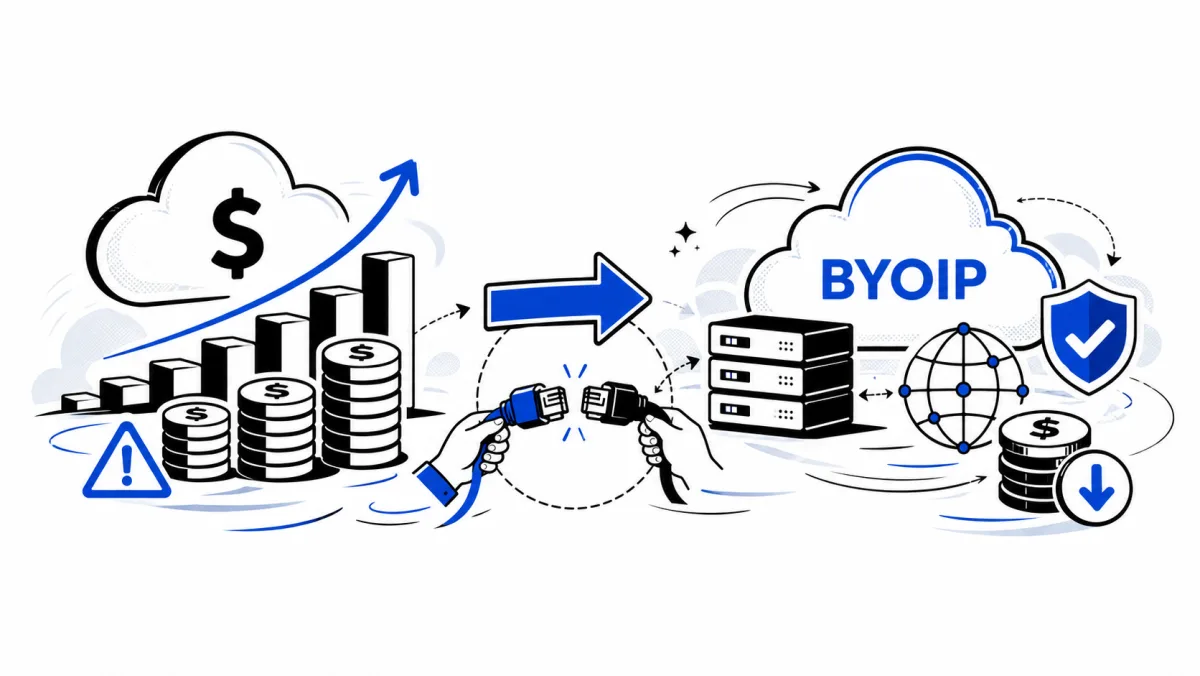
Public IPv4 use in cloud platforms is now a budget item that network and finance teams must track. Charges differ by provider, region, address type, and BYOIP support. Companies should compare rented cloud IPs, owned ranges, and leased ranges before they scale public endpoints.
Public cloud IP pricing is the cost model that cloud providers apply to public IPv4 addresses used by virtual machines, load balancers, NAT gateways, VPNs, and other internet-facing resources. It helps teams measure address-related cloud spend and decide whether a BYOIP strategy can reduce provider dependency and improve long-term IP control.
Table of Contents
- Why is public cloud IP pricing changing infrastructure planning?
- How do cloud provider fees affect IPv4 decisions?
- Why is BYOIP strategy becoming more relevant?
- What are the main IP ownership benefits?
- What risks should be checked before using BYOIP?
- When should leasing be compared with buying?
- What should teams clarify before choosing BYOIP?
- How should a company move forward?
Why is public cloud IP pricing changing infrastructure planning?
Public cloud IP pricing matters because public IPv4 is no longer treated as a minor network setting. A small number of addresses may not change a budget. Hundreds or thousands of public endpoints can create a recurring cost that grows with every region, service, and environment.
The impact is visible when a company runs:
- customer-facing SaaS, hosting, VPN, or security services;
- many NAT gateways, load balancers, or static outbound addresses;
- separate IP pools for production, staging, and disaster recovery;
- regional deployments that need fixed public source addresses.
Cloud teams should count active addresses, idle reservations, attached resources, and expected growth. Without this inventory, IP cost can hide inside the wider networking bill.
How do cloud provider fees affect IPv4 decisions?
Cloud provider fees affect whether a company keeps using provider-assigned addresses or brings its own space. Fees can apply per address, per hour, per prefix, or through related networking services. BYOIP may remove some address charges, but it does not remove egress, load balancing, NAT, or support costs.
A useful review should include:
- Number of public IPv4 addresses in each account and region.
- Address type: static, dynamic, prefix, reserved, or BYOIP-derived.
- Monthly cost per IP and expected growth.
- Services that require fixed public source addresses.
- Cost of migration, provisioning, ROA/RPKI work, and operations.
The goal is to choose an IP model that fits cost, architecture, compliance, and continuity.
Why is BYOIP strategy becoming more relevant?
A BYOIP strategy lets a company bring its own address space to a supported cloud provider and use it with cloud resources. This can reduce exposure to provider-assigned IP pricing and preserve the same public addresses across migration or hybrid architecture.
BYOIP is relevant when:
- applications depend on stable allowlists;
- customers or partners recognize existing source IPs;
- the company wants portability between cloud and non-cloud networks;
- reputation, geolocation, and abuse history must be controlled.
If a company needs a range that it can control for years, it can review buy IPv4 addresses before BYOIP planning. If ownership is not required, a leased range may be evaluated when the provider and validation path allow it.
What are the main IP ownership benefits?
IP ownership benefits are not limited to cost. Ownership can give the company direct control over registry records, RPKI/ROA authorization, routing history, address reputation, and transfer decisions. It can also reduce renumbering risk when workloads move between environments.
Ownership can support:
- long-term public endpoint stability;
- cleaner control over WHOIS, abuse contacts, and RPKI;
- hybrid cloud and disaster recovery planning;
- fewer dependencies on provider-assigned address pools;
- possible resale, leasing, or portfolio use later.
Ownership also creates responsibility. The team must manage registry compliance, reputation, routing records, and security exposure.
What risks should be checked before using BYOIP?
BYOIP is not just a cost tool. It requires validation, routing authorization, and operational planning. A range may need ROA creation, route-object review, DNS changes, and cloud-side provisioning before it is usable.
Teams should check:
- whether the provider supports BYOIP for the needed service and region;
- minimum prefix size and account limits;
- RIR records, WHOIS accuracy, and authorization rights;
- RPKI/ROA requirements and ASN details;
- geolocation, blacklist, and reputation status;
- exit steps if the range must leave the provider later.
A company can review BYOIP for cloud when it needs address-side preparation for provider validation, route objects, RPKI/ROA, LOA documentation, and cloud onboarding.
When should leasing be compared with buying?
Buying can fit long-term control. Leasing can fit cost testing, temporary cloud migration, regional expansion, or project-based public IP needs. The decision should compare provider fees, market lease cost, purchase price, onboarding effort, and future address demand.
Leasing may be useful when the workload is real but the final architecture is still changing. In that case, the company can lease IPv4 addresses and test BYOIP economics before committing to ownership.
What should teams clarify before choosing BYOIP?
How should a company move forward?
A company should evaluate cloud IP cost as part of infrastructure design, not only as a billing line. To compare public cloud IP pricing, build a BYOIP strategy, assess IP ownership benefits, and choose between buying or leasing IPv4 for cloud workloads, contact InterLIR Global and select an IPv4 resource path that supports your cloud cost and control goals.