Selling IPv4 after infrastructure consolidation: what to consider
 Cian Doherty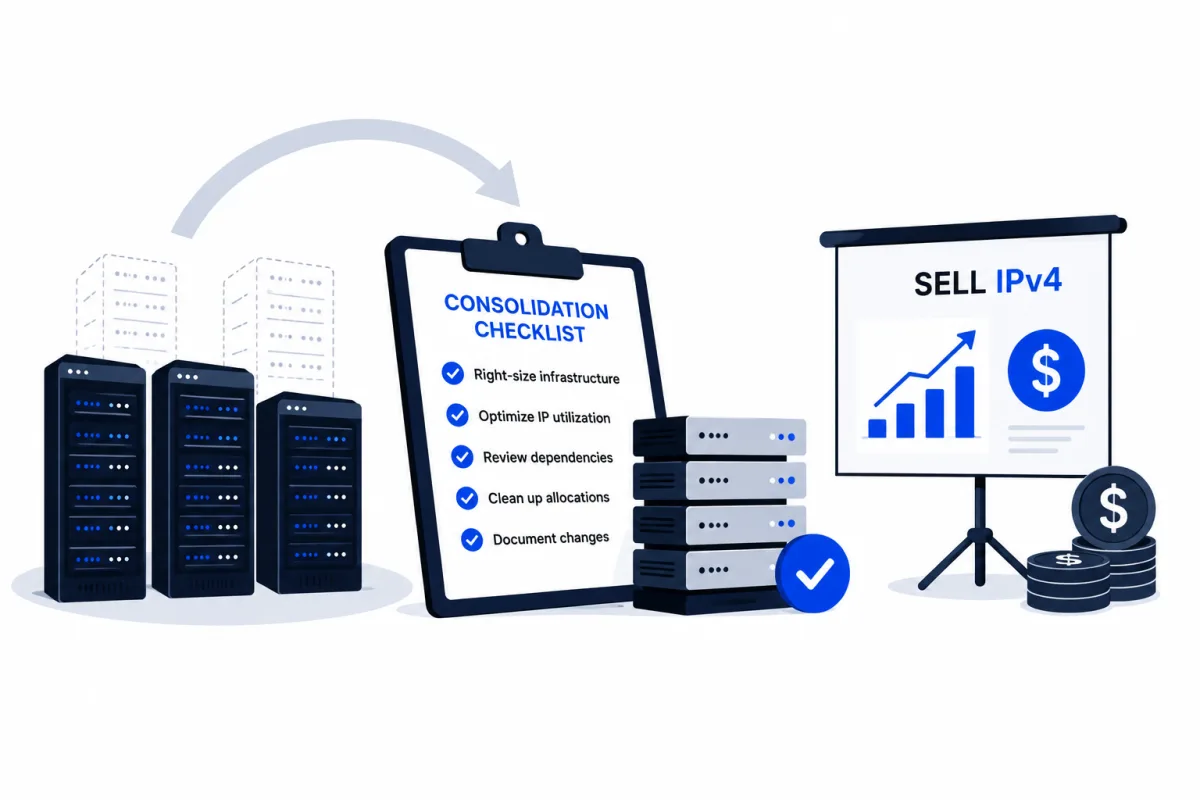
Infrastructure consolidation often leaves public IPv4 space unused, fragmented, or attached to legacy systems. A company should not sell that space until it proves which addresses are free, which dependencies remain, and which records must be cleaned before transfer.
Selling IPv4 after infrastructure consolidation is the process of turning address space released by data center closure, cloud migration, merger cleanup, or network redesign into a transferable asset. It helps owners recover value from unused prefixes, but only after audits confirm that the block is no longer required for production, routing, security, or customer access.
Table of Contents
- Why does infrastructure consolidation create IPv4 sale opportunities?
- Why are network audits needed before selling IPv4?
- How does IP block extraction work after consolidation?
- What registry and transfer issues should be checked?
- How should sellers evaluate sale, lease, or retention?
- What mistakes should sellers avoid after consolidation?
- What should owners clarify before selling after consolidation?
- How should a company move forward?
Why does infrastructure consolidation create IPv4 sale opportunities?
Infrastructure consolidation can reduce the number of data centers, transit providers, customer platforms, and public endpoints that need dedicated IPv4. The result may be a spare prefix, a partially empty allocation, or a larger block separated from active services.
Typical consolidation events include:
- moving several facilities into one core network;
- replacing physical hosting with cloud or hybrid architecture;
- merging networks after acquisition;
- retiring legacy VPN, mail, or monitoring systems;
- reducing public IPv4 use through NAT, IPv6, or private addressing.
The key risk is hidden use. An address can look idle in IPAM but still appear in firewall rules, DNS records, partner allowlists, or customer docs.
Why are network audits needed before selling IPv4?
Network audits prove whether the block is truly free. A seller should not rely only on allocation spreadsheets. The audit should compare technical systems, registry data, routing records, and business ownership.
A practical audit should check:
- IPAM, NAT, firewall, load balancer, and DNS records.
- BGP announcements, route objects, RPKI, and upstream filters.
- PTR records, mail authentication, geolocation, and monitoring tools.
- Customer contracts, allowlists, API integrations, and support notes.
- Internal approval to sell the resource and remove future claim.
This prevents sale of addresses that still support a service or obligation.
How does IP block extraction work after consolidation?
IP block extraction means separating a saleable prefix from the remaining production network. The goal is to create a clean resource boundary that a buyer can understand and a registry can transfer.
The extraction plan should define:
- exact prefix size and block boundaries;
- services that must move away from the block;
- replacement addresses for remaining workloads;
- withdrawal timing for BGP announcements;
- cleanup of DNS, PTR, ACL, and monitoring dependencies;
- evidence that the block is no longer in operational use.
Extraction is easier when the block is contiguous. Fragmented use can reduce value or force the seller to keep part of the address space.
What registry and transfer issues should be checked?
A sale after consolidation still needs a valid transfer path. The seller should verify the registered holder, account status, signatory authority, and regional policy limits before accepting final terms. Registry records should match the legal entity that can sell the resource.
Important checks include:
- current RIR holder and organization details;
- authority of the person signing transfer documents;
- transfer restrictions after previous allocation, transfer, or merger;
- compatibility of inter-RIR transfer rules, if needed;
- buyer readiness and required recipient documents.
If the owner plans a permanent exit, it can review a sell IPv4 addresses process before setting milestones for valuation, escrow, transfer, and payout.
How should sellers evaluate sale, lease, or retention?
A consolidated network does not always mean immediate sale. The owner should compare one-time capital with recurring income, future expansion needs, tax impact, and operational effort. A block that is not needed today may still support disaster recovery, customer segregation, or future integration.
A sale may fit when the block is clean, unused, and not part of a reserve. Leasing may fit when the owner wants income but does not want to give up control. In that case, the owner can compare sale planning with a monetize unused IP option and choose the post-consolidation model.
What mistakes should sellers avoid after consolidation?
The main mistake is assuming that unused infrastructure equals unused address space. Consolidation removes platforms, but IP dependencies can remain in external systems.
Sellers should avoid:
- marketing a block before dependency checks are complete;
- ignoring old DNS, PTR, or geolocation records;
- leaving route objects or RPKI records inconsistent;
- underestimating time needed for internal approvals;
- treating valuation as separate from technical condition.
What should owners clarify before selling after consolidation?
How should a company move forward?
A company should treat post-consolidation address space as an asset that needs proof, cleanup, and a transfer plan before sale. To evaluate selling IPv4 after consolidation, structure network audits, plan IP block extraction, compare sale and leasing scenarios, and prepare the resource for buyer review, contact InterLIR Global and choose an IPv4 transaction path that fits the new infrastructure model.