Setting a Reserve Price for an IPv4 Auction: How Sellers Can Avoid Undervaluing Address Space
 Henrik Sandberg
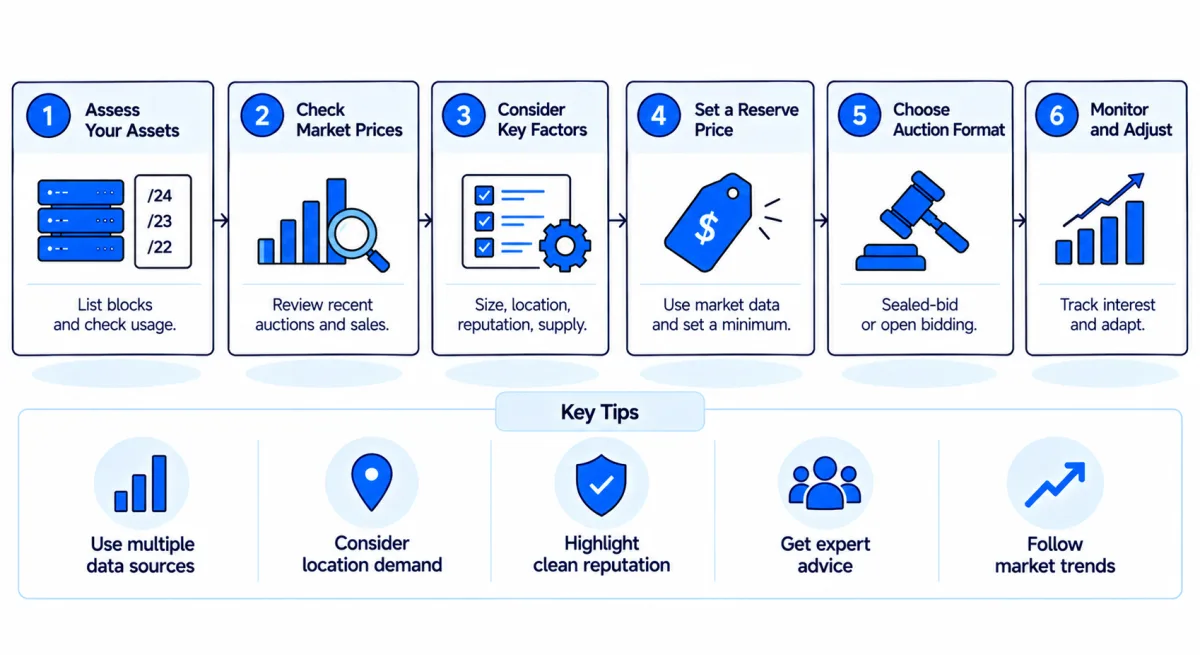
An IPv4 auction reserve should protect the seller from accepting a bid that does not reflect the block’s market value. Setting it too low can lead to undervaluation, while setting it too high can reduce bidding activity. The reserve should therefore be based on comparable transactions, prefix size, RIR region, reputation and transfer readiness.
IPv4 auction reserve price is the minimum amount a seller is prepared to accept in an auction. It acts as a valuation floor and prevents the block from being sold below an acceptable level. A practical reserve combines current market benchmarks with block-specific factors instead of copying one headline price per IP.
Table of Contents
- How should sellers calculate an IPv4 auction reserve price?
- How does block size affect auction market value?
- Which factors should change the reserve price?
- How can sellers avoid auction undervaluation risk?
- What is the difference between market value and reserve price?
- Why can reputation affect auction pricing?
- How should sellers compare auction pricing strategy with a direct sale?
- Frequently Asked Questions
- Set a defensible auction reserve
How should sellers calculate an IPv4 auction reserve price?
A simple starting point is:
Reserve price = estimated market value − acceptable negotiation margin.
Reserve price valuation should begin with recent completed transactions for similar prefix sizes and regions. Current market data shows average IPv4 sale prices around $20 per address across multiple completed transactions, while smaller blocks often trade at higher per-IP levels than larger ranges.
The average alone is not enough. A /24 and a /16 should not use the same per-IP benchmark.
How does block size affect auction market value?
Current transaction data shows a clear size effect.
| Prefix | Addresses | Approx. current average per IP |
|---|---|---|
| /24 | 256 | $26.76 |
| /23 | 512 | $23.29 |
| /22 | 1,024 | $20.74 |
| /20 | 4,096 | $17.09 |
| /16 | 65,536 | $13.19 |
These figures are marketplace benchmarks, not guaranteed auction outcomes.
This means auction minimum price should be calculated from the relevant block-size segment rather than from one market-wide average.
For example, a /22 valued at $20.74 per address has an indicative value of:
1,024 × $20.74 = $21,237.76.
The seller can use this figure as a starting point before adjusting for reputation, region and transfer conditions.
Which factors should change the reserve price?
A reliable auction valuation method should adjust the benchmark for the specific block.
Review:
- prefix size;
- RIR region;
- blocklist and abuse history;
- routing history;
- geolocation;
- legacy or allocated status;
- transfer eligibility;
- documentation quality;
- buyer demand.
Market pricing can differ materially between RIR regions. Average values may vary by several dollars per IP depending on the region, block characteristics and current buyer demand.
How can sellers avoid auction undervaluation risk?
Auction undervaluation risk increases when the reserve is based on outdated market assumptions or ignores block-specific value.
A seller should not automatically use the lowest recent transaction as the reserve. Instead, compare several relevant benchmarks and calculate a range.
A practical process is:
- Identify recent prices for the same prefix size.
- Adjust for RIR region.
- Check reputation and routing history.
- Confirm transfer eligibility.
- Estimate a reasonable market range.
- Set the reserve close to the lower acceptable boundary of that range.
This supports a more defensible seller reserve price.
What is the difference between market value and reserve price?
Auction market value is the estimated price a willing buyer may pay under current conditions. The reserve price is the seller’s minimum acceptable outcome.
They do not need to be identical.
For example, if a /24 has an estimated reserve price benchmark of $26 per address, its indicative value is:
256 × $26 = $6,656.
A seller may set a reserve somewhat below the expected sale level to encourage bidding, but only if that figure still meets the minimum acceptable return.
There is no universal percentage by which a reserve should sit below valuation.
Why can reputation affect auction pricing?
Buyers may discount blocks with poor routing or abuse history because remediation can delay deployment.
Before setting an IPv4 auction reserve price, check:
- DNS blocklists;
- BGP history;
- previous use;
- geolocation consistency;
- reverse DNS;
- registry records.
A clean, transferable block with complete documentation can justify a stronger reserve than a comparable prefix that requires remediation.
How should sellers compare auction pricing strategy with a direct sale?
An auction pricing strategy works best when several buyers may compete for the same resource. A direct sale may provide more predictable negotiation but less price discovery.
Sellers should compare:
- expected auction participation;
- reserve level;
- broker or marketplace fees;
- transfer costs;
- time required to close;
- likelihood of receiving competing bids.
Owners that prefer a negotiated transaction can also sell IPv4 addresses rather than relying exclusively on an auction format.
Frequently Asked Questions
Set a defensible auction reserve
To set a reserve price, provide the prefix, RIR, block history and transfer status to InterLIR Global. The seller can then benchmark the asset against current demand while keeping the minimum acceptable outcome tied to the block’s actual characteristics.