When does renting IPv4 make more sense than waiting for RIR allocation?
 Cian Doherty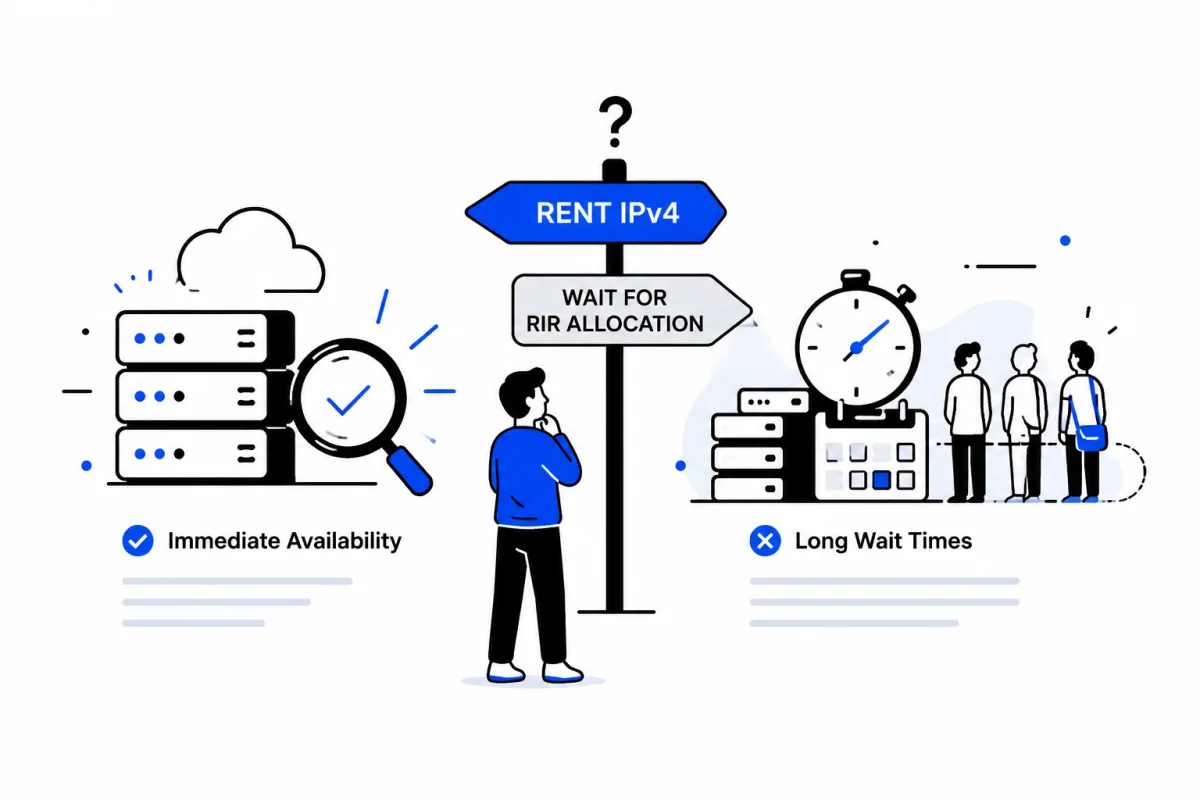
A company may need IPv4 capacity before a regional internet registry can provide address space. Waiting can work for long-term planning, but it can delay service launches, migrations, and customer onboarding. Leasing is useful when timing, reachability, and continuity are more important than waiting for uncertain allocation availability.
Renting IPv4 is a temporary access model that lets a company use public IPv4 space under a lease while ownership remains with the address holder. It helps teams handle limited IP availability, accelerate deployment speed, support migration windows, and keep services running when RIR allocation or waiting lists cannot meet the project timeline.
Table of Contents
- When is RIR allocation too slow for a business project?
- How does IP availability change the decision?
- Why does deployment speed matter for IPv4 planning?
- When should a company still wait for an RIR allocation?
- What risks should be checked before renting IPv4?
- What should teams clarify before choosing between renting and waiting?
- How should a company move forward?
When is RIR allocation too slow for a business project?
RIR allocation can be suitable when an organization qualifies, accepts the process, and can wait. It becomes too slow when the network project has a fixed launch date or when a customer contract requires public IPv4 before the allocation path is complete.
This often affects:
- hosting, SaaS, VPN, and security platforms that need routable space for production;
- companies moving workloads between data centers or cloud providers;
- teams that must update firewalls, NAT pools, DNS, and partner allowlists;
- regional launches that require testing before full commitment.
In these cases, waiting may create more risk than leasing. The company should compare the cost of delay with the cost of a temporary IPv4 lease.
How does IP availability change the decision?
IP availability is limited because free IPv4 pools have been exhausted or heavily restricted across RIR regions. Some registries use waiting lists, recovered address pools, or strict eligibility rules. The result is simple: a company cannot assume that the needed range will arrive exactly when the project needs it.
Before choosing a path, the team should check:
- Whether the organization qualifies for an allocation or waiting-list request.
- The likely block size and whether it is enough for the workload.
- The expected wait time and uncertainty around recovery pools.
- The operational cost of delaying deployment.
- Whether leasing, buying, IPv6, or NAT redesign should be combined.
This review keeps the decision tied to business impact, not only registry procedure.
Why does deployment speed matter for IPv4 planning?
Deployment speed matters when the project has dependencies outside the network team. Product releases, customer migrations, security controls, and partner integrations may all depend on public source addresses.
Leasing can help teams move faster because the address range can be planned around a defined term. The team can prepare routing, test reputation, update DNS, and move traffic before a permanent decision is made.
A company can rent IPv4 addresses when it needs IPv4 capacity for a launch, migration, regional pilot, or temporary service extension while the RIR path remains uncertain.
When should a company still wait for an RIR allocation?
Waiting can still make sense when the project is not urgent, the expected allocation size is enough, and the organization wants registry-issued space for long-term use. It may also be reasonable when the company can redesign around IPv6, private addressing, NAT, or cloud-managed endpoints.
Waiting is more practical when:
- the service launch has no fixed deadline;
- the business can operate without additional public IPv4 for now;
- the expected allocation size fits the address plan;
- internal teams can tolerate queue uncertainty;
- the cost of leasing is higher than the cost of delay.
The key question is not whether waiting is cheaper on paper. The question is whether waiting protects or harms the infrastructure plan.
What risks should be checked before renting IPv4?
Leasing should not skip technical due diligence. A rented prefix can carry routing history, reputation signals, geolocation issues, or contract limits. The team should test the range before it supports customer traffic.
Important checks include:
- authorization to announce the prefix from the intended ASN;
- BGP visibility, IRR objects, and RPKI status;
- WHOIS data, abuse contacts, and geolocation records;
- blacklist, mail, proxy, and security reputation;
- renewal, termination, and address return terms.
If the need becomes permanent, the company can compare leasing with a buy IPv4 addresses option and evaluate registry control, transfer timing, and long-term cost.
What should teams clarify before choosing between renting and waiting?
How should a company move forward?
A company should choose renting IPv4 when delay threatens launch timing, customer commitments, migration safety, or regional testing. To compare lease terms, routing readiness, address reputation, and purchase options while the RIR path remains uncertain, contact InterLIR Global and select an IPv4 resource model that protects deployment speed without losing network control.