Why some companies buy IPv4 blocks instead of relying on cloud IPs
 Cian Doherty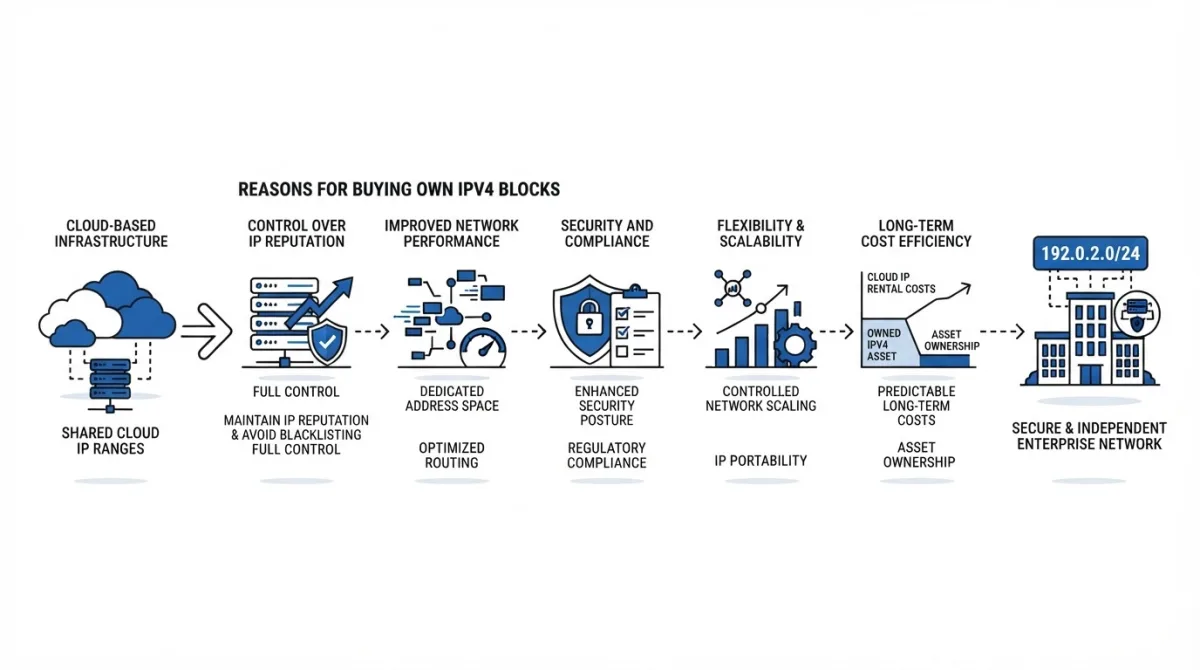
Cloud-assigned public IPs are convenient when infrastructure is tied to one provider and address continuity is not critical. Some companies choose ownership because they need stable addressing, routing control, portability between environments, and less dependence on cloud-specific network resources.
Owned IPv4 vs cloud IPs is a strategic choice between provider-assigned addresses and purchased address space that the company controls directly. IPv4 ownership can support dedicated addressing, portability, routing control, address continuity, and multi-cloud or hybrid deployments while reducing some forms of vendor lock-in.
Table of Contents
- Why does IPv4 ownership provide more infrastructure independence?
- How does address continuity affect the purchase decision?
- How does ownership improve portability?
- What routing control does an owned IPv4 block provide?
- How can buying IPv4 reduce vendor lock-in?
- When do dedicated IPv4 requirements support ownership?
- How should companies compare purchase and cloud IP costs?
- When are cloud IPs still the better option?
- What additional questions should companies ask?
- How should a company decide between owned IPv4 and cloud IPs?
Why does IPv4 ownership provide more infrastructure independence?
Cloud IPs usually remain tied to the provider’s platform. Moving workloads to another cloud, data center, or hosting environment may require new public addresses and changes to external dependencies.
Ownership separates the address resource from a specific vendor. The company can decide where the prefix is used, how it is announced, and how it moves when infrastructure changes. This independence matters when public IP identity is part of the service rather than a temporary configuration.
How does address continuity affect the purchase decision?
Address continuity matters when customers, partners, or security systems depend on fixed source or destination IPs. A change can require updates to firewalls, API policies, VPN configurations, allowlists, DNS, monitoring, and customer documentation.
Owned space can preserve the same address plan during infrastructure changes. This is especially useful for dedicated customer endpoints, enterprise integrations, security gateways, and services with long-lived external dependencies.
How does ownership improve portability?
Portability means addressing can follow the infrastructure strategy instead of remaining tied to one provider. Owned space can support:
- cloud exits and data center migrations;
- movement between hosting or colocation providers;
- disaster recovery in a secondary facility;
- multi-cloud deployments;
- long-term dedicated IP products.
Portability still depends on provider support, routing design, and BYOIP requirements. Ownership gives control of the resource, but each target platform must support the intended model.
What routing control does an owned IPv4 block provide?
With its own block, a company can define the origin ASN, prepare route objects, manage RPKI authorization, and coordinate announcements with upstream networks or supported cloud providers.
This gives the network team more control over failover, regional announcements, and future route changes. It also creates responsibility, because incorrect RPKI, IRR, or BGP configuration can affect reachability.
How can buying IPv4 reduce vendor lock-in?
Vendor lock-in increases when migration requires changing both infrastructure and public network identity. If customers or external systems depend on cloud-assigned IPs, renumbering can become a major part of the move.
Buying IPv4 addresses can reduce this dependency because the company keeps control of the prefix when infrastructure changes. Ownership does not remove all cloud dependencies, but it makes the public address layer more portable.
When do dedicated IPv4 requirements support ownership?
Dedicated addressing matters when customers require stable source identity or when workloads need separate reputation and access policies. Cloud providers can offer static IPs, but the company still depends on the provider’s allocation model.
Ownership can be useful for enterprise customers, VPN gateways, outbound SaaS traffic, security infrastructure, or long-lived services where addresses are part of contractual commitments or external allowlists.
How should companies compare purchase and cloud IP costs?
The comparison should include both financial and operational factors. Cloud IPs create recurring expenses, while ownership creates an upfront acquisition cost plus registry, routing, and administration responsibilities.
A useful comparison should consider:
- current and projected public IP usage;
- cloud charges over the expected period;
- acquisition and transfer costs;
- routing and RPKI administration;
- renumbering and migration costs;
- expected multi-cloud or data center expansion.
The company should compare total cost and flexibility over the period in which the addresses are expected to remain in use.
When are cloud IPs still the better option?
Cloud IPs remain practical when workloads are short-lived, tightly coupled to one provider, or too small to justify ownership. They can also reduce operational work because the provider manages much of the underlying address infrastructure.
A purchase becomes more relevant as scale, address continuity, dedicated addressing, and portability become strategic requirements.
What additional questions should companies ask?
How should a company decide between owned IPv4 and cloud IPs?
The decision should connect ownership with address continuity, portability, routing control, dedicated services, multi-cloud planning, and the cost of future renumbering. If a company needs to evaluate whether purchasing address space fits its cloud or hybrid architecture, it can contact InterLIR Global to assess an IPv4 acquisition model around long-term network control and deployment plans.