🧾 Glossary
This glossary contains key terms used throughout the InterLIR Global documentation, including business concepts, technical terms, and platform-specific actions.
ASN
ASN stands for Autonomous System Number. It is a unique identifier assigned to an autonomous system (AS) in the Internet that participates in the Border Gateway Protocol (BGP). An autonomous system is a collection of connected Internet Protocol (IP) routing prefixes under the control of one or more network operators that has a single, clearly defined routing policy.
In practical terms, an ASN is used by routers in the Internet to exchange information about IP routing paths. Each AS has a unique ASN, which is used to identify it to other ASes and to BGP routers in the Internet. This enables routers to determine the best path for traffic to take as it travels between different ASes and across the Internet.
ASNs are assigned by the Internet Assigned Numbers Authority (IANA) to regional Internet registries, which in turn allocate them to individual organizations or Internet Service Providers (ISPs) that operate autonomous systems.
Auction
An Auction is a sales mechanism on the InterLIR Global platform that allows Suppliers to sell their IP-Blocks via a competitive bidding process.
The auction is created and imported by the supplier and becomes publicly available on the portal from the defined start date until the end date.
Customers can place bids on the auction during this time. The customer with the highest bid at the end of the auction is declared the winner.
See: How to Participate in an Auction
Each auction includes:
- Start Date and End Date
- Starting Bid — the minimum price defined by the supplier
- Current Bid — the latest highest bid from customers
- Instant Buy Price — a predefined price; if a customer places a bid equal to this value, they instantly win the auction
Once the auction ends, InterLIR Global coordinates with the supplier and the winning customer to complete the IP-Block transfer.
📝 Note: To finalize the auction, the supplier must sign the required contract through PandaDoc during the last step of the auction import process.
Sale Offer
A Sale Offer is a direct sales mechanism on the InterLIR Global platform that allows Suppliers to list their IP-Blocks for immediate purchase at a fixed price.
Unlike auctions, sale offers provide customers with a straightforward way to purchase IP blocks without competitive bidding. Customers can request details about the offer and proceed with the purchase directly through the InterLIR Global sales team.
Each sale offer includes:
- IP Block details (size, RIR, country, status)
- Fixed price per IP address
- Transferability information
- Private comments (visible only to InterLIR Global staff)
See: How to Import a Sale Offer, How to Buy an IP-Block
Assignment Request
The Assignment Request (AR) process is initiated by the Customer after successfully completing an order to rent an IP-Block. Other participants in the process include the Supplier of the IP-Block and the InterLIR Global Manager.
The outcome of the process is that the Customer can announce an ASN on the IP-Block using an LOA (Letter of Authorization) and utilize the rented block in accordance with the signed contract and the rules governing the use of the rented resource.
See: General Terms and Conditions
Business Account
A Business Account (BA) is a representation of your organization on the InterLIR Global portal.
Without a BA, you can only view the marketplace. After adding a BA, all other functions of the platform become available to you, such as renting blocks through the marketplace or renting out blocks.
See: Business Account importing process, Edit Business Account importing process
Customer
A Customer is a registered user of the InterLIR Global platform who rents IP-Blocks from Suppliers via the Marketplace, pays for them monthly, and interacts with blocks during the rental lifecycle.
Capabilities:
- Initiates Orders for one or more IP-Blocks
- Pays monthly through Stripe
- Submits Assignment Requests (AR)
- Submits rDNS Requests
- Cancels subscriptions at any time via the order details page
- Participates in IP auctions (bidding)
- Purchases IP blocks directly from sale offers
- Sends inquiries regarding sale offers from Suppliers
See: How to Participate in an Auction, How to Buy an IP-Block
Customers must have:
- A registered account
- An approved Business Account
- A valid payment method (e.g., card, SEPA, iDEAL)
Supplier
A Supplier is a registered user of the platform who provides IP-Blocks for rent, auction, or sale to Customers via the Marketplace.
Capabilities:
- Imports IP-Blocks to the platform
- Publishes blocks on the Marketplace, sets pricing, availability, and lease terms
- Signs Certificate of Authorisation
- Confirms and sets up RPKI / ROA & Routes
- Approves or manages rDNS Requests
- Edits or splits blocks into sub-blocks
- Participates in auctions as sellers
- Creates sale offers for direct IP block sales
- Requests payouts via Stripe Connected Accounts
See: How to Import an Auction, How to Import a Sale Offer
Suppliers must have:
- An approved Business Account
- Completed Stripe Onboarding
- At least one block imported and approved by the InterLIR Global team
Certificate of Authorisation
The Certificate of Authorisation is a mandatory agreement signed by Suppliers when importing an IP-Block onto the platform. This certificate signifies the Supplier’s’s consent for their IP-Block to be listed on the marketplace and rented out to other users.
When a Supplier imports an IP-Block, the certificate is sent to them via PandaDoc. By signing the document, the Supplier confirms their agreement to the terms of usage.
CIDR
CIDR (Classless Inter-Domain Routing) is a method for allocating and representing IP addresses and their associated routing. It uses the format IP_address/prefix_length, where:
IP_addressis the starting address of the rangeprefix_lengthis the prefix, specifying how many bits are used for the network portion
IP-Geo
IP-Geo refers to the geographical location associated with an IP-Block or specific IP address.
This data is used on the InterLIR Global platform to indicate the region or country where the block is registered or most likely routed. It is helpful for clients looking to lease IP space with specific regional requirements (e.g., for latency, compliance, or localization).
InterLIR Global uses multiple public and commercial geolocation providers to determine IP-Geo, including:
Note: IP-Geo data is approximate and based on public geolocation databases.
LOA (Letter of Authorization)
The Letter of Authorization (LOA) is a formal document issued to a client after successfully completing the Assignment Request process. This document grants permission to announce an ASN for a specific IP address range.
It includes:
- Client’s name and contact information
- Assigned IP range
- ASN details
- Authorization dates
- Issuer details
LIR (Local Internet Registry)
A Local Internet Registry (LIR) is an organization (usually an ISP or enterprise) that receives IP allocations directly from an RIR.
Responsibilities:
- Manage IP space
- Maintain WHOIS data
- Comply with RIR policy
- Interface with end users
Minimal Lease Period
The minimal lease period is the duration (14–60 months) during which settings made by the IP-Block owner are stored in the RIR database.
Minimal Order Period
The minimal order period is the shortest duration for which an IP-Block can be rented.
Minimal Split Size
Defines the smallest prefix into which an IP-Block can be divided for rental. For example, a /20 block can be split into /24s if allowed.
Order
An Order is the process initiated by a Customer to lease one or more IP-Blocks via the InterLIR Global marketplace.
The ordering workflow begins when a Customer adds IP-Blocks to their cart. Once ready, the Customer proceeds to place the order through the cart interface.
Orders may include:
- A single IP-Block
- Multiple IP-Blocks from one or more Suppliers
To complete an order, the registered Customer with an approved Business Account must proceed to payment from the order details page.
Lease Contract
Upon payment, a Lease Contract is automatically created between the Customer and the Supplier, facilitated by InterLIR Global.
- The contract defines the lease term, which is chosen during checkout.
- The minimum term depends on:
- The Minimal Order Period defined by the Supplier
- The remaining availability of the block on the platform
At the end of the lease term, the contract is automatically extended unless one of the parties initiates a cancellation request.
Early Termination
Premature termination of the lease contract may occur under the conditions described in the:
- Terms of Service
- Specific clauses within the contract
PandaDoc
PandaDoc is a document automation platform used on InterLIR Global to send and sign agreements like the Certificate of Authorisation.
Learn more
Payout Request
A Payout Request is an action initiated by a Supplier to withdraw funds accumulated from leasing their IP-Blocks via the InterLIR Global platform. The funds arrive on the supplier’s Stripe account as Customers pay for their block subscriptions.
Each month, Suppliers receive payments based on the conditions of each active lease contract.
To withdraw money, the Supplier must submit a Payout Request and specify a payout method.
Learn how to do this in the How to Make a Payout Request guide.
Request Statuses
- Initial – The request is open and can be submitted. As long as the Amount is greater than zero, new rental payments will accumulate in this request.
- Execution – The request has been submitted and is being processed.
- Executed – The payout has been successfully processed, and funds have been sent to the supplier.
Balance Categories (above the table)
- Available Balance – Funds that are ready for withdrawal. These funds have been fully processed by Stripe (typically takes 7–14 days).
- Available Soon – Funds pending Stripe processing. Once processed, they will move to “Available Balance”.
- Processing – Funds currently being transferred to the selected payout method.
- Paid Out – Total amount that has already been paid out to the Supplier. This is useful for tracking overall payout history.
Reports
Invoices PDF
It includes all invoices generated during the time period specified during the generation
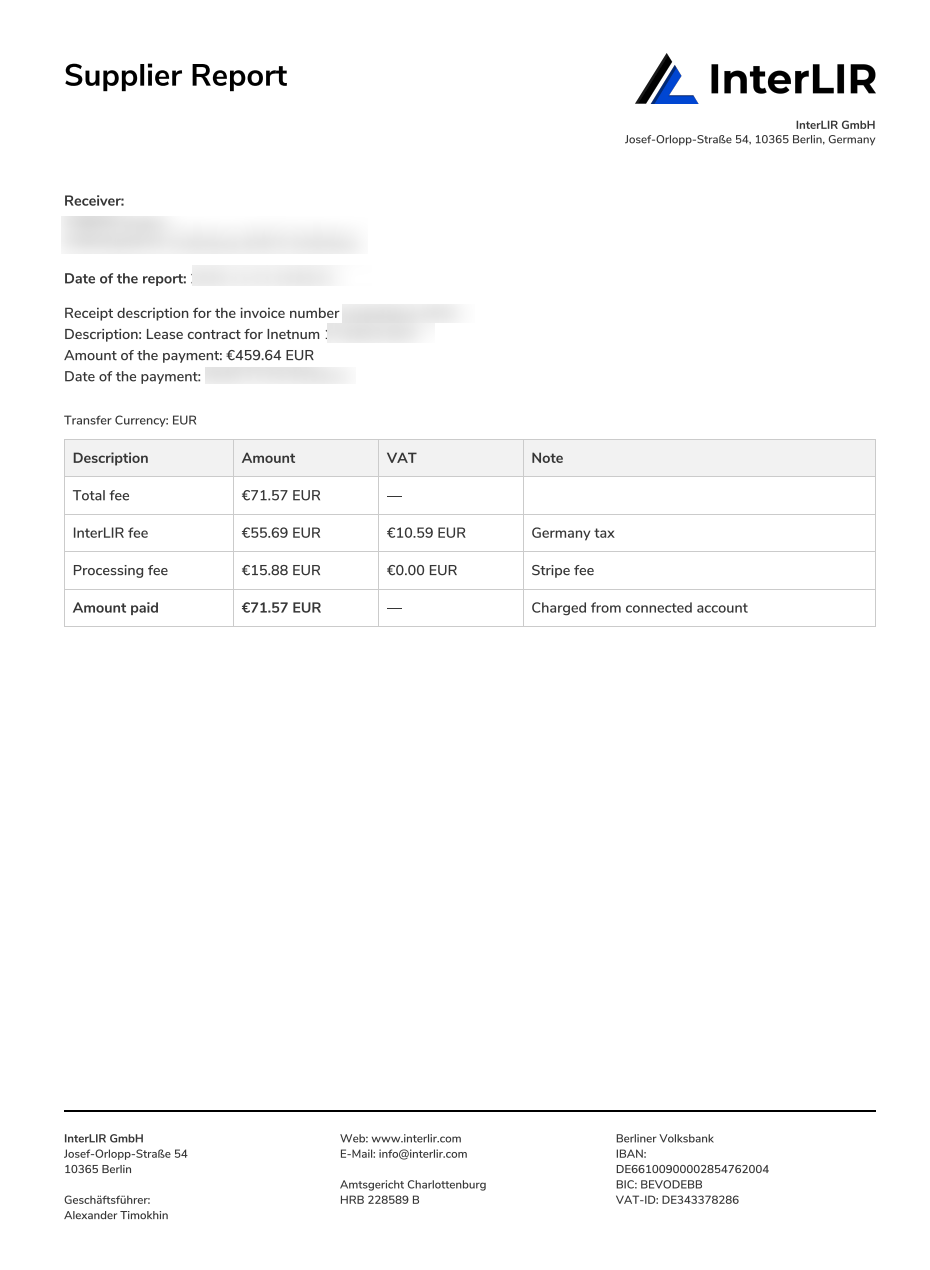
Supplier invoices
The Supplier invoices Report includes information on all Fee and VAT for all invoices that were generated during the time period specified during the declaration. The report will list the Supplier report for all these invoices.
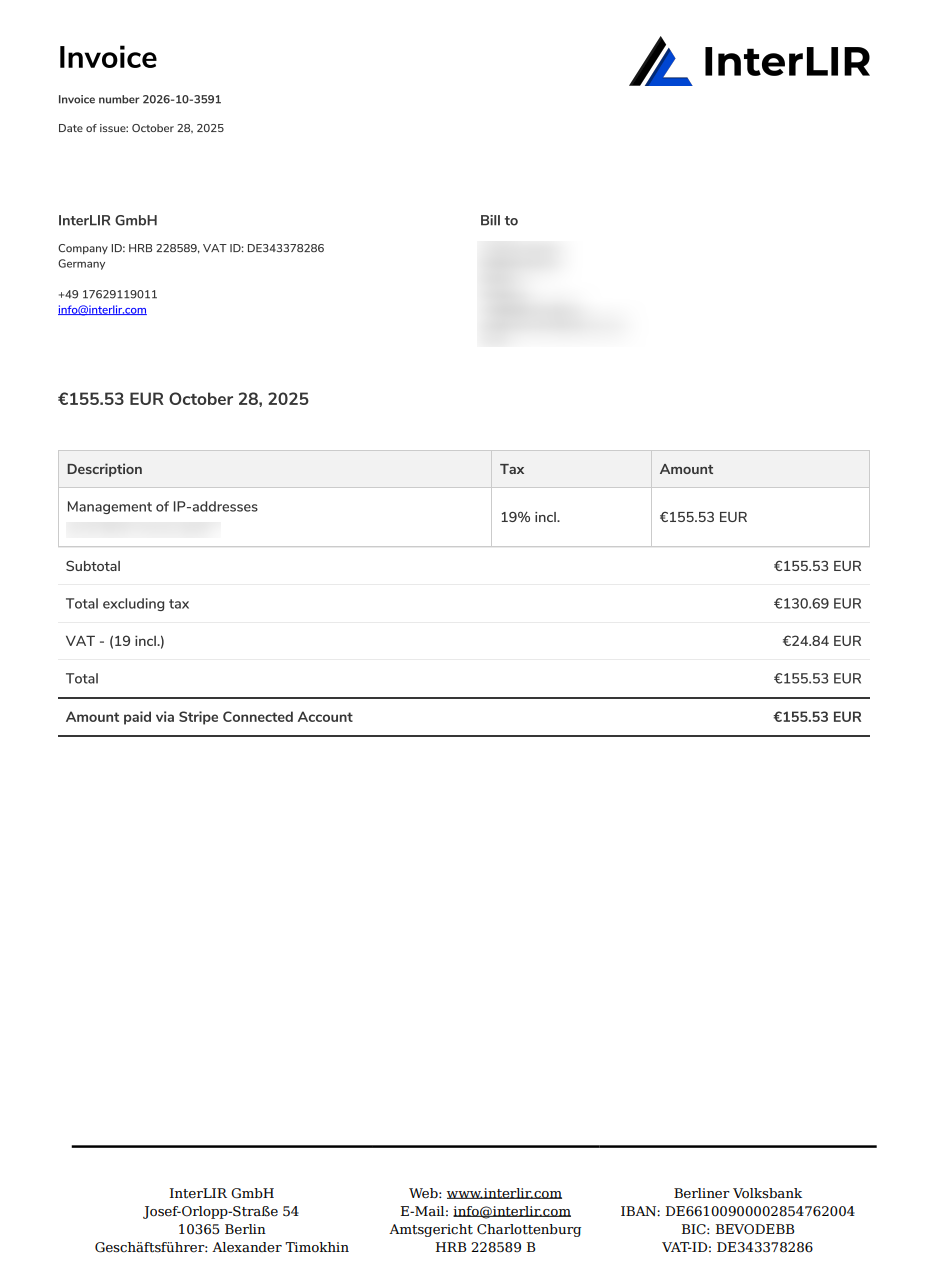
InterLIR Global fee invoices
The InterLIR Global Fees Statement Report includes a breakdown of the total platform fee and service fees charged by InterLIR Global for the time period specified during generation. This is particularly useful for accounting, invoicing, or financial audits.
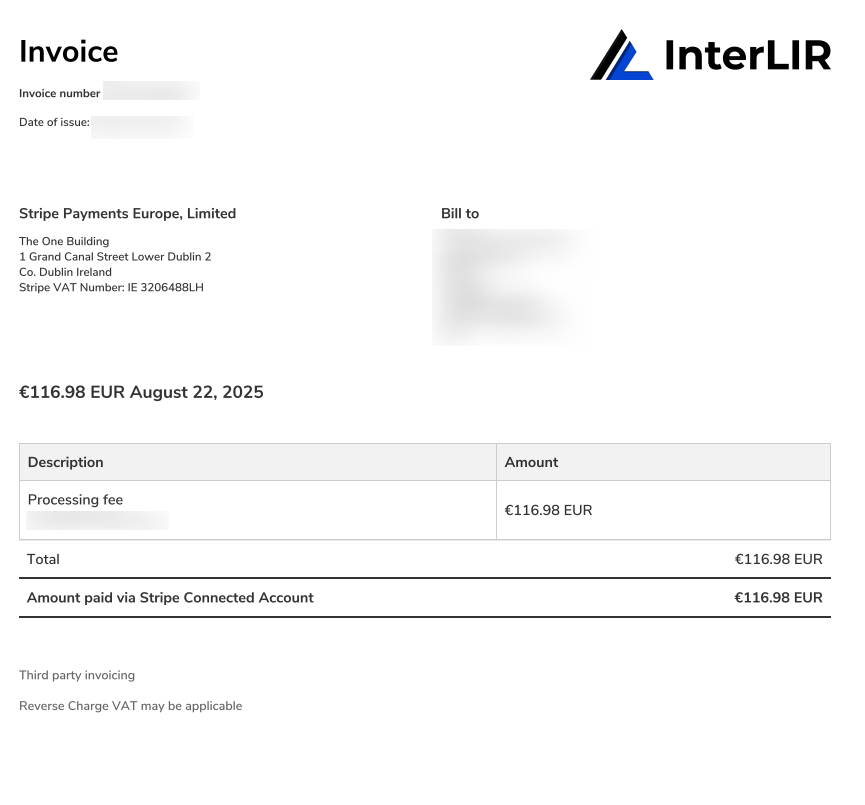
Processing fee
The Processing Fees Statement Report details all Stripe fees applied to payment transactions included in in all invoices generated during the time period specified during the generation.
It helps Suppliers understand external processing charges applied by the payment gateway.
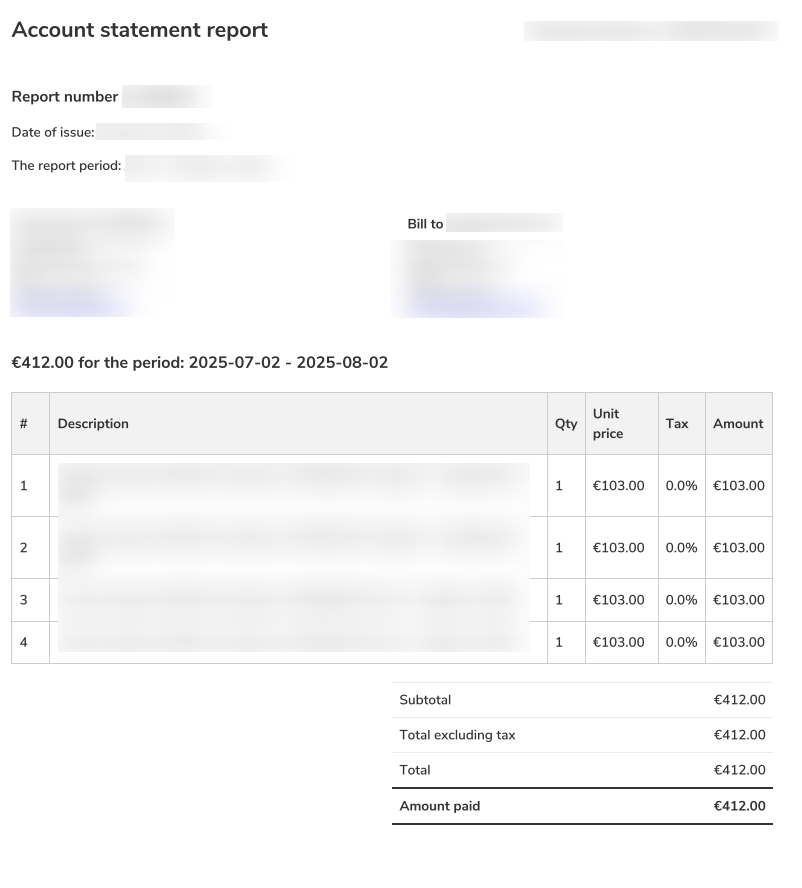
Account statement
The Account Statement Report provides a customer-level view of who paid what.
It includes a list of Business Accounts (Customers) who paid invoices, and the IP-Blocks those payments were associated with.
The data is grouped by Customer and is suitable for reconciliation and external reporting.
Payout Reports
Payout Reports are documents that can be generated after a successful Payout Request. These reports help Suppliers analyze the financial, operational, and transactional aspects of their payouts from InterLIR Global.
The following types of reports are available:
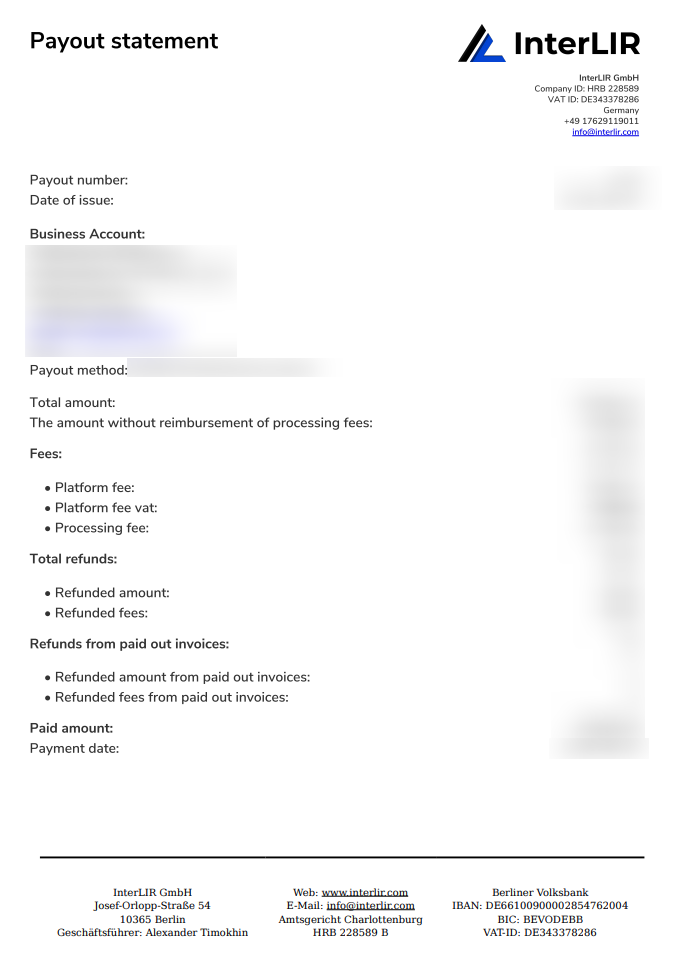
Payout Statement Report
The Payout Statement Report provides a summary of all payout-related data visible in the payout details view.
This report serves as a general-purpose overview and can be used for internal records or reporting.
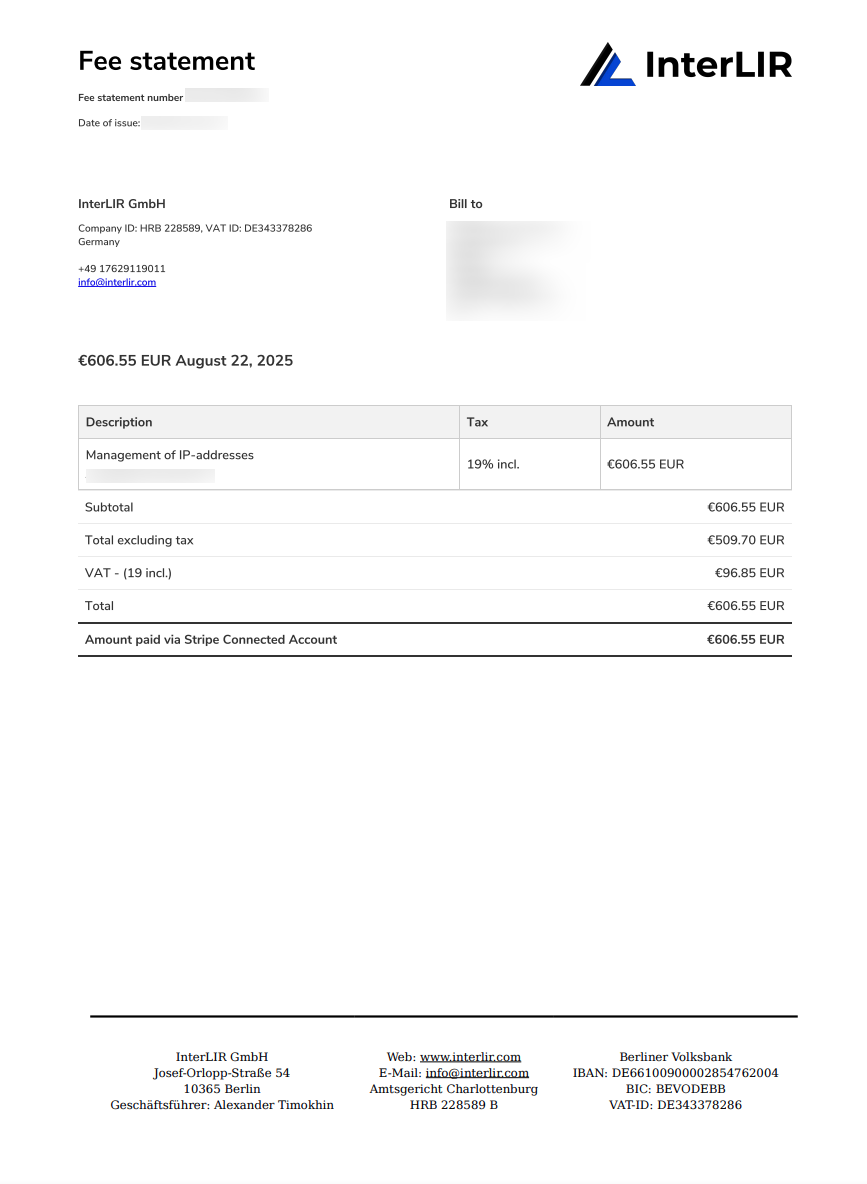
Payout Fees Statement Report
The Payout Fees Statement Report includes a breakdown of the total platform fee and service fees charged by InterLIR Global for processing the payout.
This is particularly useful for accounting, invoicing, or financial audits.
Payout Processing Fees Statement Report
The Payout Processing Fees Statement Report details all Stripe fees applied to payment transactions included in the payout.
It helps Suppliers understand external processing charges applied by the payment gateway.
Payout Account Statement Report
The Payout Account Statement Report provides a customer-level view of who paid what.
It includes a list of Business Accounts (Customers) who paid invoices, and the IP-Blocks those payments were associated with.
The data is grouped by Customer and is suitable for reconciliation and external reporting.
Payment Method
A Payment Method is the financial instrument used by Customers to pay for their IP-Block contracts.
Supported payment methods include:
- Card - Credit or debit cards
- SEPA - Single Euro Payments Area bank transfers
- iDEAL - Dutch online payment system
Payment methods are managed through Stripe and must be added to the customer’s account before they can be used for payments.
Payout Method
A Payout Method is the bank account where a Supplier receives funds after submitting a Payout Request. This is the bank account of the supplier that is used by Stripe to transfer funds from the platform.
The payout method must be:
- Added and verified through Stripe before it can be used on the platform
- Associated with the supplier’s Stripe Connected Account
- Valid and active to receive payouts
To add a new payout method, follow the instructions in the How to Import a Payout Method guide.
Platform Fee
The platform fee is InterLIR Global’s commission applied to payouts for using the platform’s services and infrastructure. It is calculated and shown in payout-related views and included in the Payout Fees Statement Report.
Prefix
The prefix represents the number of leading bits in an IP-Block and defines its size.
rDNS (Reverse DNS)
rDNS maps IPs to domain names. Used for:
- Email validation
- Network diagnostics
- Logging
Requires a PTR record and IP block owner control.
ROA (Route Origin Authorization)
ROA authorizes a specific ASN to originate a prefix in BGP. It’s a key component of RPKI.
Route Object
A route object is a record in the IRR (Internet Routing Registry) that states which ASN is allowed to announce a given prefix.
RPKI (Resource Public Key Infrastructure)
A cryptographic framework used to validate BGP route announcements via ROAs. Helps prevent hijacks and leaks.
IP-Blocks
A contiguous range of IPs. May have statuses:
- New: Awaiting approval
- Suspended: Rejected or penalized
- Avail: Ready to lease
- Expired: Certificate expired
- Occupied: Fully leased
See: IP-Block importing process
Stripe
A platform for payment processing.
Learn more
Stripe Connected Accounts
Connected user accounts under the main Stripe platform account, used to process payouts to Suppliers.
Subnet Status
Possible values:
- Allocated PA: Aggregated space assigned to LIR
- Allocated PI: Portable space assigned to end user
- Assigned: In use, not sub-allocatable
- Reserved: Not routable
- Available: Not yet assigned
- Deprecated: Outdated
RIR (Regional Internet Registry)
Entities responsible for IP/ASN distribution.
Examples: RIPE NCC, ARIN, APNIC.
RIPE NCC
Manages IP/ASN allocation in Europe and surrounding regions. Maintains WHOIS and other registry data.
RIPE Maintainer Attributes
- MNT-BY, MNT-DOMAIN, MNT-ROUTE, etc.: define who controls resources in the RIPE DB.
ARIN Maintainer Attributes
- ORG Handle, Descr, etc.: define organization and resource metadata in ARIN’s registry.
Usage Type
Usage Type refers to the classification of how an IP-Block is typically used — for example, by a data center, an ISP, an enterprise, or for mobile, hosting, or residential purposes.
This classification helps clients on the InterLIR Global platform choose IP space that aligns with their technical or compliance requirements.
Usage Type examples include:
- Data Center / Web Hosting
- ISP / Fixed Line
- Residential Broadband
- Mobile / Cellular
- Corporate / Business
- Educational / Academic
InterLIR Global uses external geolocation and network intelligence providers to determine usage type for IP space, including:
Note: Usage type is based on public and commercial datasets and may not always reflect real-time or newly reassigned usage.
VAT
Value Added Tax applied depending on jurisdictions.
VAT Number
Required for EU companies registering a Business Account.
Check via VIES VAT Validation
WHOIS
Public database for IPs, ASNs, and domains. Lists:
- Contacts
- Resource ownership
- Allocation/assignment data
Abuse-c attribute
The “abuse-c:” attribute is contained within the organisation object, and references a role object containing abuse contact information in an “abuse-mailbox:” attribute.
Address spaces
There are 3 types of address space: PA (Provider-aggregatable address space), PI (provider-independent address space), Legacy.
Admin-c attribute
This attribute is optional in some objects and mandatory in others. It references the primary key, or NIC Handle, of either a role or person object. It should always reference a role object, except in the role object where it optionally references nested role objects or a person object.
The reference must be the contact details of an on-site administrative contact. This contact may be a single person, or it may be a role within the organisation that more than one person takes on. These people may or may not be listed in the role object.
Allocation
An allocation is a block of IP addresses from which assignments are taken. LIRs and End Users receive an allocation from the RIR or IANA.
AS
An autonomous system is a collection of connected Internet Protocol routing prefixes under the control of one or more network operators on behalf of a single administrative entity or domain that presents a common, clearly defined routing policy to the Internet.
Aut-num object
The aut-num object serves a dual purpose in the database. As part of the RIPE Internet Number Registry, it contains the registration details of an Autonomous System Number (ASN) resource assigned by the RIR. As part of an Internet Routing Registry, it allows routing policies to be published.
DNS
The Domain Name System is a hierarchical and decentralized naming system for computers, services, or other resources connected to the Internet or a private network. It associates various information with domain names assigned to each of the participating entities
Domain object
The domain object is mainly for registering reverse delegations (number-to-name translations) in both the RIR Database and the DNS zone files. The Database is used as the management database for producing the DNS zones. No forward domain names are stored in the RIPE Database. IANA provides information about forward domains.
Inet6num object
An inet6num object contains information on allocations and assignments of IPv6 address space resources.
Inetnum object
An inetnum object contains information on allocations and assignments of IPv4 address space resources.
Internet Protocol version 4 (IPv4)
Is the fourth version of the Internet Protocol (IP). It is one of the core protocols of standards-based internetworking methods in the Internet and other packet-switched networks. IPv4 uses a 32-bit address space which provides 4,294,967,296 (232) unique addresses, but large blocks are reserved for special networking methods.
Internet Protocol version 6 (IPv6)
Is the most recent version of the Internet Protocol (IP), the communications protocol that provides an identification and location system for computers on networks and routes traffic across the Internet. IPv6 uses a 128-bit address, theoretically allowing 2128, or approximately 3.4×1038addresses.
IP
The Internet Protocol (IP) is the principal communications protocol in the Internet protocol suite for relaying datagrams across network boundaries. Its routing function enables internet working, and essentially establishes the Internet.
There are 2 internet protocols: IPv4 and IPv6.
Lease contract
After successfully paying the monthly subscription for the IP-Block through the Marketplace or a private offer from the Supplier, the Customer will see an active contract in the “IPv4 resources -> Lease contracts” section. As long as the contract is active, the Customer has the right to manage the IP-Block within the contract’s terms and until the contract end date. The Customer is guaranteed the right to use the IP-Block during this period.
After the rental period specified in the contract ends, the Customer continues to be the lessee of the IP-Block until the cancellation process is completed. An automatic renewal will occur if neither party objects and will continue until one of the parties submits a request for cancellation.
To initiate the contract cancellation procedure, the Customer needs to submit a cancellation request in the “IPv4 resources -> Lease contracts -> IP-Block contract -> Details” cancellation section. After the cancellation was approved by the manager, the contract will be canceled at the end of the lease period. Please note, keep in mind that the cancelation request must be submitted at least 24h before the renewal date.
Legacy number resource
Is an IPv4 address or Autonomous System Number (ASN) that was originally allocated to the current registrant by IANA prior to the Regional Internet Registries (RIRs) being established.
LIR
A local Internet registry (LIR) is an organization that has been allocated a block of IP addresses by a RIR, and that assigns most parts of this block to its own Customers. Most LIRs are Internet service providers, enterprises, or academic institutions.
mnt-domains attribute
Attribute is used to reference a mntner object that authorises the creation of domain objects. If no “mnt-domain:” attribute is present, one of the “mnt-by:” attributes of the parent object will be used instead.
This parent authorisation is only required when a domain object is created. This authorisation is in addition to the authorisation of the individual object itself.
mnt-lower attribute
Attribute is used to reference a mntner object that authorises the creation of more specific inetnum or inet6num objects. If no “mnt-lower:” attribute is present, one of the “mnt-by:” attributes of the parent object will be used instead.
This parent authorisation is only required when an inetnum or inet6num object is created. This authorisation is in addition to the authorisation of the individual object itself.
mnt-routes attribute
Attribute is used to reference a mntner object that authorises the creation of route or route6 objects. If no “mnt-route:” attribute is present, one of the “mnt-by:” attributes of the parent object will be used instead.
This parent authorisation is only required when an route or route6 object is created. This authorisation is in addition to the authorisation of the individual object itself.
Mntner object
Objects in the Database are protected using mntner objects. A mntner object is an anonymous box containing the credentials needed to authorise creation, deletion or modification of any objects that it protects by whomever maintains this data. Currently, these credentials are MD5 passwords or PGP keys or Single Sign-On user names from the Access system. The syntax also allows for X.509 certificates, but these are not fully implemented throughout the whois software.
Objects are protected by a mntner, if they contain a reference to the mntner in the object. This is done by including a “mnt-by:” attribute. Other “mnt-xxx:” attributes offer hierarchical protection. The “mnt-by:” attribute is mandatory in all object types.
The “mnt-lower:”, “mnt-routes:” and “mnt-domains:” attributes all provide for hierarchical authorisation. These also work in a logical ‘OR’ when multiple values are included in an object. How they are used is described in the object descriptions where these attributes are valid.
NIR
A national Internet registry (or NIR) is an organization under the umbrella of a regional Internet registry with the task of coordinating IP address allocations and other Internet resource management functions at a national level within a country or economic unit.
NIRs operate primarily in the Asia Pacific region, under the authority of APNIC, the regional Internet registry for that region.
The following NIRs are currently operating in the APNIC region:
APJII (Asosiasi Penyelenggara Jasa Internet Indonesia), Indonesian ISP Association
CNNIC, China Internet Network Information Center
JPNIC, Japan Network Information Center
KRNIC, Korea Internet & Security Agency
TWNIC, Taiwan Network Information Center
VNNIC, Vietnam Internet Network Information Center
Indian Registry for Internet Names and Numbers
The following NIRs are currently operating in the Latin American (LACNIC) region:
NIC Mexico
NIC.br
There are no NIRs operating in the RIPE NCC region.
Notify attribute
This optional attribute specifies an email address to which notifications of changes to an object will be sent. Only the email addresses from the “notify:” attribute values contained in ‘this’ object will be notified of changes to ‘this’ object. Only successful changes will be notified.
ORG attribute
This optional attribute references the primary key, or id, of an organisation object that currently exists in the database.
The referenced object contains details of the organisation that holds Internet resources or secondary objects to help manage resources in the Database. In some situations, this attribute is required.
Person object
The person object provides information about a real person. The original intention was that this should only be used for contacts responsible for technical or administrative issues relating to Internet resources registered in the Database.
Provider-aggregatable address space (PA)
Is a block of IP addresses assigned by a regional Internet registry to an Internet service provider which can be aggregated into a single route advertisement for improved Internet routing efficiency. Unlike provider-independent address space, the end-user of address blocks within a provider-supplied space cannot reuse the addresses if they change up-stream connectivity providers.
Provider-independent address space (PI)
Is a block of IP addresses assigned by a regional Internet registry (RIR) directly to an end-user organization. The user must contract with a local Internet registry (LIR) through an Internet service provider to obtain routing of the address block within the Internet.
Remarks attribute
This optional attribute can be any free format text, within the allowable encoding. This attribute can even have a blank value and be used as a spacer to separate different parts of the information in an object.
Reverse DNS
Reverse DNS delegations allow applications to map to a domain name from an IP address. Reverse delegation is achieved by use of the special domain names in-addr.arpa (IPv4) and ip6.arpa (IPv6).
RIR
A regional Internet registry (RIR) is an organization that manages the allocation and registration of Internet number resources within a region of the world. Internet number resources include IP addresses and autonomous system (AS) numbers.
There are 5 RIRs:
The African Network Information Center (AFRINIC) serves Africa.
The American Registry for Internet Numbers (ARIN) serves Antarctica, Canada, parts of the Caribbean, and the United States.
The Asia-Pacific Network Information Centre (APNIC) serves East Asia, Oceania, South Asia, and Southeast Asia.
The Latin America and Caribbean Network Information Centre (LACNIC) serves most of the Caribbean and all of Latin America.
The Réseaux IP Européens Network Coordination Centre (RIPE NCC) serves Europe, Central Asia, Russia, and West Asia.
ROA
Route Origin Authorisation (ROA) is a cryptographically signed object that states which Autonomous System (AS) is authorised to originate a certain prefix.
Role object
A role object is similar to a person object. However, instead of describing a single person, it describes a role performed by one or more people. This might be a help desk, network monitoring centre, team of system administrators, etc. A role object is useful since often a person performing a specific function may change while the role itself remains.
The role object should only include business information about the role. It should not contain any personal information, although it can reference person objects.
Route object
A route object contains routing information for IPv4 address space resources. Each interAS route (also known as an interdomain route) originated by an Autonomous System can be specified by using a route object for IPv4 addresses.
Route6 object
A route6 object contains routing information for IPv6 address space resources. Each interAS route (also known as an interdomain route) originated by an Autonomous System can be specified by using a route6 object for IPv6 addresses.
RPKI
RPKI is a security framework that helps network operators make more informed and secure routing decisions.
Sponsoring LIR
A Sponsoring LIR is a RIR member, which acts as an intermediary between PI and Legacy resource holders and RIPE NCC. A Sponsoring LIR shall keep the data for PI and Legacy resources of their Customers up-to-date.Transfer in the database
Suballocation
This suballocation means that the address space has been sub-allocated by an LIR to a downstream network operator that will make assignments from it. All assignments made from it are PA.
Tech-c attribute
This attribute is optional in some objects and mandatory in others. It references the primary key, or Nic Handle, of either a role or person object. It should always reference a role object, except in the role object where it optionally references nested role objects or a person object.
The reference must be the contact details of a technical contact. This contact may be a single person, or it may be a role within the organisation that more than one person takes on. These people may or may not be listed in the role object.